Wingspan
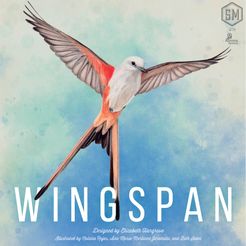
Attract birds with complementary abilities to build an efficient wildlife preserve.
Wingspan supports 1–5 players; community best: 3 players; playing time: 40–70 minutes. A WANGO browser trial has not been confirmed.
Background & introduction
Attract birds with complementary abilities to develop a wildlife preserve. Each bird enters a habitat on your personal mat and adds an effect to that area. Individual bird illustrations reinforce the natural theme.
Growing the preserve requires food, eggs, and more cards. Food comes from dice in the birdfeeder, eggs help pay for expansion, and newly drawn birds provide future opportunities. A suitable bird improves later actions, so each choice affects both immediate resources and future development.
The game lasts four rounds and the highest total score wins. The central challenge is maintaining necessary resources while building productive combinations. Evaluate a bird both for its own value and for how it strengthens an existing habitat and supports your preserve’s direction.
Core rules & scoring
Setup: Each player receives eight action cubes, five random birds, one food of each of the five types, and two bonus cards. Discard one food for each bird kept, and keep one bonus card. Choose a goal-board side, assign four random round goals, display three birds, and roll the food dice.
Turns: Proceed clockwise, spending one cube to play a bird, gain food, lay eggs, or draw birds. For the latter three actions, take the benefit of that row’s leftmost exposed space, perform its optional conversion, then resolve brown powers from right to left. Leave the cube at the left edge.
Play a bird: Pay its food and column’s egg cost, then place it in the leftmost open space of a matching habitat, with at most five birds per row. Column one costs no eggs, columns two and three cost one, and columns four and five cost two. Only its white power activates; the whole row does not. Only when paying to play a bird may any two food substitute for one required food.
Forest food action: Select birdfeeder dice one at a time, gaining one matching food per die; the invertebrate/seed face offers a choice of one. If the action space allows, discard at most one hand card for an extra food. Reroll all five dice whenever the feeder empties. When about to gain food, you may also reroll all five if the remaining dice show the same face.
Grassland egg action: Place the shown number of eggs on any of your birds without exceeding each bird’s egg limit; excess eggs that cannot fit are lost. If the action space allows, pay at most one food for an extra egg. Eggs support bird placement and score at game end.
Wetland card action: Draw the shown number of birds from the three face-up cards or deck top. If the action space allows, discard at most one egg to draw another card. There is no hand limit; refill the display at turn end and reshuffle discards if the deck runs out. White powers occur when played, brown powers during row activation, and each pink power at most once between your turns when triggered. Powers are optional.
Round end: Once all players have used their cubes, retrieve cubes, score that round’s goal, and leave one cube each on the goal board. Replace the face-up birds and pass first player clockwise. Each player therefore has eight, seven, six, then five turns. Green goals score by rank only with at least one qualifying item; divide tied places’ combined points and round down. Zero items score zero. Blue goals score one per item, capped at five per round.
Final scoring: After round four, total printed bird points, bonus cards, and round goals, plus one point per egg on birds, cached food, and tucked card. Highest score wins; ties go to the most unused food beside the mat, then remain shared.
Rules & gameplay questions
Do I keep the same number of birds and food at setup?
No. Start with five birds and one of each food, then discard one food for every bird kept. Keeping two birds leaves three food; keeping five leaves none. Keep one of your two bonus cards.
How many eggs does playing a bird cost, and does it activate the row?
Pay no eggs in column one, one in columns two or three, and two in columns four or five, plus the printed food. Use the leftmost open space of a matching habitat, with five birds per row. Only the new bird’s white power may activate; its brown or pink power does not trigger simply because it was played.
In what order do food, egg, and card actions activate brown powers?
Take the leftmost exposed space’s basic benefit, perform its optional conversion at most once, then resolve the row’s brown powers from right to left. You may skip powers. Leave the cube at the left edge to mark the completed turn.
Can I reroll a lone birdfeeder die, and does a split face give two food?
When about to gain food, all remaining dice showing the same face permits a reroll of all five, including when only one remains. An empty feeder is rerolled. An invertebrate/seed face gives just one chosen food and is a distinct face; different faces are not identical merely because both can provide seed.
May I inspect one drawn card before choosing where to draw the next?
Yes. Draw one at a time and inspect a deck card before deciding whether the next comes from the deck or display. Refill display gaps only after the entire turn, so drawing does not immediately reveal replacement options.
Rules & introduction sources
- Edition
- Original Wingspan base game: this overview covers standard competitive play for 2–5 players using the original player mats, English r24 (March 11, 2023; 12 pages), and official FAQs. The core has 170 birds; the additional ten Swift-Start teaching birds can be shuffled in after learning. Solo uses separate Automa rules. Excludes expansion powers, resources, mats, and modes from Europe, Oceania, Asia, the Americas, and other expansions.
- Rule references
- Introduction source
- BoardGameGeek
WANGO editorial
| Parameter | Recorded value |
|---|---|
| BGG overall rank (snapshot) | #38 |
| Complexity Weight | 2.48 / 5 |
| Best player count (community) | 3 |
| Player range | 1–5 |
| Playing time (minutes) | 40–70 |
| Core mechanisms | Action Queue · Dice Rolling · End Game Bonuses · Hand Management · Once-Per-Game Abilities · Open Drafting · Set Collection · Solo / Solitaire Game · Turn Order: Progressive |
| Chinese publication | Unconfirmed |
| WANGO browser play | No confirmed WANGO trial |
| Year published | 2019 |
| Suggested age | 10+ |
BGG statistics are stored snapshots, not live rankings. Source checked:2026-09-26
Player questions
What is the best player count for Wingspan, and can I play online?
Wingspan supports 1–5 players; community best: 3 players; playing time: 40–70 minutes. A WANGO browser trial has not been confirmed. Recorded mechanism tags: Solo / Solitaire Game.
How complex is Wingspan, and which mechanisms does it use?
Weight: 2.48 / 5. Mechanisms: Action Queue · Dice Rolling · End Game Bonuses · Hand Management · Once-Per-Game Abilities · Open Drafting · Set Collection · Solo / Solitaire Game · Turn Order: Progressive. Chinese publication: Unconfirmed.
Where can I learn Wingspan?
Available resources: Strategy https://wangogame.com/wiki/analysis/wingspan