Planet Unknown
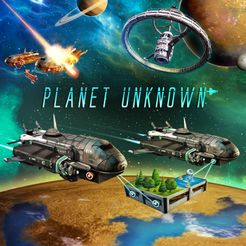
Draft dual-resource tiles simultaneously from a rotating space station, develop your own planet and corporation, and send rovers to recover lifepods and clear meteorites that block row and column scoring.
Planet Unknown supports 1–6 players; community best: 4 players; playing time: 60–80 minutes. A WANGO browser trial has not been confirmed.
Background & introduction
In Planet Unknown, everyone develops a separate planet at the same time. The rotating commander sets the station orientation, leaving each player a choice between the large and small tile in their own depot. A useful shape or resource pair may also be something the next commander hopes to reserve.
Tiles do more than fill space. Their resources advance corporation tracks toward civilization cards, technology, rover movement, and small biomass patches. Water rewards covering ice, while energy depends on surrounding terrain. Efficient coverage and an effective development chain do not always suggest the same placement.
Meteorites turn the spatial puzzle into an ongoing maintenance problem: their rows and columns cannot earn normal planet points even when filled. Rovers must clear them and rescue lifepods before construction destroys them. Symmetric boards offer an introduction; different corporations and planets add variety, while solo play uses rotating depots and Events.
Core rules & scoring
The base game supports one to six players. Begin with symmetric planets and Universal Coalition if learning, and prepare civilization cards and objectives for the player count.
In multiplayer, the commander rotates the station or leaves it still. Everyone simultaneously chooses a top tile from the two stacks in their assigned depot.
The first tile touches the planet perimeter; later tiles connect orthogonally to existing tiles. Align with the grid without overlap or overhang, subject to technologies and special board rules.
After placement, advance for both resources shown, regardless of tile size. Choose which resource to resolve first.
A water resource advances water only if at least one of its water-terrain squares covers planetary ice. Other placement may be legal without earning that advancement.
Energy has no track. Advance the tile's other resource, or a resource corresponding to terrain orthogonally adjacent to the energy terrain area established by the placement.
Place a meteorite on a placed tile's meteor symbol. Rovers spend movement along orthogonal grid squares and collect lifepods or meteorites they pass over. Covering a rover or lifepod with a tile destroys it.
Milestones provide civilization cards, technology, rovers, or biomass. A biomass patch has terrain but no resource, so placing it does not advance biomass again.
Finish the round when a player cannot place either available tile, or both stacks of any depot run out. A player unable to place still chooses a tile and gains its two resource advancements without placing it. When using Events, the final Event card also triggers the last round.
Score complete meteorite-free rows and columns, the highest reached track medals, recovered objects, civilization cards, and objectives. Highest multiplayer score wins. Solo uses clockwise one-depot rotation, Events, private objectives, and an Event-adjusted target score.
Rules & gameplay questions
Can I turn or flip a tile?
Yes. You may change its orientation, and the rulebook FAQ expressly permits flipping. The resulting placement must still meet all applicable restrictions.
Does a meteorite prevent only its own square from scoring?
No. It blocks planet scoring for its entire row and column. Rovers and other applicable effects can clear it.
Must I resolve the two resources in a fixed order?
No. The rulebook FAQ lets you choose the order, which can matter for newly unlocked technology and other benefits.
Can I end the game if one tile fits but the other does not?
No. If either available tile can legally be placed, you must place a legal one. Both must be impossible to place for this end condition.
Does solo play use neighbor competitions?
No. Keep three of four private objectives and use the Event deck. Rotate one depot clockwise each round, then compare your final score with the target adjusted for the Event composition.
Rules & introduction sources
- Edition
- Physical base game v3.59.1: general symmetric-board rules for two to six competitive players and official solo play. Apply any selected asymmetric corporation or planet rules separately. Events are optional in multiplayer and used in solo. Excludes Supermoon, other expansions, and fan solo campaigns.
- Rule references
- Introduction source
- BoardGameGeek
WANGO editorial
| Parameter | Recorded value |
|---|---|
| BGG overall rank (snapshot) | #168 |
| Complexity Weight | 2.25 / 5 |
| Best player count (community) | 4 |
| Player range | 1–6 |
| Playing time (minutes) | 60–80 |
| Core mechanisms | End Game Bonuses · Events · Grid Coverage · Grid Movement · Hidden Victory Points · Map Addition · Neighbor Scope · Network and Route Building · Open Drafting · Pattern Building · Rondel · Simultaneous Action Selection · Solo / Solitaire Game · Square Grid · Sudden Death Ending · Tags · Tech Trees / Tech Tracks · Tile Placement · Turn Order: Progressive · Variable Player Powers |
| Chinese publication | Unconfirmed |
| WANGO browser play | No confirmed WANGO trial |
| Year published | 2022 |
| Suggested age | 10+ |
BGG statistics are stored snapshots, not live rankings. Source checked:2026-09-27
Player questions
What is the best player count for Planet Unknown, and can I play online?
Planet Unknown supports 1–6 players; community best: 4 players; playing time: 60–80 minutes. A WANGO browser trial has not been confirmed. Recorded mechanism tags: Solo / Solitaire Game.
How complex is Planet Unknown, and which mechanisms does it use?
Weight: 2.25 / 5. Mechanisms: End Game Bonuses · Events · Grid Coverage · Grid Movement · Hidden Victory Points · Map Addition · Neighbor Scope · Network and Route Building · Open Drafting · Pattern Building · Rondel · Simultaneous Action Selection · Solo / Solitaire Game · Square Grid · Sudden Death Ending · Tags · Tech Trees / Tech Tracks · Tile Placement · Turn Order: Progressive · Variable Player Powers. Chinese publication: Unconfirmed.
Where can I learn Planet Unknown?
No rule guide, strategy article or WANGO trial has been confirmed for this record.