Concordia Venus
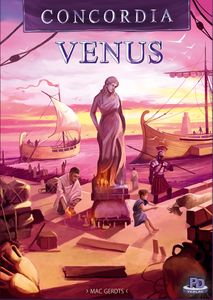
Expand a Roman trading network with personality cards, producing goods and earning divine rewards in individual competition or in two-player teams.
Concordia Venus supports 2–6 players; community best: 4 players; playing time: 60–120 minutes. A WANGO browser trial has not been confirmed.
Background & introduction
Concordia Venus is a complete standalone game with individual competition for 2–5 players and partnerships for four or six. Players send colonists along land and sea routes and build houses in cities to develop a trading network.
Each turn uses one personality card, which remains in your discard pile until your Tribune retrieves it. Buying cards adds future actions and additional scoring opportunities for their associated gods.
Venus adds a spatial connection: individual players benefit from multiple houses in one province, while teams benefit from provinces settled by both partners. Partners normally use the actions of a single card but retain separate goods, colonists, and hands.
Core rules & scoring
Choose a mode: individuals use column-marked cards for 2–5 players; teams use double-circle cards for four or six players, with partners opposite each other. Prepare the market for the player count. Each player has 15 houses, a 12-space storehouse, and six colonists. Individuals start with eight cards; team partners remove the specified card for their position and start with six each.
Play and recover cards: clockwise, play one personality and execute its actions, leaving it in your discard pile. Tribune retrieves all your played cards, including itself, grants one coin per card beyond three, and optionally builds one colonist in the capital for one food and one tool.
Architect moves before building: distribute movement steps equal to your colonists on the board along their land or sea routes; no colonist may finish on an occupied line. Then build in cities adjacent to your colonists, at most one of your houses per city and none in the capital. Pay the required goods and coins; multiply the coin price by the total houses present after construction.
Prefect and production: choose a province whose marker shows goods, flip it, take its bonus, and produce one city good for every house there, including opponents’ houses. Alternatively collect all visible coins and reset the markers. Praefectus Magnus must double its holder’s province bonus and then pass right; it does not double city production or activate for the cash option.
Trade and capacity: Mercator grants three coins, or five on a purchased card, then trades up to two types of goods at fixed prices. Each storehouse space holds one good or colonist; existing goods cannot be discarded to make room. Players cannot trade goods with each other. Specialists produce one good in each of your houses of the specified type.
Acquire and copy cards: in individual play, Senator buys up to two cards for their printed and display costs; Consul buys one without display costs. Purchases enter your hand. Diplomat copies a legal personality atop an opponent’s discard pile. Individual-only Magister repeats your previous personality except Senator. Team Praetor allows each partner to buy at most one card, replenishing only after both finish.
Team turns: the card player acts first, then their partner uses the same actions, normally without playing a card. Double-choice cards require the partner to use the other personality. Goods and cards stay separate, but needed coins may be taken from the partner. Legatus lets you inspect your partner’s hand and request a card that both use. Proconsul buys one non-Proconsul card, then the partner alone uses a non-Legatus card.
End and score the gods: emptying the market or building your fifteenth house earns the seven-point Concordia card. Finish the triggering team’s turn, then every other team takes one last turn; individually, each other player takes one. Gather hand and discarded cards and score each god for houses, provinces, production types, colonists, and other criteria. Each individual Venus card scores two per province with at least two of your houses; team Venus scores one per province containing houses of both partners. Add partners’ scores; highest wins, with ties decided by possession of Praefectus Magnus or who would receive it next.
Rules & gameplay questions
Does this require the original game like the Venus expansion kit?
No. This entry covers the complete standalone edition. The separately sold Venus expansion needs original-game components; its component list is not used here.
Can partners freely exchange goods or inspect hands?
No. Goods, colonists, and cards remain separate and cannot be lent or traded. Needed coins are the exception. Under the standard rules, Legatus permits inspecting a partner’s hand and suggesting a card; agree on verbal communication before play.
Does my Prefect also produce goods for opponents?
Yes. Every house in the chosen province produces. Only the acting player takes the province-marker bonus, and Praefectus Magnus doubles only its holder’s own marker bonus.
How do team Venus cards score?
Each card gives its owner one point per province where both partners have at least one house. Score separately before adding the team total. Legatus names three gods and scores under Jupiter, Saturnus, and Venus.
May I discard stored goods to accept better ones?
No. If incoming goods exceed free spaces, choose which incoming units to accept, filling all available spaces. Colonists not yet placed on the board also occupy storage.
Rules & introduction sources
- Edition
- Complete standalone Concordia Venus, English Rules 1.01 and Setup 1.0 (designer notes dated October 2018). Covers individual play for 2–5 and teams for four or six, rather than the Venus expansion kit. Excludes Salsa, additional expansion maps, conversion to original Concordia cards, and optional intermediate scoring. Consult the rules for individual card and map exceptions.
- Rule references
- Introduction source
- BoardGameGeek
WANGO editorial
| Parameter | Recorded value |
|---|---|
| BGG overall rank (snapshot) | #103 |
| Complexity Weight | 3.01 / 5 |
| Best player count (community) | 4 |
| Player range | 2–6 |
| Playing time (minutes) | 60–120 |
| Core mechanisms | Action Retrieval · Advantage Token · Auction: Dutch · Communication Limits · Deck, Bag, and Pool Building · Hand Management · Investment · Movement Points · Network and Route Building · Open Drafting · Point to Point Movement · Set Collection · Team-Based Game · Variable Set-up |
| Chinese publication | Unconfirmed |
| WANGO browser play | No confirmed WANGO trial |
| Year published | 2018 |
| Suggested age | 12+ |
BGG statistics are stored snapshots, not live rankings. Source checked:2026-09-27
Player questions
What is the best player count for Concordia Venus, and can I play online?
Concordia Venus supports 2–6 players; community best: 4 players; playing time: 60–120 minutes. A WANGO browser trial has not been confirmed. Recorded mechanism tags: Team-Based Game.
How complex is Concordia Venus, and which mechanisms does it use?
Weight: 3.01 / 5. Mechanisms: Action Retrieval · Advantage Token · Auction: Dutch · Communication Limits · Deck, Bag, and Pool Building · Hand Management · Investment · Movement Points · Network and Route Building · Open Drafting · Point to Point Movement · Set Collection · Team-Based Game · Variable Set-up. Chinese publication: Unconfirmed.
Where can I learn Concordia Venus?
No rule guide, strategy article or WANGO trial has been confirmed for this record.