Return to Dark Tower
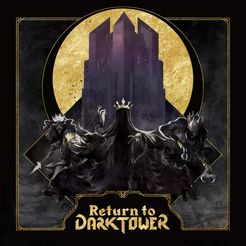
Heroes cross four kingdoms while a physical Tower and companion app drive the crisis: complete the shared goal and defeat the adversary before six months expire.
Return to Dark Tower supports 1–4 players; community best: 4 players; playing time: 100–120 minutes. A WANGO browser trial has not been confirmed.
Background & introduction
Return to Dark Tower combines heroes on a physical map with an app-controlled Tower. Players share responsibility for warriors, spirit and equipment while responding to threats and finding opportunities to complete the main goal.
Each turn accommodates movement, one heroic action and one reinforcement. Movement can be split around actions, but scarce resources, destroyed buildings and glyphs facing a hero’s home kingdom complicate the route. Coordinating destinations and risks matters to the whole group.
The app presents battles and dungeons, advantages improve encounters, and physical components track hero growth and the kingdoms. Standard cooperative play gives everyone a shared result, including solo play. This overview explains procedures without revealing quest or room solutions.
Core rules & scoring
The base cooperative game supports 1–4 players, each controlling one hero; solo also uses one hero. A physical Tower and official companion app are required. Configure player count, difficulty and base-game goals. Each hero starts with 7 warriors and 1 spirit; put exactly 24 skulls in the shared supply.
Complete the main goal and then defeat the adversary within six months. Everyone wins or loses together. A kingdom without a hero claiming it as home is dormant; it is not assigned an imaginary additional hero.
At the start of a turn you may use your banner ability. Then interleave movement, one heroic action and one reinforcement as permitted, splitting movement if desired. End by dropping one skull into the Tower, resolving skulls and then app events.
Move through adjacent spaces up to your hero’s movement allowance. Spending 1 spirit to double movement must be declared before starting movement, with applicable modifiers counted before doubling; it cannot be bought after moving partway.
Choose cleanse, battle or quest as your one heroic action, gaining 2 spirit after completing it. Cleanse requires a building containing skulls at your location and returns all its skulls to the shared supply.
Battle a foe in your space using the app and the battle cards required by its level. Matching advantages improve cards. At most 10 advantages can be spent in one heroic action; unused advantages do not carry into a later action.
Quest actions follow the location and requirements shown by the app; dungeon rooms are also resolved there. Merely moving a physical hero onto a space does not automatically satisfy a quest: record completion as the app directs.
Once each turn, reinforce at your current building, choosing its free option or spending spirit for its enhanced option. Pay forced losses as fully as possible; inability to meet a complete forced loss causes corruption as instructed rather than cancelling the loss for free.
Place an emerging skull in the kingdom of the Tower exit it first passes through. That kingdom’s home hero chooses a building; the active player chooses in a dormant kingdom. A fourth skull destroys the building and removes it and all four skulls from the game. Its home hero, if any, gains corruption.
Glyphs facing your home kingdom add a 1-spirit cost to the matching action regardless of your hero’s current kingdom. The group loses if any hero gains a third corruption, a skull must be taken from an empty supply, or six months end without victory.
Rules & gameplay questions
Must a solo player control several heroes?
No. Set up one player and one hero in base cooperative solo play. Other kingdoms are dormant, and the app runs with the selected player count.
Does a building’s fourth skull return to the supply?
No under v2.0 and the official second-printing FAQ. Remove the building and all four skulls from the game. Cleanse instead returns skulls to the supply.
Can a hero away from home ignore the home kingdom’s glyphs?
No. Check glyphs facing that hero’s home kingdom. Matching actions require the extra spirit wherever the hero currently stands.
Can an item gained during a battle immediately provide advantages?
Yes. The official FAQ allows its advantages in the current battle. Losing a source after advantages were calculated also does not subtract the advantages already available for that battle.
Does enhanced bazaar reinforcement cost 1 or 2 spirit?
2 spirit. The official FAQ identifies 1 spirit in an older example as an error; this entry follows the current rulebook and correction.
Rules & introduction sources
- Edition
- Modern Return to Dark Tower base cooperative game, including official solo and 1–4 players. Uses rulebook v2.0 (copyright 2023), current publisher product FAQ and second-printing FAQ. Companion-app information checked 2026-10-26; the official Android listing was updated 2026-05-01, with no installed build tested. Excludes the base competitive variant, Alliances, Covenant and the 1981 original; no story solutions.
- Rule references
- Introduction source
- BoardGameGeek
WANGO editorial
| Parameter | Recorded value |
|---|---|
| BGG overall rank (snapshot) | #230 |
| Complexity Weight | 2.66 / 5 |
| Best player count (community) | 4 |
| Player range | 1–4 |
| Playing time (minutes) | 100–120 |
| Core mechanisms | Area Movement · Cooperative Game · Events · Push Your Luck · Random Production · Scenario / Mission / Campaign Game · Solo / Solitaire Game · Sudden Death Ending · Trading · Variable Player Powers · Variable Set-up |
| Chinese publication | Unconfirmed |
| WANGO browser play | No confirmed WANGO trial |
| Year published | 2022 |
| Suggested age | 10+ |
BGG statistics are stored snapshots, not live rankings. Source checked:2026-09-27
Player questions
What is the best player count for Return to Dark Tower, and can I play online?
Return to Dark Tower supports 1–4 players; community best: 4 players; playing time: 100–120 minutes. A WANGO browser trial has not been confirmed. Recorded mechanism tags: Solo / Solitaire Game.
How complex is Return to Dark Tower, and which mechanisms does it use?
Weight: 2.66 / 5. Mechanisms: Area Movement · Cooperative Game · Events · Push Your Luck · Random Production · Scenario / Mission / Campaign Game · Solo / Solitaire Game · Sudden Death Ending · Trading · Variable Player Powers · Variable Set-up. Chinese publication: Unconfirmed.
Where can I learn Return to Dark Tower?
No rule guide, strategy article or WANGO trial has been confirmed for this record.