Through the Ages: A Story of Civilization
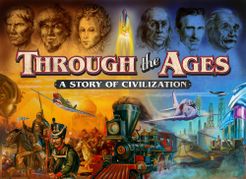
Develop farms, mines, technologies, governments and culture while balancing military pressure and population needs to earn the most culture.
Through the Ages: A Story of Civilization supports 2–4 players; community best: 3 players; playing time: 120 minutes. A WANGO browser trial has not been confirmed.
Background & introduction
Through the Ages: A Story of Civilization is Vlaada Chvátil’s original civilization game, first released in 2006. Players build personal card tableaux, assigning workers to farms, mines, urban buildings and military units while leaders and wonders shape their civilizations.
A card’s position in the shared row determines its civil-action cost. Research unlocks construction options rather than granting buildings outright. Food, resources, science and workers must support one another: stored goods occupy blue tokens, while population growth raises consumption and happiness requirements.
The Full Game advances from Antiquity through three historical ages and ends in a fourth age without new cards. Political actions introduce events, colonies, aggressions and wars. Culture production and Age III events shape the final result; the rules and card balance differ from the 2015 A New Story of Civilization.
Core rules & scoring
Setup: 2–4 players. The FRED 2009 printing lists 185 civil cards, 155 military cards and one starting-player card. Use all ages for the Full Game, removing marked 3+/4+ civil cards for lower counts and pacts for two players. Each civilization begins with 25 yellow and 18 blue tokens: six workers on cards, one unused worker and 18 tokens in its yellow bank.
Actions and row: in round one, players only take cards, receiving 1/2/3/4 civil actions in seat order. Later turns remove cards from the first 3/2/1 row positions for 2/3/4 players, then slide and refill. Taking a card costs 1/2/3 civil actions by region. Despotism normally supplies four civil and two military actions.
Development: increasing population costs food and takes a worker from the yellow bank. Building costs resources and an action and uses an unused worker. Research separately costs science; upgrading within a type costs the construction-cost difference. Governments limit urban buildings per type. Wonders require stages, and taking another wonder costs one extra civil action per completed wonder.
Politics and military cards: before regular actions, take at most one political action to seed an event, attack, offer/cancel a pact or declare war. Seeding an event earns culture equal to its age and reveals a current event. Colonization bids require sacrificing at least one unit, supplemented by bonuses. Draw one military card per unused military action, maximum three, at turn end; discard excess after your next political action to your total military-action limit.
Original conflicts: aggressions resolve immediately and succeed only if attack exceeds defense. Both sides may sacrifice units; defenders may also use defense bonus cards. Wars resolve at the start of the declarer’s next turn, allow sacrifices but no defense bonus cards, and apply effects by strength difference. Unit sacrifices are forbidden in the last round; defense bonus cards may still resist aggressions.
Production and risks: without an uprising, gain science and culture, produce food and pay consumption, then produce resources and assess corruption using the resulting blue bank. Corruption costs resources, never food; each missing food costs four culture. More discontent workers than unused workers causes an uprising, skipping production and maintenance, including military-card draws.
Ages: placing the last civil card of Age I, II or III ends that age. Hand cards, leaders, unfinished wonders and pacts from the preceding age become obsolete; technologies, tactics, colonies and completed wonders remain. In the Full Game also remove two yellow-bank tokens to the box, or as many as remain there.
Ending: Age III gives way to cardless Age IV. If this happens at the start of the starting player’s turn, the current round is last; otherwise finish it and play one full additional round. Score remaining Age III current/future events, then highest culture wins. Event-ranking ties follow turn order from the current player; final events assume the starting player’s turn. This manual gives no separate final-culture tie-breaker.
Rules & gameplay questions
Does researching Iron immediately increase production?
No. Research unlocks better mines. You must still build one with an unused worker or upgrade an existing mine, paying the action and resources. The card holding a blue token determines its resource value.
Is corruption paid before resource production?
The original rules used here assess it after food production and consumption and then resource production. This differs from the 2015 edition’s sequence; do not interchange them.
Can I discard any military card for defense?
These original rules permit dedicated defense bonus cards and unit sacrifices, without a general rule converting arbitrary military cards into a fixed defense value. Sacrifices are also forbidden in the last round.
Are event ties the same as a tie for the game?
No. Event rankings normally favor the current player, then subsequent players in turn order; final events assume the starting player’s turn. The 2009 manual says highest culture wins without printing a separate final-score tie-breaker. Do not invent a strength or science comparison.
Do Simple, Advanced and Full Games end alike?
No. Simple ends with Age I and fixed development bonuses. Advanced ends with Age II and scores four Age III events displayed from setup. This summary primarily covers the Full Game, including wars, Age III and yellow-token loss at age changes.
Rules & introduction sources
- Edition
- Original 2006 game, using the 20-page FRED Distribution ©2009 English rules for the 2–4-player Full Game, with Simple/Advanced distinctions. Excludes the 2015 A New Story edition, New Leaders & Wonders, solo variants and digital adaptations. The consulted manual does not specify a final-score tie-breaker.
- Introduction source
- BoardGameGeek
WANGO editorial
| Parameter | Recorded value |
|---|---|
| BGG overall rank (snapshot) | #119 |
| Complexity Weight | 4.18 / 5 |
| Best player count (community) | 3 |
| Player range | 2–4 |
| Playing time (minutes) | 120 |
| Core mechanisms | Action Points · Auction / Bidding · Auction: Dutch · Hand Management · Income · Open Drafting · Tags · Take That |
| Chinese publication | Unconfirmed |
| WANGO browser play | No confirmed WANGO trial |
| Year published | 2006 |
| Suggested age | 12+ |
BGG statistics are stored snapshots, not live rankings. Source checked:2026-09-27
Player questions
What is the best player count for Through the Ages: A Story of Civilization, and can I play online?
Through the Ages: A Story of Civilization supports 2–4 players; community best: 3 players; playing time: 120 minutes. A WANGO browser trial has not been confirmed.
How complex is Through the Ages: A Story of Civilization, and which mechanisms does it use?
Weight: 4.18 / 5. Mechanisms: Action Points · Auction / Bidding · Auction: Dutch · Hand Management · Income · Open Drafting · Tags · Take That. Chinese publication: Unconfirmed.
Where can I learn Through the Ages: A Story of Civilization?
No rule guide, strategy article or WANGO trial has been confirmed for this record.