Cthulhu: Death May Die
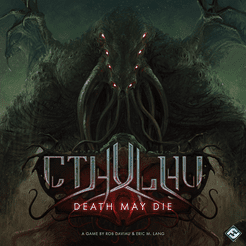
Cthulhu: Death May Die is a cooperative horror adventure. Investigators disrupt an episode’s ritual to make the summoned Elder One vulnerable, then defeat its Final Stage together.
Cthulhu: Death May Die supports 1–5 players; community best: 3 players; playing time: 90–120 minutes. A WANGO browser trial has not been confirmed.
Background & introduction
Each game combines one Episode box with one Elder One box. The episode specifies the map, special actions and ritual requirements; the Elder One supplies its minions, Mythos cards and escalating stages. Use the selected combination rather than freely mixing components from other boxes.
Investigators divide their limited actions between movement, attacks, recovery, trades and episode tasks. Finishing those actions does not end the danger: a Mythos card follows, then discovery in a safe space or attacks by enemies sharing the active investigator’s space, followed by fire and summoning checks.
Losing sanity triggers an investigator’s insanity while improving skills and eventually adding bonus dice to eligible rolls. That growing power has a limit: investigators can be consumed by madness, while the summoning track continues toward a shared defeat.
Core rules & scoring
Combination and turn: Choose one episode and one Elder One, setting up their map, enemies and ritual requirements. Take up to three actions, repeating actions if desired; then draw Mythos, investigate or suffer enemy attacks, and resolve the end-of-turn sequence.
Actions: Run up to three spaces; enemies in each space you leave normally follow. Add personal Fire tokens equal to those in each burning space you leave. A normal attack targets one enemy in your space, dealing one wound per success; skills can change these restrictions.
Safety and discovery: A space without enemies is Safe. Rest there to heal three total stress and/or wounds, never sanity. Investigators sharing a space can trade Items and Companions, but not Conditions. After Mythos, a Safe investigator must draw Discovery if cards remain; otherwise enemies sharing the space attack the active investigator in the chosen order.
Dice and stress: An investigator’s check normally uses three standard dice plus applicable bonus dice; enemy attacks use their reference card’s pool. Take one stress to reroll one die, including dice rolled against you. Your bonus dice do not automatically apply to enemy attacks, Fire or other rolls against you unless an effect explicitly permits it.
Sanity and insanity: Resolve successes and associated effects before losing sanity from tentacles. Stop at the next Insanity Threshold and ignore excess sanity loss from that instance; activate insanity before improving one skill. Some thresholds permanently add bonus dice to eligible rolls. Rest never restores sanity.
Mythos and summoning: Resolve Mythos from top to bottom, skipping summons without an available matching figure. End-of-turn steps are ordinary effects, personal Fire, Mythos discard check, Elder One summoning, then stage end-of-turn effects. Three discarded cards with Summoning symbols advance the track and reshuffle Mythos. Reaching the first red space or disrupting the ritual that turn summons the Elder One during the summoning check.
Ritual and confrontation: Until the ritual is disrupted, even a summoned Elder One cannot be attacked or wounded. Afterwards defeat its stages in order. Excess damage does not carry into the next stage; previous stages’ ongoing abilities and attack dice remain active.
Shared ending and solo: Defeat the Final Stage to win together. Lose if any investigator dies or is consumed before summoning, everyone is eliminated after summoning, or progression reaches the eighth track space. Simultaneous victory takes precedence. Solo alternates two investigators. After summoning, survivors may continue after a death and the eliminated investigator’s later turns are skipped.
Rules & gameplay questions
Can we attack an Elder One as soon as it appears?
No. Disrupting the ritual removes its protection against attacks and damage; a summoned Elder One can still attack investigators beforehand. Defeating a stage does not carry excess wounds into the next one.
Do sanity-track green dice also increase enemy attacks or Fire rolls?
No. Official FAQ v2.0 excludes rolls against you unless an effect explicitly says otherwise. You may still take stress to reroll those dice. In your own eligible rolls, sanity-track bonus dice are mandatory.
Does maximum stress automatically turn more stress into wounds?
No, only an effect explicitly saying so causes replacement wounds. You also cannot choose a Discovery option requiring more stress than you have room to take.
Can I skip investigation in safety, or automatically reshuffle Discovery?
No. A Safe investigator must investigate while Discovery cards remain. An exhausted deck is not automatically reshuffled; only an explicit effect does that. Without cards, investigators no longer investigate.
Can the team always continue after losing an investigator?
Before summoning, any investigator’s death or consumption by madness loses the game. After summoning, survivors may continue. If someone dies during their own turn, only the Mythos discard check remains from the later phases; their future turns are skipped entirely.
Rules & introduction sources
- Edition
- Original CMON Cthulhu: Death May Die English base rulebook, 20 pages, with official FAQ v2.0, 15 pages; 1–5 players, with two investigators controlled in solo play. Shared procedures only; specific episode, skill and Elder One cards take precedence. No episode objective spoilers or rules imported from Fear of the Unknown, later seasons or optional modules.
- Introduction source
- BoardGameGeek
WANGO editorial
| Parameter | Recorded value |
|---|---|
| BGG overall rank (snapshot) | #54 |
| Complexity Weight | 2.49 / 5 |
| Best player count (community) | 3 |
| Player range | 1–5 |
| Playing time (minutes) | 90–120 |
| Core mechanisms | Action Points · Area Movement · Cooperative Game · Dice Rolling · Role Playing · Scenario / Mission / Campaign Game · Solo / Solitaire Game · Variable Player Powers |
| Chinese publication | Unconfirmed |
| WANGO browser play | No confirmed WANGO trial |
| Year published | 2019 |
| Suggested age | 14+ |
BGG statistics are stored snapshots, not live rankings. Source checked:2026-09-27
Player questions
What is the best player count for Cthulhu: Death May Die, and can I play online?
Cthulhu: Death May Die supports 1–5 players; community best: 3 players; playing time: 90–120 minutes. A WANGO browser trial has not been confirmed. Recorded mechanism tags: Solo / Solitaire Game.
How complex is Cthulhu: Death May Die, and which mechanisms does it use?
Weight: 2.49 / 5. Mechanisms: Action Points · Area Movement · Cooperative Game · Dice Rolling · Role Playing · Scenario / Mission / Campaign Game · Solo / Solitaire Game · Variable Player Powers. Chinese publication: Unconfirmed.
Where can I learn Cthulhu: Death May Die?
No rule guide, strategy article or WANGO trial has been confirmed for this record.