Barrage
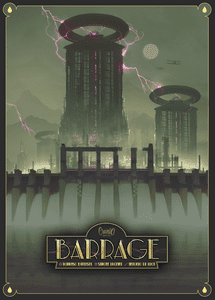
A demanding hydroelectric construction game set in Alpine valleys, where dams, water flow, energy production and a rotating construction wheel shape your industrial plans.
Barrage supports 1–4 players; community best: 4 players; playing time: 90–180 minutes. A WANGO browser trial has not been confirmed.
Background & introduction
Barrage makes hydroelectric engineering its central contest. Build dams, conduits and powerhouses, planning a production network around elevation, limited water and public scoring objectives.
Production draws water from your own or neutral dams through a legal conduit to your own powerhouse. You may pay to use another player’s conduit, but that does not give access to water behind their dams.
Machinery invested in the construction wheel takes time to return, creating a continuing construction rhythm. Water flows downstream after production; neutral dams cannot be raised or claimed, so engineering locations and timing matter together.
Core rules & scoring
Play five rounds: Income and Headstreams, Actions, Water Flow, Scoring, then End of Round. Take turns placing the required Engineers on one available action space and resolving it until everyone has used their Engineers. Most shared spaces remain occupied for the round; the Bank is an exception.
For construction, use your Company board’s spaces from left to right, insert an appropriate or wild Technology tile and all required machinery, then immediately rotate the wheel one segment clockwise and place the structure. Reclaim machinery and tiles when they return to the open segment. Round end does not empty the wheel; Workshop and other effects can accelerate it. Spent Credits return to the supply, never to the wheel.
Bases cost five, four or three Excavators in Mountains, Hills or Plains; Elevations cost four, three or two Concrete Mixers respectively. Raise only your own dams, to level three at most. Conduits cost twice their production value in Excavators; powerhouses cost two Concrete Mixers plus one per existing powerhouse. Red-bordered building spaces add a fee. Neutral dams cannot be modified.
Production requires water in your own or a neutral dam, a legal conduit of any player’s color, and your own powerhouse. Multiply water drops by conduit value, then apply action and Company modifiers. For an opponent’s conduit, pay its owner one Credit per drop; that owner also scores one VP per drop. The production must yield at least one Energy Unit.
Contracts use a single production, never the sum of several productions, with at most one private or National Contract fulfilled per production. Record the energy on the round track as well; fulfilling a contract does not spend it. Hold at most three unfulfilled contracts; completed contracts do not count toward that limit.
After production, water leaves the powerhouse along natural rivers, one drop at a time. It stops at dams with remaining capacity, overflows full dams and is removed only on leaving the map. A normal dam holds one drop per level. New headstream water normally waits until Water Flow; actions explicitly showing immediate flow are exceptions.
The first and second energy producers normally score six and two VP, provided they produced at least one Energy Unit; ties use the printed split rules. At least six energy is required for the current Bonus tile; subtract four VP for each energy section behind the current round, to a minimum of zero. Zero energy also loses three VP. Construction unlocks income immediately and again in later Income phases.
After round five scoring, award the final Objective’s first three places 15, 10 and five VP, sharing tied tiers and rounding up. Score one VP per combined five Credits and machinery in your personal supply, plus one per water drop in your dams. Machinery still on the wheel does not count. Most VP wins; break ties by energy produced in the final round.
Rules & gameplay questions
Can I use an opponent’s stored water or borrow their conduit for free?
No. Use your own or neutral stored water and your own powerhouse. Using an opponent’s conduit costs one Credit per drop paid to its owner, who also earns one VP per drop. Access to a conduit does not allow taking water from an opponent’s dam.
Does wheel machinery return automatically at round end?
No. Construction inserts machinery and a Technology tile in the open segment, then advances the wheel once. Reclaim them when they rotate back to that open segment. Retrieving Engineers at round end does not retrieve wheel investments. Workshop, income and contract effects can accelerate the wheel.
Can several small productions combine to fulfill a large contract?
No. One production must meet the requirement and can fulfill only one contract. Accumulated round energy matters for round scoring. Fulfilling a contract does not spend energy from the track.
Does used water disappear, and can neutral dams be raised?
Water continues downstream from the powerhouse and may stop in lower dams with spare capacity; remove it only when it leaves the map. Neutral dams cannot be changed after setup. Elevations may be added only to your own dams.
Does reaching six energy guarantee the full building bonus?
No. Six energy makes you eligible. If you have not reached the section for the current round, subtract four VP from the Bonus tile reward per section behind, to a minimum of zero. Energy-ranking VP is scored separately.
Rules & introduction sources
- Edition
- Barrage base map, 2–4-player full game, including base-box Companies, Executive Officers and Advanced Technology. Introductory setup omits some elements. Solo play requires the separate base-box Automa rules and is not detailed here. Excludes The Leeghwater Project’s Dutch Company, External Works and Private Buildings, other maps, the fifth player and later expansions.
- Rule references
- Introduction source
- BoardGameGeek
WANGO editorial
| Parameter | Recorded value |
|---|---|
| BGG overall rank (snapshot) | #40 |
| Complexity Weight | 4.12 / 5 |
| Best player count (community) | 4 |
| Player range | 1–4 |
| Playing time (minutes) | 90–180 |
| Core mechanisms | Contracts · End Game Bonuses · Income · Network and Route Building · Ownership · Solo / Solitaire Game · Turn Order: Stat-Based · Variable Player Powers · Variable Set-up · Worker Placement |
| Chinese publication | Unconfirmed |
| WANGO browser play | No confirmed WANGO trial |
| Year published | 2019 |
| Suggested age | 14+ |
BGG statistics are stored snapshots, not live rankings. Source checked:2026-09-27
Player questions
What is the best player count for Barrage, and can I play online?
Barrage supports 1–4 players; community best: 4 players; playing time: 90–180 minutes. A WANGO browser trial has not been confirmed. Recorded mechanism tags: Solo / Solitaire Game.
How complex is Barrage, and which mechanisms does it use?
Weight: 4.12 / 5. Mechanisms: Contracts · End Game Bonuses · Income · Network and Route Building · Ownership · Solo / Solitaire Game · Turn Order: Stat-Based · Variable Player Powers · Variable Set-up · Worker Placement. Chinese publication: Unconfirmed.
Where can I learn Barrage?
No rule guide, strategy article or WANGO trial has been confirmed for this record.