Sherlock Holmes Consulting Detective: The Thames Murders & Other Cases
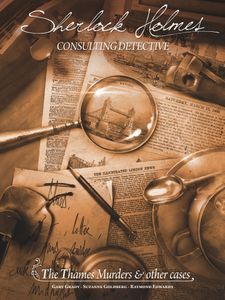
A cooperative deduction game built around reading, discussion and checking accounts against one another. Choose your own leads, decide when to close the case, then compare your answers and investigative efficiency with Holmes.
Sherlock Holmes Consulting Detective: The Thames Murders & Other Cases supports 1–8 players; community best: 2 players; playing time: 60–120 minutes. A WANGO browser trial has not been confirmed.
Background & introduction
As members of the Baker Street Irregulars, you investigate with case booklets, a London map, a directory and newspapers. The game leaves the route to you: deciding which statements and connections deserve attention is part of the puzzle.
A different lead investigator selects and reads a lead each turn while everyone discusses interpretations and keeps notes. Following an interesting diversion can expand your picture of London without necessarily resolving the central uncertainty.
The box contains ten cases for individual investigation or group discussion. Your final result combines answers with the number of leads followed, so reaching a convincing explanation and reaching it efficiently are connected challenges. This introduction supplies no case solutions or suggested investigation addresses.
Core rules & scoring
This box supports cooperative investigation for 1–8 players. Agree on a case; chronological order is recommended to reduce spoilers from newspapers.
Set out the map, directory, informant list, the newspaper dated for the case and all earlier newspapers. Later newspapers are unavailable. Paper and pencils may be used for notes.
Choose a lead investigator to hold the case booklet and read its introduction. Consult leads from the current case only.
On their turn, the lead investigator chooses a lead, locates its reference using the available material, reads the matching passage aloud and records the visit, then passes the booklet to the player on their left.
If the chosen location has no passage in the current booklet, choose another lead. A turn permits one new lead, but there is no fixed limit on the total leads you may follow.
The directory, eligible newspapers and previously visited leads may be consulted or reread without limit. Rereading an existing lead does not constitute another new investigation.
Everyone may discuss the next step. If there is disagreement, the current lead investigator decides. The map supports location and timing checks; the investigators’ own travel time is ignored.
The group may stop investigating whenever it chooses, then answers both sets of questions: the main case questions and additional questions about related events.
After answering, read the solution and open the scoring section. Total the answer points and the leads followed, excluding any free leads specifically identified in that case’s solution.
Compare your lead count with Holmes: subtract 5 points per additional lead or add 5 per lead fewer. Compare the adjusted result with his fixed score of 100.
Rules & gameplay questions
Can we read the questions first to guide further investigation?
The formal sequence moves to the questions after you decide to end the investigation. Make your deductions and stopping decision before reading the questions and subsequent solution.
Is only the current newspaper available?
No. You may consult the paper dated for the case and all earlier papers. Papers from later dates are unavailable for that investigation.
Does rereading a lead cost another scoring penalty?
No. Previously visited leads may be reread freely. Count the leads followed, excluding any free leads identified by that case’s solution.
What if an address has no passage?
Choose another lead when the current case has no corresponding passage. Do not substitute a passage for that address from a different case booklet.
Must we read every lead to finish?
No. Stop when you believe you can explain the case. Further leads can add understanding, but every counted lead beyond Holmes’ total costs 5 points.
Rules & introduction sources
- Edition
- Based on the current official English rules for the Space Cowboys The Thames Murders & Other Cases box (©2016; PDF produced in 2017). Covers its general cooperative and individual investigation procedure and scoring, without reconstructing every earlier edition associated with ID 2511. Other standalone boxes, case answers, solution addresses and story hints are excluded.
- Introduction source
- BoardGameGeek
WANGO editorial
| Parameter | Recorded value |
|---|---|
| BGG overall rank (snapshot) | #209 |
| Complexity Weight | 2.66 / 5 |
| Best player count (community) | 2 |
| Player range | 1–8 |
| Playing time (minutes) | 60–120 |
| Core mechanisms | Cooperative Game · Deduction · Narrative Choice / Paragraph · Solo / Solitaire Game · Storytelling |
| Chinese publication | Unconfirmed |
| WANGO browser play | No confirmed WANGO trial |
| Year published | 1981 |
| Suggested age | 13+ |
BGG statistics are stored snapshots, not live rankings. Source checked:2026-09-27
Player questions
What is the best player count for Sherlock Holmes Consulting Detective: The Thames Murders & Other Cases, and can I play online?
Sherlock Holmes Consulting Detective: The Thames Murders & Other Cases supports 1–8 players; community best: 2 players; playing time: 60–120 minutes. A WANGO browser trial has not been confirmed. Recorded mechanism tags: Solo / Solitaire Game.
How complex is Sherlock Holmes Consulting Detective: The Thames Murders & Other Cases, and which mechanisms does it use?
Weight: 2.66 / 5. Mechanisms: Cooperative Game · Deduction · Narrative Choice / Paragraph · Solo / Solitaire Game · Storytelling. Chinese publication: Unconfirmed.
Where can I learn Sherlock Holmes Consulting Detective: The Thames Murders & Other Cases?
No rule guide, strategy article or WANGO trial has been confirmed for this record.