Sekigahara: The Unification of Japan
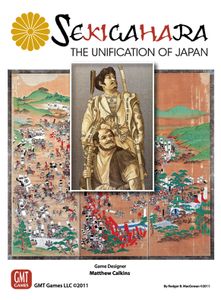
A two-player block wargame of Japan’s unification campaign, where hidden forces, clan cards and battlefield defections shape a seven-week contest.
Sekigahara: The Unification of Japan supports 2 players; community best: 2 players; playing time: 180 minutes. A WANGO browser trial has not been confirmed.
Background & introduction
Army sizes are visible, but clan identities and strengths face their owner. Bringing a large force to a location does not guarantee its participation: most blocks need matching clan cards to enter the battle.
Roads connect scattered castles, resource locations and recruitment sites. Castles improve card income, resources improve reinforcements, and large armies move more slowly. Splitting a force changes both the front and its support network.
Battles use no dice. The trailing side deploys until it gains the lead. A saved clan card can either deploy another unit or answer a loyalty challenge, making the final commitment matter beyond the battle itself.
Core rules & scoring
The players control Tokugawa and Ishida over seven weeks. Each week has A and B turns, with both players taking movement and combat in a fixed order each turn. Start with five cards each and set up designated and randomly drawn blocks.
Skip reinforcements in week one. Later, discard half your hand rounded down, then draw five cards; the player with more castles draws one extra. Draw reinforcement blocks according to the week track; more resource locations earns one extra block, with both players receiving it on a resource tie.
Each week, secretly bid one card for order. The higher number chooses who acts first in both turns, and both cards are discarded. For movement, zero cards permits no movement with a hand refresh, or one stack move/muster; one card permits three stack moves, while two permits all stacks plus one muster.
A normal move follows roads for one location. An entirely highway move, eligible leadership at the origin and a card-paid force march each add one. Each group of four blocks or fraction beyond the first four reduces movement by one. A block cannot move twice per turn, and a road segment cannot be reused within a movement phase.
Muster at most once per turn. Reveal any number of one clan’s reinforcement blocks at its matching recruitment location, or secretly place a single block of any clan at a friendly recruitment location. Mustered blocks cannot move that turn and may only support combat already initiated by on-map blocks.
After movement, resolve each location containing opposing forces. In a field battle the attacker deploys first, normally using one matching clan card per block. Before your first card deployment, leaders may deploy free and are immune to loyalty challenges. The special Ishida and Ii blocks accept any friendly clan card other than a Loyalty Challenge.
A deployment produces the block’s mon count plus one per previously deployed friendly block of the same clan. A sword card deploying cavalry or guns adds two, plus two per previously deployed friendly block of that attack type. A double-mon card deploys two matching blocks sequentially but cannot launch special attacks.
The side behind in Impact keeps deploying; ties count as a defender lead. Once you stop deploying, you cannot resume, but may still issue loyalty challenges. A challenge immediately follows an enemy deployment: showing another card able to deploy that block refutes it and returns that card to hand; otherwise the block temporarily defects for this battle.
In a field battle, each side loses one block per seven enemy Impact; the loser loses one extra and retreats. Select defectors first, then deployed blocks, then undeployed blocks. A castle holds up to two blocks in a siege. Its defender does not deploy; every seven attacking Impact removes a block or disk. Sieges prohibit special attacks and loyalty challenges.
Tokugawa immediately wins if Ishida Mitsunari dies or Toyotomi Hideyori is captured; Ishida immediately wins if Tokugawa Ieyasu dies. If both earn instant victory in the same battle, Ishida wins. Otherwise score two per castle and one per resource location after week seven; Ishida wins a tied total.
Rules & gameplay questions
Does every block present automatically fight?
No. Most require matching clan cards. Free initial leader deployments and the specific Ishida/Ii matching exceptions follow their own rules. Undeployed blocks can still be lost after defeat.
Does a loyalty challenge permanently steal troops?
No. Defection lasts for the battle, after which blocks revert to their owner. That owner must choose defectors first when taking losses. A card shown to refute the challenge stays in hand.
How is a double-mon card challenged?
One further eligible card refutes the entire challenge; otherwise both blocks defect. Double cards cannot launch special attacks, and deploying the exceptional Ishida or Ii block with one prevents deployment of a second block.
Does the defender win every kind of tie?
These are separate tests. Tied field-battle Impact favors the defender; tied end-of-week-seven victory points favor Ishida. Simultaneous instant victories in one battle also favor Ishida.
Can reinforcements initiate an attack, or a besieged defender play combat cards?
Neither. Mustering may only join combat begun by on-map forces, and new blocks cannot move that turn. A siege defender neither deploys nor plays combat cards, and neither side may use Loyalty Challenges.
Rules & introduction sources
- Edition
- GMT base two-player campaign, checked against the 2016 Final Rulebook still linked by the current fifth-printing product page; rules pages 2–12 and the combat example read. Excludes other games named Sekigahara, historical notes, unofficial FAQs and variants. The current product page provides no separate official FAQ link.
- Introduction source
- BoardGameGeek
WANGO editorial
| Parameter | Recorded value |
|---|---|
| BGG overall rank (snapshot) | #235 |
| Complexity Weight | 2.80 / 5 |
| Best player count (community) | 2 |
| Player range | 2 |
| Playing time (minutes) | 180 |
| Core mechanisms | Action Points · Card Play Conflict Resolution · Force Commitment · Hand Management · Point to Point Movement · Secret Unit Deployment · Turn Order: Auction · Variable Set-up |
| Chinese publication | Unconfirmed |
| WANGO browser play | No confirmed WANGO trial |
| Year published | 2011 |
| Suggested age | 14+ |
BGG statistics are stored snapshots, not live rankings. Source checked:2026-09-27
Player questions
What is the best player count for Sekigahara: The Unification of Japan, and can I play online?
Sekigahara: The Unification of Japan supports 2 players; community best: 2 players; playing time: 180 minutes. A WANGO browser trial has not been confirmed.
How complex is Sekigahara: The Unification of Japan, and which mechanisms does it use?
Weight: 2.80 / 5. Mechanisms: Action Points · Card Play Conflict Resolution · Force Commitment · Hand Management · Point to Point Movement · Secret Unit Deployment · Turn Order: Auction · Variable Set-up. Chinese publication: Unconfirmed.
Where can I learn Sekigahara: The Unification of Japan?
No rule guide, strategy article or WANGO trial has been confirmed for this record.