Underwater Cities
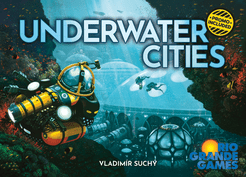
Underwater Cities combines action-slot selection, color-matched cards and city-network construction in an undersea settlement game, with production, feeding and the final network composition all affecting the score.
Underwater Cities supports 1–4 players; community best: 2 players; playing time: 80–150 minutes. A WANGO browser trial has not been confirmed.
Background & introduction
With resources under pressure on land, humanity builds sustainable nations under the sea. Starting with one white-domed city, players connect new cities, kelp farms, desalination plants and laboratories through tunnels, then extend their networks to coastal metropolises.
Every action also requires playing a card. A matching color gives both the slot action and the card effect; a mismatch still allows the action but loses the card’s benefit. Slots fill during each round, making card colors and turn order important constraints.
A newly built city is not necessarily operational. Cities and buildings outside the starting city’s network neither produce nor contribute to final network scoring. Connected cities need food after each Production phase, so expansion, upgrades and feeding must be planned together.
Core rules & scoring
Flow: Three eras contain ten rounds, split four, three and three. Each player takes three turns per round, playing a card with an action slot. A matching card and slot can resolve in either order, but each must resolve completely before the other; do not interleave the two effects.
Actions and costs: Normally choose an unoccupied slot and perform at least part of its effect. Construction still costs the usual resources unless a card specifies a different price or says free. Resolve newly triggered rewards immediately. Draw one card at turn end and discard to three before your next turn. The colorless always-available slot can be reused but never matches a card.
Network: Tunnels must connect back to the starting city through existing tunnels, possibly across empty city sites. New cities must be adjacent to an existing city but can precede their connecting tunnels. Buildings require an existing city or a legal new-city site, and join the network only beside a connected city.
Production and feeding: Produce once at each era’s end. Connected buildings, tunnels adjacent to cities, and connected symbiotic cities produce as specified. Feed each connected city one kelp; use biomatter for any shortfall, then lose three points per remaining unfed city, never falling below zero.
Action cards: Claimed action cards normally work once per era and need a slot or effect authorizing their use. Keep at most four, including your Personal Assistant. Upgrading a structure normally costs one science, and an upgraded structure cannot be upgraded again.
Special cards: Taking one into your hand does not require paying its printed credit cost; pay when playing it with a matching slot. Discarded one- or two-credit Special cards return to their deck’s bottom. Keep paid instant Special cards under your board so they cannot circulate again. Only six three-credit cards are initially offered, without replacement.
Final scoring: After the third Production and feeding, score metropolises and end-scoring cards. A connected city with zero, one, two or three building types scores two, three, four or six points. Sell biomatter for two credits each, then convert each combined four credits, kelp, science or steelplast into one point. Most points wins; ties use the order determined after the final round.
Solo: Use an advanced player board and the two-player main board. Three non-player action tiles move clockwise each round; failing to advance on the Federation track adds a randomly blocked slot next round. After ten rounds, win with at least seven connected cities and at least 100 points. Do not use government contracts.
Rules & gameplay questions
Can a mismatched card still be kept for its ongoing effect?
No. Resolve only the slot and discard the mismatched card. Matching is required to claim permanent, action, production or end-scoring cards. The colorless always-available slot cannot match any card.
Does a disconnected city need kelp?
No. It neither produces nor needs food and does not count for final network scoring. Its buildings must wait for the city to join the network before producing.
Can I resolve half a matching card, take the action, then finish the card?
No. Resolve the complete card effect before the slot action, or the complete slot action before the card. Newly triggered immediate rewards resolve at once and can supply resources within the effect being resolved.
Must I pay immediately when taking a Special card?
No. Taking it into your hand is free; pay its printed cost when subsequently playing it with a matching slot. A mismatched or unpaid one- or two-credit Special card returns to its deck’s bottom. A paid instant Special card stays out of circulation.
Rules & introduction sources
- Edition
- Current Delicious Games English base rulebook, 20 pages, PDF created April 7, 2020, with no printed revision number; 1–4 players. Includes page 18 solo rules and base player-board variant notes. Excludes New Discoveries, Data Era and the government-contract variant.
- Rule references
- Introduction source
- BoardGameGeek
WANGO editorial
| Parameter | Recorded value |
|---|---|
| BGG overall rank (snapshot) | #53 |
| Complexity Weight | 3.59 / 5 |
| Best player count (community) | 2 |
| Player range | 1–4 |
| Playing time (minutes) | 80–150 |
| Core mechanisms | End Game Bonuses · Hand Management · Income · Network and Route Building · Solo / Solitaire Game · Turn Order: Claim Action · Turn Order: Stat-Based · Worker Placement |
| Chinese publication | Unconfirmed |
| WANGO browser play | No confirmed WANGO trial |
| Year published | 2018 |
| Suggested age | 12+ |
BGG statistics are stored snapshots, not live rankings. Source checked:2026-09-27
Player questions
What is the best player count for Underwater Cities, and can I play online?
Underwater Cities supports 1–4 players; community best: 2 players; playing time: 80–150 minutes. A WANGO browser trial has not been confirmed. Recorded mechanism tags: Solo / Solitaire Game.
How complex is Underwater Cities, and which mechanisms does it use?
Weight: 3.59 / 5. Mechanisms: End Game Bonuses · Hand Management · Income · Network and Route Building · Solo / Solitaire Game · Turn Order: Claim Action · Turn Order: Stat-Based · Worker Placement. Chinese publication: Unconfirmed.
Where can I learn Underwater Cities?
No rule guide, strategy article or WANGO trial has been confirmed for this record.