Coimbra
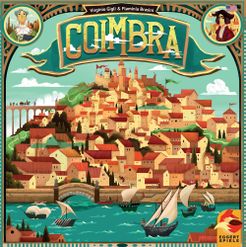
Coimbra is a four-round dice drafting and placement game in which die values determine priority and character costs, while die colors trigger influence income. Build a scoring plan through characters, monasteries and voyages.
Coimbra supports 2–4 players; community best: 3 players; playing time: 60–90 minutes. A WANGO browser trial has not been confirmed.
Background & introduction
Coimbra places competing family houses in Portugal during the Age of Discovery. Players seek the support of council members, merchants, clerics and scholars in a prosperous city known for its university. The rulebook frames protection as another way to secure influential citizens: some character cards require guards rather than coins. Recruiting these characters improves a family's influence and supplies immediate rewards, recurring abilities or final scoring opportunities.
The central decision is choosing a die from a shared pool and committing it to a location. Its value determines both its position in that location's queue and, in the three city districts, the price of a character. Its color separately determines which influence track supplies income later. A large value may secure early access to a desired card but make that card expensive; a small value is advantageous in the castle, where favors are free.
Pilgrims visit monasteries for rewards and abilities, while voyage investments qualify a player for specific final scoring tasks. The available combinations of monasteries, voyages and characters vary between games. The standard game lasts exactly four rounds, including income and investment in the last round. Players then add voyage scores, influence majorities, diploma sets, character bonuses and remaining resources to their running scores; the highest total wins.
Core rules & scoring
Scope and structure: These rules cover the 2018 eggertspiele / Plan B Games base game for 2–4 players, without expansions. Play four rounds, each with six phases: roll dice, draft and place dice, retrieve dice and take actions, establish a new player order, collect influence income, and invest in a voyage. Reaching the end of an influence track does not end the game early.
Shared setup: Randomly place eight level-I, four level-II and two level-III monasteries on their matching spaces. Reveal six random voyage cards. Randomly assign the four influence scoring tiles to the tracks, using the face for the player count. Separate character decks I, II and III; place shuffled II on top of shuffled III. Reveal four characters beside each of the upper, central and lower city locations, and display the four favor tiles beside the castle.
Player-count adjustments: Four players use all 13 dice and no neutral die tokens. Three players remove one purple and one green die, leaving 11 dice, and place fixed tokens of value 3 in the upper city, 4 in the central city and 3 in the lower city. Two players remove one gray, one orange, two purple and two green dice, leaving seven; place tokens 3 and 2 in the upper city, 4 and 3 in the central city, and 5 in the lower city. Tokens are not draftable dice.
Personal setup: Each player has three die holders, a pilgrim and matching markers. Start with seven coins, seven guards, zero points and zero on each influence track. Randomize player order and display one pair of start characters per player. In reverse order, each player either takes one available pair or occupies an empty starting corner of Coimbra. In forward order, everyone performs the other action. Apply both starting cards' influence and immediate rewards.
Character display and crowns: To distribute crown tokens each round, examine the fourth column from top to bottom, then the third, second and first columns as necessary. Place each class's token on the first encountered character of that class; leave it unused if the class is absent. A character's cost icon specifies coins or guards, its influence value specifies advancement on its class track, and its bonus symbol identifies when its ability operates.
Drafting and placement: The first player rolls the entire applicable dice pool once. In player order, take one die at a time, preserve its rolled value in an empty holder, and place it at one location. Continue until everyone has placed three dice. The castle queue runs from low to high; each city queue runs from high to low. Insert a new die to the right of existing equal values. Neutral tokens participate in sorting. There is no location capacity limit, and one player may place multiple dice in a location.
Retrieval and actions: Resolve the castle first, then the upper, central and lower city. Within each location, resolve dice from left to right rather than in player order. A castle die takes an available favor tile for free and applies its immediate reward. A city die acquires one character from that location's row, paying the die's value in the resource shown on the chosen card. Die color does not restrict character class. After the action, return the die in its holder to a shutter space on your board.
Acquiring characters and distress: Pay before receiving the acquired card's rewards. Gain its influence, resolve or position its own ability, apply any triggered phase-C starting-card bonus, and collect its crown token if present. If unable or unwilling to take the location's action, take the distress action instead: gain up to two coins and up to two guards. You cannot borrow resources or select a character from another row. Discard any characters left in a city row when that location finishes resolving.
Neutral tokens: When a neutral token becomes the leftmost unresolved item, discard the remaining character in that row with the highest printed influence value; break a tie by taking the leftmost tied card. Flip the token face down and continue. Flip it face up again when the location is finished. It neither belongs to a player nor collects income, and its value is not rerolled between rounds.
New order: Add crowns on tokens collected this round, favor tiles held this round, and the flag currently occupied by your lion. Rank players by this total, highest first. For equal totals, reverse the tied players' previous relative order. The new order immediately governs income and investment. Favor tiles and crown tokens are redistributed during preparation for the next round; they are not a permanently accumulating crown reserve.
Income: In the new order, each player activates their three returned dice once each, in a sequence of their choice. Gray uses the council track for guards, orange the merchant track for coins, purple the cleric track for pilgrim movement, and green the scholar track for points. Read the income box beside your marker; some higher boxes include additional rewards. White selects any one track. Multiple dice of one color each produce income, and die values have no effect in this phase. Apply phase-E character abilities at their specified times, then empty the holders.
Pilgrims and limits: Each movement step follows a road to the next stopover or monastery. Stopovers have no reward. Your first step leaves your starting corner along a one-way road; those roads cannot be used to return to Coimbra. On first reaching a monastery without your disk, place one and apply its reward at the indicated time. Later visits do not repeat that reward. Other pilgrims do not block movement; unused steps may be forfeited. Coins and guards are each capped at 20, influence at 15, and excess is lost.
Voyage investment: In phase F, each player may invest in one voyage, paying its printed coin or guard cost and marking it with a disk. Each player can invest in any particular voyage only once, but different players may invest in the same voyage. Other abilities can grant additional investment actions. A voyage normally scores its task at game end rather than immediately. An applicable favor discount operates while that favor remains in front of its owner.
Round end and influence scoring: After round four's investment phase, perform final scoring; in earlier rounds, reset favors and deal twelve new characters with newly allocated crown tokens. Score invested voyage tasks, then each influence track's printed ranking awards. A lower disk in a shared space ranks ahead. Disks at zero score nothing. Four players award the first three places; three players award the first two. In two-player games, second place scores only if at most three spaces behind the leader.
Other final points and victory: Form diploma sets with distinct symbols. Sets of one, two, three, four or five different diplomas score 1, 2, 4, 8 or 12 points. Wild diplomas substitute for a type, but no icon can belong to multiple sets. Resolve end-game character bonuses. Finally add remaining guards, coins and current crowns counted as in phase D, divide the combined total by two and round down for points. Add all final points to the running score. Most points wins; ties go to the tied player earlier in the current player order.
Rules & gameplay questions
Are higher-value dice always better?
No. High values act earlier in city rows, but also increase the price of the character you acquire. The castle instead resolves low values first, and its favors cost nothing. Color independently determines later income. A six that secures first choice can still lead to distress if you cannot pay six of the chosen card's required resource. Evaluate priority, affordability and income together.
Who acts first on equal values, and can I place several dice in one location?
A newly placed die goes to the right of existing equal values, so the earlier placement resolves first. This applies both to the ascending castle queue and descending city queues. Locations have no capacity limit and can contain several dice belonging to the same player. However, each player still drafts only three dice per round, and concentrating them does not guarantee enough remaining favors or characters.
What happens if I cannot afford a character or the display is empty?
Take the distress action: gain up to two coins and up to two guards, then retrieve the die normally. You may also choose distress voluntarily. Pay character costs using the icon on the chosen card; coins cannot freely replace guards, and the acquired card's reward cannot finance a cost you were unable to pay. The returned die still participates in the later income phase.
Does income use the die's value, and does white count as a chosen color for abilities?
Regular influence income uses color and your track position, not die value. Each die activates once, including repeated colors. White can select one track's income, but it is not a die of that color for abilities requiring colored dice. In particular, white does not count as purple for an ability checking whether you have no purple dice. Resource caps still apply while collecting income.
Can a pilgrim repeat monastery rewards, and can other pilgrims block it?
Other pilgrims do not block movement, and several may share a location. Place your disk and obtain the indicated reward only on your first visit to that monastery. Returning later does not repeat its first-visit reward. Each step reaches the next location along a road; stopovers have no effect, and you may stop before using the full allowance. The roads leaving Coimbra are one-way and cannot be followed back into the city.
How do the neutral die tokens remove characters?
At a token's turn, discard the remaining character in its row with the highest printed influence value. If tied, discard the leftmost of those tied cards. Flip the token down, continue the queue, and flip it up again after the location resolves. The token is a fixed sorting and removal mechanism, not a player: it is not drafted, rerolled or activated for income. Its removal is not chosen to target another player's plans.
How are influence ties, diploma sets and leftover resources scored?
A lower disk in a shared influence space ranks ahead; awards are not split. Zero scores nothing, and two-player second place requires a gap of at most three spaces. Diploma sets need distinct symbols, with each icon used once; wilds fill missing types. Combine guards, coins and current crowns before halving and rounding down, rather than halving each separately. A tied final score is resolved by current player order.
Rules & introduction sources
- Edition
- Coimbra, 2018 eggertspiele / Plan B Games base game for 2–4 players. Based on the publisher-authored 16-page English rulebook hosted by 1jour-1jeu; this third-party mirror is not represented as the publisher's current download service. No expansions or unverified variants.
- Introduction source
- BoardGameGeek
WANGO editorial
| Parameter | Recorded value |
|---|---|
| BGG overall rank (snapshot) | #268 |
| Complexity Weight | 3.24 / 5 |
| Best player count (community) | 3 |
| Player range | 2–4 |
| Playing time (minutes) | 60–90 |
| Core mechanisms | Action Drafting · Auction / Bidding · Dice Rolling · End Game Bonuses · Income · Open Drafting · Point to Point Movement · Set Collection · Tech Trees / Tech Tracks · Turn Order: Stat-Based · Variable Set-up · Worker Placement with Dice Workers |
| Chinese publication | Unconfirmed |
| WANGO browser play | No confirmed WANGO trial |
| Year published | 2018 |
| Suggested age | 14+ |
BGG statistics are stored snapshots, not live rankings. Source checked:2026-09-27
Player questions
What is the best player count for Coimbra, and can I play online?
Coimbra supports 2–4 players; community best: 3 players; playing time: 60–90 minutes. A WANGO browser trial has not been confirmed.
How complex is Coimbra, and which mechanisms does it use?
Weight: 3.24 / 5. Mechanisms: Action Drafting · Auction / Bidding · Dice Rolling · End Game Bonuses · Income · Open Drafting · Point to Point Movement · Set Collection · Tech Trees / Tech Tracks · Turn Order: Stat-Based · Variable Set-up · Worker Placement with Dice Workers. Chinese publication: Unconfirmed.
Where can I learn Coimbra?
No rule guide, strategy article or WANGO trial has been confirmed for this record.