That's Pretty Clever!
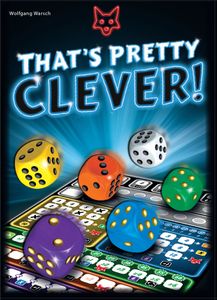
Choose dice, fill five scoring areas and turn bonuses into chains. A high value can help your sheet while sending smaller dice to the other players.
That's Pretty Clever! supports 1–4 players; community best: 2 players; playing time: 30 minutes. A WANGO browser trial has not been confirmed.
Background & introduction
That’s Pretty Clever uses shared dice and individual score sheets. As the active player you can roll and select up to three times, but dice lower than your chosen value move to the silver platter for the other players. Your choice shapes both your remaining options and theirs.
The five colors ask for different patterns: yellow completes columns, blue uses the blue-white sum, green meets successive thresholds, orange accumulates values and purple climbs upward. A white die substitutes for a color but still follows that area’s rules.
Completing important spaces, rows or columns grants additional marks that can trigger further bonuses. Foxes reward the weakest scoring area, while stored rerolls and extra-die actions offer flexibility. Official solo play alternates active and passive selections to challenge your previous score.
Core rules & scoring
The base game supports one to four players using the original score sheet. Play four rounds with four players, five with three, and six with one or two. Everyone is active once per round; take the indicated start-of-round bonuses in the first four rounds.
The active player rolls six dice, selects one onto their sheet and records its color and value. Move all lower-valued dice to the platter, then repeat with remaining dice for at most three selections. Platter dice normally cannot be rolled again.
After active selection, move the remaining dice to the platter. Each passive player chooses one platter die to record; several players may use the same die. Only when no platter die is usable may a passive player use a die on the active player’s sheet.
White can substitute for any color. Yellow marks one matching-number space and scores completed columns. Blue always uses the current blue-plus-white sum, even if the other die is already on the platter or a sheet; using only one value is not allowed.
Green, orange and purple progress left to right without gaps. Green must meet the next threshold; orange records the value with any printed multiplier; purple must exceed the previous value, except that any value may follow a six.
Resolve earned marking and number bonuses immediately rather than saving them. A bonus can trigger another bonus. Yellow and blue cross bonuses can mark any empty space; green marks its next space.
Earned reroll and extra-die actions may be saved. Only an active player may reroll, and must reroll all dice just thrown, rather than selecting a subset or rerolling dice already chosen or on the platter.
Extra-die actions occur after normal selection for the turn and are available to active and passive players. Choose any of the six dice, including one just used normally. Multiple actions are allowed, but each physical die can be chosen as an extra die only once per turn.
After the final round’s active and passive choices and extra-die actions, total the five colors and add the lowest color score for each fox. Highest total wins; ties compare the highest individual color score, then share victory.
Official solo lasts six rounds, alternating six active and six passive turns. On a passive turn roll all six dice and put the lowest three on the platter, breaking equal values by proximity to the platter. Still place only three dice, and do not use rerolls as a passive player.
Rules & gameplay questions
If blue is on the platter, does white still add it when used for blue?
Yes. The blue area always uses the current values of both dice, regardless of their positions. Ordinary die selection cannot use just one value.
Must a purple value still increase after a six?
No. Any value can follow six; subsequent entries must increase from that new value. Continue filling left to right.
Can I reject a legal platter option to use an active player’s selected die?
No. That exception applies only when none of the platter dice can legally be used.
Can two extra-die actions use the same white die twice?
Not as two extra selections in one turn. You may use it normally and once as an extra die. The blue die is a separate physical die and can also be selected, using the blue-white sum.
Can foxes ignore a color that scores zero?
No. Every fox uses the lowest of all five color scores. A zero in any area makes every fox worth zero.
Rules & introduction sources
- Edition
- Original eight-page English base rules currently hosted by Schmidt, produced in 2019: original score sheet for one to four players and official solo. Alternative sheets, Deluxe additions and later Clever titles are excluded.
- Rule references
- Introduction source
- BoardGameGeek
WANGO editorial
| Parameter | Recorded value |
|---|---|
| BGG overall rank (snapshot) | #203 |
| Complexity Weight | 1.85 / 5 |
| Best player count (community) | 2 |
| Player range | 1–4 |
| Playing time (minutes) | 30 |
| Core mechanisms | Dice Rolling · Paper-and-Pencil · Re-rolling and Locking · Solo / Solitaire Game |
| Chinese publication | Unconfirmed |
| WANGO browser play | No confirmed WANGO trial |
| Year published | 2018 |
| Suggested age | 8+ |
BGG statistics are stored snapshots, not live rankings. Source checked:2026-09-27
Player questions
What is the best player count for That's Pretty Clever!, and can I play online?
That's Pretty Clever! supports 1–4 players; community best: 2 players; playing time: 30 minutes. A WANGO browser trial has not been confirmed. Recorded mechanism tags: Solo / Solitaire Game.
How complex is That's Pretty Clever!, and which mechanisms does it use?
Weight: 1.85 / 5. Mechanisms: Dice Rolling · Paper-and-Pencil · Re-rolling and Locking · Solo / Solitaire Game. Chinese publication: Unconfirmed.
Where can I learn That's Pretty Clever!?
No rule guide, strategy article or WANGO trial has been confirmed for this record.