Space Base
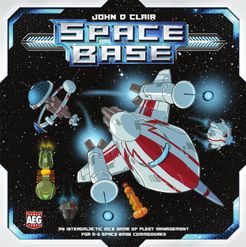
Keep new ships at your station and deploy the old ones: every player’s dice can help build your space economy.
Space Base supports 2–5 players; community best: 3–4 players; playing time: 60 minutes. A WANGO browser trial has not been confirmed.
Background & introduction
Space Base gives each player twelve numbered sectors. A replacement ship improves the station on your own turns while sending the previous ship into deployment, where it can earn rewards during other players’ turns. An upgrade changes both sides of that economy.
Whenever two dice are rolled, each player chooses between their separate values and their sum. The same roll can therefore serve very different fleets. Your sector layout determines whether two smaller rewards or one larger activation is more useful.
Credits, income and victory points serve different purposes. A normal purchase empties your credit reserve, while income provides a floor at the end of your turn. Colonies offer immediate points but close station positions, gradually turning construction into a race to finish.
Core rules & scoring
The base game supports 2–5 players. Set out twelve starting ships per player, with 5 credits, 0 income and 0 victory points; display six shipyard cards per level and the colonies. The random starting level-one ship costs only its printed price and replaces its sector; use the rulebook’s starting-player and position compensation procedure.
The active player rolls two six-sided dice. Each player independently allocates the two individual values or their sum to rewards; they need not copy the roller. Choosing separate equal dice rewards the same sector twice.
On your turn, receive the corresponding station ships’ blue rewards. On another player’s turn, receive the red rewards of every deployed ship in the corresponding sectors. Several deployed ships can accumulate in one sector.
At the normal purchase step, pass or buy one affordable shipyard ship or colony. A normal purchase spends all your current credits rather than just the printed price; explicit special purchase abilities follow their own instructions.
A purchased ship normally enters its printed sector at your station. Rotate and deploy the previous ship in that sector with its red area exposed. Refill the shipyard at the end of the turn; colonies have their own replacement restriction.
At the end of your own turn, raise credits to your income level only if credits are lower. Income does not add credits when you are already at or above that level. Play then passes clockwise.
A charge reward places a cube on an empty charge square; gaining a charge does not itself activate the ability. Remove the required cubes to activate it, including the full linked requirement where charge squares are connected.
Ability color and timing govern activation: blue on your turn, red on opponents’ turns and green on any turn. Dice adjustments have specified timing windows. When a charged ship deploys, its cubes can transfer to that same card’s red effect if it can accommodate them.
A colony immediately awards its printed victory points, occupies its station sector and deploys the previous ship. It provides no later station reward and cannot be replaced or deployed. Previously deployed red rewards in that sector remain available.
Normally, reaching at least 40 victory points triggers completion of the round so everyone has equal turns; highest score wins. A tie sends all players through another complete round, repeating until there is one leader. The explicit “You Win!” ability instead ends the game immediately in its user’s favor.
Rules & gameplay questions
Must I use the roller’s choice of separate dice or their sum?
No. Each player makes that choice independently and collects from their own applicable red or blue areas.
Does income 3 always give me another 3 credits?
No. It is a floor: 1 credit becomes 3, while a reserve of 5 stays at 5.
Does a Buy a Card ability cost the same as a normal purchase?
No. A normal purchase spends all current credits. This ability pays only the card’s actual price and still allows the normal purchase that turn. Claim effects obtain the specified card without payment.
Does replacing a ship make the old ship useless?
It becomes a deployed ship in that sector and provides red rewards on other players’ turns. Multiple ships can deploy there; they no longer provide their previous blue station rewards.
Does reaching 40 points win immediately?
Normally it only triggers completion of the round, followed by score comparison and further full rounds for everyone if tied. Explicit immediate-win abilities are exceptions.
Rules & introduction sources
- Edition
- Original base game for 2–5 players, using AEG’s currently linked base rulebook with 2018 body text and its included ability clarifications; checked 2026-10-26. The 2025 upload path is not treated as a new rules edition. Excludes Shy Pluto, Command Station and other expansions or variants.
- Rule references
- Introduction source
- BoardGameGeek
WANGO editorial
| Parameter | Recorded value |
|---|---|
| BGG overall rank (snapshot) | #229 |
| Complexity Weight | 2.14 / 5 |
| Best player count (community) | 3–4 |
| Player range | 2–5 |
| Playing time (minutes) | 60 |
| Core mechanisms | Dice Rolling · Open Drafting · Random Production |
| Chinese publication | Unconfirmed |
| WANGO browser play | No confirmed WANGO trial |
| Year published | 2018 |
| Suggested age | 14+ |
BGG statistics are stored snapshots, not live rankings. Source checked:2026-09-27
Player questions
What is the best player count for Space Base, and can I play online?
Space Base supports 2–5 players; community best: 3–4 players; playing time: 60 minutes. A WANGO browser trial has not been confirmed.
How complex is Space Base, and which mechanisms does it use?
Weight: 2.14 / 5. Mechanisms: Dice Rolling · Open Drafting · Random Production. Chinese publication: Unconfirmed.
Where can I learn Space Base?
No rule guide, strategy article or WANGO trial has been confirmed for this record.