Root
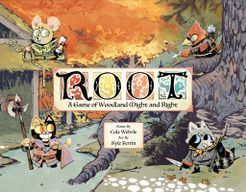
Four Woodland factions with different action systems compete through clearing control, shared cards, and distinct scoring engines.
Root supports 2–4 players; community best: 4 players; playing time: 60–90 minutes. A WANGO browser trial has not been confirmed.
Background & introduction
Root’s base game pits the Marquise de Cat, Eyrie Dynasties, Woodland Alliance, and Vagabond against one another. The Marquise builds through a wood economy; the Eyrie expand through roosts and an accumulating Decree; the Alliance spreads sympathy and revolts; the Vagabond manages items, quests, and relationships. They share a map but not an action system or scoring engine.
Shared rules connect these factions. Clearing suits determine card uses, warriors and buildings determine rule, paths constrain armies, and crafting or removing enemy buildings can generate points. Estimating an opponent’s next scoring burst can matter as much as counting their army.
Each player completes Birdsong, Daylight, and Evening before passing play clockwise. There is no universal three-action turn. The base box supports two to four players; this overview uses all four base factions, the autumn map, and Standard Setup. Changing player count or factions changes the conflict, and expansion or alternate-map rules do not automatically apply.
Core rules & scoring
Setup and turns: Randomize the starting player and seating order. Give each player their faction board, pieces, and three shared-deck cards; start scores at zero, place four ruins, form the item supply, and gather battle dice. Set up factions in faction setup order. Each player follows their own Birdsong, Daylight, and Evening, then passes play clockwise.
Victory and common scoring: The first player to reach 30 points wins immediately. If several reach 30 simultaneously, the tied player closest clockwise starting with the current player wins. Removing each enemy building or token normally scores one point, and crafting items also scores as instructed. Ordinary warriors are not a general source of points.
Rule and movement: Count each faction’s warriors plus buildings in a clearing. Normally the strict highest total rules; a tie for highest means no ruler. Tokens and the Vagabond pawn do not count. Move a positive number of warriors along a path to one adjacent clearing, normally ruling the origin or destination. Rivers are not ordinary paths. The Eyrie rule a highest-total tie if they have at least one Eyrie piece there; the Vagabond ignores rule for movement.
Cards and crafting: Bird cards normally substitute for other suits, but other suits cannot substitute for birds. Activate crafting pieces matching a card’s bottom-left cost, normally once per piece per turn: workshops for the Marquise, roosts for the Eyrie, sympathy for the Alliance, and hammers under the Vagabond’s rules. An item must remain in the supply to craft its card; duplicate persistent effects cannot be crafted. The Eyrie normally score only one point per crafted item, except with the Builder leader.
Battle: Resolve defender ambush and any foil, before-roll effects, both dice, after-roll effects, then count and deal hits. Normally the attacker takes the higher roll and defender the lower, capped by their warriors in the clearing; extra hits ignore this cap. Remove all your warriors there before choosing your buildings or tokens. The Alliance takes the higher roll when defending; the Vagabond’s roll cap uses undamaged swords, and hits damage items.
Marquise and Eyrie: The Marquise produces one wood per sawmill in Birdsong, may craft first in Daylight, then takes up to three actions plus one per bird card spent. Building requires a ruled clearing with an open slot and wood connected through ruled clearings, scoring the exposed track value. The Eyrie add one or two Decree cards in Birdsong, at most one bird, then resolve every card in Recruit, Move, Battle, and Build column order. Failure causes turmoil: lose points for Decree birds, purge and replace the leader, end Daylight, then still score the roost track in Evening.
Alliance and Vagabond: The Alliance spends a separate Supporters stack for Birdsong revolts and sympathy, crafts, mobilizes, and trains in Daylight, then takes military operations up to its officer count in Evening. Spreading sympathy or organizing scores the exposed track value. The Vagabond exhausts undamaged items for Daylight movement, battle, aid, exploration, quests, and other actions, refreshing and optionally slipping in Birdsong. It has no army and cannot rule; quests, relationship improvements, exploration, and qualifying hostile battles provide points.
Dominance: During Daylight with at least ten points, activate a dominance card from hand, remove your score marker, and stop scoring points. Fox, rabbit, or mouse dominance requires ruling three matching clearings at the start of your Birdsong; bird dominance requires ruling two opposite corners then. An activated card cannot be replaced. Discarded dominance cards become available beside the map and may be taken during Daylight by spending a matching card. The Vagabond uses its coalition exception; two-player Standard Setup removes all dominance cards.
Rules & gameplay questions
How does the Vagabond form a coalition?
With at least four players, the Vagabond can activate dominance during Daylight with at least ten points to join the lowest-scoring other player who is not already in a coalition, choosing among tied lowest players. It stops scoring and shares that partner’s victory. This differs from an Allied relationship gained through Aid.
Does every faction take three Daylight actions?
No. The Marquise normally has three and can spend birds for more; the Eyrie must fulfill the Decree; the Alliance mainly takes military operations in Evening according to its officers; the Vagabond pays for actions by exhausting items.
Can buildings absorb battle hits before warriors?
No. You choose the order of your own removals, but all your warriors in that battle clearing must go before your buildings or tokens. The Vagabond has no warriors and follows its item-damage rules.
Does destroying a Marquise building erase its previous construction points?
Normally no. The remover scores one point per enemy building or token removed; the building returns to its faction board, affecting development and future construction rather than reversing earlier points.
May we freely exchange cards or enforce negotiated deals?
Cards can only be given when a rule explicitly permits it. Players may discuss the game and make agreements, but those agreements are not binding.
Rules & introduction sources
- Edition
- Physical base game: four base factions, autumn map, four-player Standard Setup. Uses The Law of Root dated October 13, 2025; the older learning guide is explanatory only. Excludes expansion factions, alternate decks, hirelings, landmarks, and Advanced Setup.
- Rule references
- Introduction source
- BoardGameGeek
WANGO editorial
| Parameter | Recorded value |
|---|---|
| BGG overall rank (snapshot) | #34 |
| Complexity Weight | 3.84 / 5 |
| Best player count (community) | 4 |
| Player range | 2–4 |
| Playing time (minutes) | 60–90 |
| Core mechanisms | Action Points · Action Queue · Action Retrieval · Area Majority / Influence · Area Movement · Dice Rolling · Hand Management · Multi-Use Cards · Negotiation · Point to Point Movement · Race · Sudden Death Ending · Take That · Variable Player Powers · Variable Set-up |
| Chinese publication | Unconfirmed |
| WANGO browser play | No confirmed WANGO trial |
| Year published | 2018 |
| Suggested age | 14+ |
BGG statistics are stored snapshots, not live rankings. Source checked:2026-09-26
Player questions
What is the best player count for Root, and can I play online?
Root supports 2–4 players; community best: 4 players; playing time: 60–90 minutes. A WANGO browser trial has not been confirmed.
How complex is Root, and which mechanisms does it use?
Weight: 3.84 / 5. Mechanisms: Action Points · Action Queue · Action Retrieval · Area Majority / Influence · Area Movement · Dice Rolling · Hand Management · Multi-Use Cards · Negotiation · Point to Point Movement · Race · Sudden Death Ending · Take That · Variable Player Powers · Variable Set-up. Chinese publication: Unconfirmed.
Where can I learn Root?
Available resources: Strategy https://wangogame.com/wiki/analysis/root