Twilight Imperium: Fourth Edition
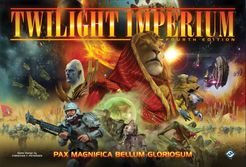
Lead an interstellar faction through warfare, trade, diplomacy and politics to claim leadership of the galaxy.
Twilight Imperium: Fourth Edition supports 3–6 players; community best: 6 players; playing time: 240–480 minutes. A WANGO browser trial has not been confirmed.
Background & introduction
Distinct interstellar factions compete for leadership in a galaxy assembled from modular system tiles. Military expansion matters alongside negotiation, trade, technology and political decisions. Your faction and the arrangement of planets and hazards create a different strategic setting each game.
Each round begins with players choosing strategy cards that determine turn order and grant powerful actions. Fleets then travel between systems, planets change hands and players decide how to spend their limited opportunities. Political agendas can change the conditions facing everyone.
Victory comes from completing objectives, rather than simply holding the most territory. Public objectives emerge over the game, while secret objectives offer personal routes to points. The first player to reach ten points wins. Effective planning keeps scoring opportunities in view while managing other factions’ promises and threats.
Core rules & scoring
Each round proceeds through the strategy, action and status phases. Once the custodians token is removed from Mecatol Rex, add the agenda phase after status from that round onward. Choose strategy cards clockwise from the speaker: 1 each with 5–6 players, or repeat selection until everyone has 2 with 3–4 players. Your lowest-numbered strategy card determines initiative order.
During the action phase, take turns in initiative order, performing 1 tactical, strategic or component action at a time. You may pass for the remainder of the phase only after exhausting all your strategy cards. A strategic action resolves your primary ability, then lets other players pay the relevant costs to use the secondary. Passed players may still use secondaries; you cannot use your own card’s secondary. After everyone passes, proceed to status.
A tactical action proceeds through activation, movement, space combat, invasion and production. Place 1 token from your tactic pool in the active system; you cannot activate a system already containing your token. Ships must reach it within their move values and normally cannot pass through enemy ships. They cannot begin a tactical move from another system that already contains one of your command tokens; this prohibition does not apply to ships already in the active system. Ships with capacity may transport fighters and ground forces.
Opposing ships in the same system resolve space combat. Roll for units using their combat values; results equal to or above the value produce hits, which each side assigns to its own units. Invasion commits ground forces to planets and may require ground combat; gain control of an invaded planet only if your ground forces remain there. Your fleet-pool tokens normally limit your non-fighter ships in each system. Fighters and ground forces in space normally require capacity; a standard space dock allows up to three fighters in its system not to count against your ships’ capacity. Specific faction, technology and unit abilities override the general rules only as their text allows.
Production normally uses space docks in the active system. Pay units’ resource costs and obey the number of units allowed by production capacity. Exhaust a planet card to spend its resources or influence; excess value is lost. Newly acquired planet cards enter exhausted. Each trade good can substitute for 1 resource or 1 influence. Research must meet technology prerequisites; technology colors and unit upgrades shape subsequent abilities.
Commodities cannot themselves pay resource or influence costs; they become the recipient’s trade goods when given to another player. During the action phase, the active player may transact with each neighbor at most once per turn; agenda voting allows transactions with non-neighbors. Deals that can be fully resolved immediately are binding, while promises of future actions are not enforced.
During status, score in initiative order, at most 1 public and 1 secret objective each. This limit applies to status-phase scoring. Action-phase objectives follow their own timing, with at most one objective scored during or after each combat. Then reveal a new public objective, draw 1 action card each, remove board command tokens, gain 2 tokens and redistribute, ready cards, repair units and return strategy cards. The agenda phase resolves 2 votes in sequence. Exhaust planets to vote with their influence; the speaker breaks ties. Planets do not ready between votes, but ready at the end of the agenda phase.
The first player to reach 10 victory points wins immediately in a standard game. Objectives must be fulfilled at their specified timing and cannot be scored repeatedly. Scoring public objectives also requires control of every planet in your home system. You may hold at most 3 scored and unscored secret objectives combined. If a public objective must be revealed but none remain, end immediately: highest score wins, with initiative breaking ties. Simultaneous tenth points also use initiative; without strategy cards, priority runs clockwise from the speaker, including the speaker.
Rules & gameplay questions
Why can a newly produced fleet usually not leave in the same round?
Production in a tactical action follows activation, so your command token is already in that system and normally prevents ships from leaving. Removing it with Warfare’s primary ability can lift this restriction. Warfare’s secondary produces in your home system without itself requiring activation, so production does not always lock ships down. Other explicit exceptions follow their ability text.
Can I score a public objective after losing a home planet?
No. When scoring a public objective, you must control every planet in your home system and fulfill the objective at its specified timing; having met it earlier is insufficient. The home-system restriction does not automatically apply to secret objectives or abilities that award points directly.
Can a planet pay resources and cast votes at once? Can trade goods buy votes?
Spending a planet’s resources or influence exhausts it; one exhaustion cannot provide both. Status readies planets, allowing them to vote in the following agenda phase, but they do not ready between its two votes. Trade goods can pay influence costs, but cannot directly substitute for agenda votes.
After passing, may I still use another player’s strategy secondary?
Yes. Passing ends your active turns in that action phase, but you may still pay to use other players’ secondaries. With 5–6 players, exhaust your 1 strategy card before passing; with 3–4 players, exhaust both.
Does the agenda phase disappear if nobody later controls Mecatol Rex?
No. The condition is removal of the custodians token, not current ownership. Normally the first landing requires spending 6 influence to remove the token, earning 1 point. You must be able to commit at least one ground force and then actually land it; paying influence alone is not sufficient. Every round from then on includes an agenda phase; specific faction exceptions follow their abilities.
Rules & introduction sources
- Edition
- Twilight Imperium: Fourth Edition base game for 3–6 players, standard 10-point game; official 2020 Learn to Play plus base-game rules and corrections in Living Rules Reference v2.0. Excludes Third Edition, Prophecy of Kings, Thunder’s Edge, Codex replacement components and the optional 14-point game.
- Rule references
- Introduction source
- BoardGameGeek
WANGO editorial
| Parameter | Recorded value |
|---|---|
| BGG overall rank (snapshot) | #7 |
| Complexity Weight | 4.37 / 5 |
| Best player count (community) | 6 |
| Player range | 3–6 |
| Playing time (minutes) | 240–480 |
| Core mechanisms | Action Drafting · Area-Impulse · Dice Rolling · Follow · Grid Movement · Hexagon Grid · Increase Value of Unchosen Resources · King of the Hill · Modular Board · Movement Points · Player Elimination · Race · Tech Trees / Tech Tracks · Trading · Variable Phase Order · Variable Player Powers · Variable Set-up · Voting |
| Chinese publication | Unconfirmed |
| WANGO browser play | No confirmed WANGO trial |
| Year published | 2017 |
| Suggested age | 14+ |
BGG statistics are stored snapshots, not live rankings. Source checked:2026-09-26
Player questions
What is the best player count for Twilight Imperium: Fourth Edition, and can I play online?
Twilight Imperium: Fourth Edition supports 3–6 players; community best: 6 players; playing time: 240–480 minutes. A WANGO browser trial has not been confirmed.
How complex is Twilight Imperium: Fourth Edition, and which mechanisms does it use?
Weight: 4.37 / 5. Mechanisms: Action Drafting · Area-Impulse · Dice Rolling · Follow · Grid Movement · Hexagon Grid · Increase Value of Unchosen Resources · King of the Hill · Modular Board · Movement Points · Player Elimination · Race · Tech Trees / Tech Tracks · Trading · Variable Phase Order · Variable Player Powers · Variable Set-up · Voting. Chinese publication: Unconfirmed.
Where can I learn Twilight Imperium: Fourth Edition?
No rule guide, strategy article or WANGO trial has been confirmed for this record.