Obsession
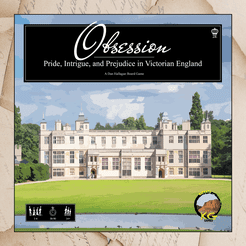
Manage a Victorian country estate, coordinating guests and servants, improving the property and family reputation, and competing for the Fairchild family’s favour.
Obsession supports 1–4 players; community best: 2 players; playing time: 30–90 minutes. A WANGO browser trial has not been confirmed.
Background & introduction
Obsession takes place among the landed families of nineteenth-century Derbyshire. Each household seeks to restore its estate and reputation by entertaining influential guests and pursuing a connection with the wealthy Fairchild family.
Improvement tiles determine which activities you can host; family and guest cards supply attendees, while servants meet their service requirements. Successful hospitality brings money, reputation and new connections, but played guests enter your discard pile and staff need time to recover.
Each season’s courtship theme puts a particular improvement category in the spotlight, and final courtship revisits all four themes. Secret objectives provide additional priorities, making estate investment, service capacity and valuable guests competing demands.
Core rules & scoring
A standard game has four seasons, each with three player rounds and one courtship event: 16 track spaces but 12 turns per player. Extended play has four player rounds per season: 20 spaces and 16 turns. Courtship spaces grant no player turns or service rotation.
The four base families have different starting bonuses: Asquith gains the Dowager Countess card; Cavendish starts at reputation level 1, position 4; Ponsonby gains £300; York gains a footman. Ordinary family cards have no prestige rating or personal service needs, although their activity tile may still require staff.
Choose either hosting or passing. To host, use an owned activity tile, play the exact required number and types of gentry, and meet prestige ratings and service needs. Reputation determines which tiles and cards can be played, rather than which can be bought or acquired.
Before hosting, rotate service: Servants’ Quarters to Available Service, then Expended Service to Servants’ Quarters, moving each servant only once; check track events and ongoing effects. At cleanup, played gentry enter your discard pile and used servants enter Expended Service, so all staff do not automatically recover next turn.
Enjoy activity and gentry favours, then normally buy at most one improvement. Ordinary activity tiles must upgrade after first use and remain upgraded thereafter. Hybrid tiles flip after each use, changing their active category.
Passing fully refreshes servants, returns discarded gentry to hand, resolves track and ongoing effects, then grants a base passing benefit of £200 or a market refresh; you may still buy an improvement. Hiring when passing is optional in a base-only game.
Discard one secret objective at every courtship. Ties in the first three courtships give each tied player a VP card but no Fairchild; final courtship uses reputation level to break a theme-score tie. Under the current compendium, refresh the market after each of the first three seasons: Service tiles enter the Reserve after season one, except the Largest Wine Cellar monument, and PR1 tiles after season two.
The first three courtships compare tiles matching that season’s theme; final courtship totals all four themes, counting repeated categories again. Final scoring adds improvements, gentry, objectives, reputation, unused VP cards, 2 VP per servant and 1 VP per £200 rounded down, including negative tile and guest values.
Rules & gameplay questions
Must newly acquired guests be revealed?
Yes. Reveal a newly invited guest before adding it to your hand. When screening guests, reveal only those kept; return rejected cards to the bottom of the appropriate deck.
Can I buy a tile or acquire a guest above my reputation level?
Yes. Prestige ratings restrict playing tiles and cards, not buying or drawing them. Their VP still count at game end.
How are tied final scores resolved?
Among tied players, the player who claimed a Fairchild in final courtship wins. Otherwise compare reputation level, ignoring the marker’s position around the wheel. If still tied, share victory.
Can the base box be played solo?
Yes, in standard length against a base opponent. The d20 and AI card remove market tiles; the opponent uses printed courtship scores and a fixed final score plus rewards. Solo reveals themes at courtship, uses its own courtship tie rewards for both sides, and awards you victory if you equal or exceed the opponent’s final score. Extended solo requires a compatible expansion opponent card; multiplayer tiebreakers do not transfer unchanged.
Do Wessex and Upstairs, Downstairs only add families?
No. Wessex uses the base rules while adding a family, cards and tiles. Upstairs, Downstairs adds four servant types and other mechanisms; Characters adds characters and second chance servants. These expansions are not enabled here. Hiring when passing remains optional with the base game alone.
Rules & introduction sources
- Edition
- Current Kayenta Universal Rules Compendium (official-linked file dated 2025-12-17, 118 pages) and Corrigendum 1.0 (2026-10-06); base 2–4-player standard/extended play and a base solo overview. Uses the compendium’s default seasonal market refresh. The 2.3E printing includes hybrid tiles and the Reserve; older printings need not have identical components. Excludes Wessex, Upstairs, Downstairs, Characters, promos and other variants; extended solo needs compatible opponent cards.
- Rule references
- Introduction source
- BoardGameGeek
WANGO editorial
| Parameter | Recorded value |
|---|---|
| BGG overall rank (snapshot) | #67 |
| Complexity Weight | 3.12 / 5 |
| Best player count (community) | 2 |
| Player range | 1–4 |
| Playing time (minutes) | 30–90 |
| Core mechanisms | Action Retrieval · Closed Drafting · Deck, Bag, and Pool Building · Hand Management · Solo / Solitaire Game · Worker Placement |
| Chinese publication | Unconfirmed |
| WANGO browser play | No confirmed WANGO trial |
| Year published | 2018 |
| Suggested age | 14+ |
BGG statistics are stored snapshots, not live rankings. Source checked:2026-09-27
Player questions
What is the best player count for Obsession, and can I play online?
Obsession supports 1–4 players; community best: 2 players; playing time: 30–90 minutes. A WANGO browser trial has not been confirmed. Recorded mechanism tags: Solo / Solitaire Game.
How complex is Obsession, and which mechanisms does it use?
Weight: 3.12 / 5. Mechanisms: Action Retrieval · Closed Drafting · Deck, Bag, and Pool Building · Hand Management · Solo / Solitaire Game · Worker Placement. Chinese publication: Unconfirmed.
Where can I learn Obsession?
No rule guide, strategy article or WANGO trial has been confirmed for this record.