Azul
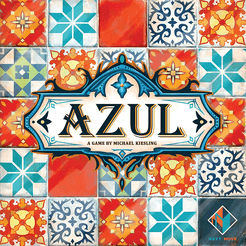
Draft matching tiles from factories and the table center, prepare pattern lines, and decorate the palace walls in Evora for points.
Azul supports 2–4 players; community best: 2 players; playing time: 30–45 minutes. A WANGO browser trial has not been confirmed.
Background & introduction
Michael Kiesling’s Azul draws on the story of Portugal’s King Manuel I admiring Moorish tiles at the Alhambra in Spain and wanting similar decoration for his own palace. Players tile the walls of the Royal Palace of Evora.
Each round has a factory offer, wall-tiling, and preparation phase. Players take every tile of one color from a single factory or the center and assign the batch to one legal pattern line. Excess tiles enter the floor line; the first player taking from the center also takes the starting player marker.
Once all public tiles are gone, each complete pattern line supplies one tile to the matching wall row, scoring continuous horizontal and vertical connections. Incomplete lines carry over and the floor costs points. A completed wall row ends the game after that round’s wall-tiling; final bonuses help determine the highest score.
Core rules & scoring
Setup: Use 5, 7, or 9 factories with 2, 3, or 4 players, respectively, and deal four random tiles to each. Everyone uses the colored wall, starts at zero points, and draws from a bag containing 100 tiles in five colors.
Draft clockwise: Take all tiles of one color from one factory and push its other tiles to the center, or take all tiles of one color from the center. The first center drafter places the starting marker in the leftmost free floor space and starts next round.
Pattern lines: Assign each batch to a single line, filling right to left. An occupied line accepts only its existing color; a color already present in the corresponding wall row is forbidden. Excess tiles go to the floor, and unwanted tiles may be placed there directly.
Wall-tiling: When every factory and the center are empty, resolve complete pattern lines top to bottom. Move only the rightmost tile to the matching color space of its wall row and score immediately. Store the line’s remaining tiles in the box lid; incomplete lines stay.
Connections: An isolated new tile scores one point. For each horizontal or vertical connection, score the whole continuous line including the new tile. If both directions connect, score both separately, counting the new tile in both; diagonals and gaps do not connect.
Floor penalties: After tiling, subtract each occupied floor space’s printed penalty, including the starting marker, without dropping below zero. Move floor tiles to the lid and keep the marker in front of its owner. Tiles beyond a full floor go directly to the lid.
Refill and ending: Unless a wall row is complete, refill every factory with four tiles. Refill an empty bag from the lid; if both run out, begin with partially filled factories. A completed five-tile wall row ends the game after all wall-tiling and floor penalties that round.
Final bonuses: Add two points per complete horizontal row, seven per complete vertical column, and ten per color with all five tiles on the wall. Highest score wins; tied players compare completed horizontal rows, then share victory if still tied.
Rules & gameplay questions
Can I take just one blue tile from a factory holding two blue, one red, and one yellow?
No. Take both blue tiles and move red and yellow to the center. Taking blue from the center likewise means taking all blue tiles there, without adding tiles from another factory.
Can three drafted blue tiles fill two different pattern lines?
No. The batch goes to one legal line, right to left. An existing line must match, and its wall row cannot already contain blue. Excess goes to the floor; you may instead put the whole batch on the floor.
Do I move a tile to the wall immediately when its pattern line fills?
No. Wait until the factories and center are empty, then process full lines top to bottom. Move one tile per full line, score it, discard the others to the lid, and leave incomplete lines in place.
A new tile makes a horizontal pair and a vertical pair. Is that three points?
It scores four: each pair includes the new tile and scores separately. A connection in only one direction scores that line alone; no connections scores one. Diagonal tiles and tiles beyond gaps do not count.
What happens if floor penalties would make my score negative, or the bag runs out?
Your score stops at zero. Cleared floor tiles enter the lid and the marker stays with its owner. When refilling factories, refill an empty bag from the lid; if both are empty, start the round with partially filled factories.
Rules & introduction sources
- Edition
- Original Azul for 2–4 players, standard colored-wall game, using the copyright 2018 English rules hosted officially in 2024. Excludes the gray-wall variant, Crystal Mosaic, special chocolate-edition factories, and standalone games such as Summer Pavilion and Queen’s Garden.
- Rule references
- Introduction source
- BoardGameGeek
WANGO editorial
| Parameter | Recorded value |
|---|---|
| BGG overall rank (snapshot) | #99 |
| Complexity Weight | 1.77 / 5 |
| Best player count (community) | 2 |
| Player range | 2–4 |
| Playing time (minutes) | 30–45 |
| Core mechanisms | Chaining · End Game Bonuses · Grid Coverage · Open Drafting · Pattern Building · Set Collection · Square Grid · Tile Placement · Turn Order: Claim Action |
| Chinese publication | Unconfirmed |
| WANGO browser play | No confirmed WANGO trial |
| Year published | 2017 |
| Suggested age | 8+ |
BGG statistics are stored snapshots, not live rankings. Source checked:2026-09-26
Player questions
What is the best player count for Azul, and can I play online?
Azul supports 2–4 players; community best: 2 players; playing time: 30–45 minutes. A WANGO browser trial has not been confirmed.
How complex is Azul, and which mechanisms does it use?
Weight: 1.77 / 5. Mechanisms: Chaining · End Game Bonuses · Grid Coverage · Open Drafting · Pattern Building · Set Collection · Square Grid · Tile Placement · Turn Order: Claim Action. Chinese publication: Unconfirmed.
Where can I learn Azul?
Available resources: Strategy https://wangogame.com/wiki/analysis/azul