Star Realms: Frontiers
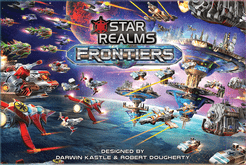
Star Realms: Frontiers is a science-fiction deck-building game. Recruit Ships and Bases, combine faction abilities, and attack rival fleets; Challenge cards add solo and cooperative boss battles.
Star Realms: Frontiers supports 1–4 players; community best: 2 players; playing time: 20–45 minutes. A WANGO browser trial has not been confirmed.
Background & introduction
Star Realms: Frontiers places players in a science-fiction struggle among rival powers on the edge of known space. Each player commands a personal deck representing a fleet, recruits Ships and Bases from a shared Trade Row, and combines faction abilities. New purchases gradually turn a deck of basic Scouts and Vipers into a more distinctive armada. Players must build an economy while protecting Authority, the measure of their survival in a standard duel.
In a standard game, players play cards during a Main Phase to gain Trade, Combat, and Authority, then use those resources to acquire cards, attack opponents, or destroy Bases. Faction cards can trigger Ally abilities, and Frontiers adds Double Ally abilities that reward a focused faction deck. Ships usually remain in play only for the current turn, while Bases can continue providing abilities and shielding a player from attacks until they are destroyed or scrapped.
Frontiers differs from a basic head-to-head deck-builder because it includes eight oversized Challenge cards for solo play or cooperative boss fights. Each Challenge sets the Boss's Authority, special attacks, and victory condition. Players still use the regular deck, Trade Row, and turn structure, but change the setup and Boss actions according to the Challenge. The box can support direct player-versus-player play as well as a small team working together to overcome a scenario.
Core rules & scoring
Goal and scope: Frontiers is a standalone deck-building game for 1–4 players. In standard combat, reduce an opponent's Authority to zero to win; multiplayer formats follow their own team and targeting rules. In solo or cooperative play, use a Challenge card to fight a Boss and satisfy its stated objective. The box contains 152 cards: an 80-card Trade Deck, 8 oversized Challenge cards, starting decks, Explorers, and scorecards. Other expansions and Command Decks are outside this base setup.
Standard setup: Each player takes a 10-card starter deck of 8 Scouts and 2 Vipers and starts at 50 Authority. Place the 16 Explorers in a separate public pile, shuffle the Trade Deck, and leave space for the shared Scrap Heap, separate from each personal Discard Pile. Reveal five cards to form the Trade Row. In a two-player game, randomly choose who goes first; the first player draws three cards for the first turn and the second player draws five. Later turns normally draw five. Set Challenge cards aside unless choosing a solo or cooperative game.
Turn sequence: Players alternate turns. Each turn has a Main Phase, Discard Phase, and Draw Phase. During the Main Phase, play cards, use Primary abilities of Bases in play, use Ally or Scrap abilities of Ships and Bases, acquire cards with Trade, and attack with Combat in any order. These actions may be repeated as often as permitted. During Discard, lose unused Trade and Combat, discard Ships from play and remaining hand cards; during Draw, draw five new cards.
Cards, abilities and factions: A Ship’s Primary ability resolves when played. Choose when to use a Base’s Primary ability during your own Main Phase; each ability is usable once per turn, not repeatedly. Bases remain across turns. Two same-faction cards in play trigger the relevant Ally abilities regardless of play order; Double Ally needs two other cards, making three in total. Triggering and using are separate: while the ability’s card remains in play, a triggered Ally ability may be used later in that Main Phase. Hand, discard and teammate cards do not supply your faction count. Authority can exceed its starting fifty.
Buying and deck cycling: Spend Trade during the Main Phase to acquire a card from the Trade Row or an Explorer. Put the new card in your Discard Pile; acquiring it is not playing it, so buying alone does not resolve its abilities. When a card is acquired or scrapped from the Trade Row, immediately reveal a replacement to keep five cards available. If you need to draw five but your deck is short, draw the remaining cards, shuffle your Discard Pile into a new deck, and draw the rest. A later draw effect in this same turn can shuffle and draw a newly bought card, which can then be played normally; there is no blanket prohibition until a future turn. Scrapped cards go to the Scrap Heap and do not return to your deck.
Combat, Bases, and defense: Combat can be spent on any number of attacks during your Main Phase. Attacking a player reduces their Authority by the amount spent. Destroying a Base requires spending at least its Defense in one turn; the Base is then destroyed and placed in its owner's Discard Pile. Partial damage is removed at the end of the turn. An Outpost protects its owner from direct attacks and protects their non-Outpost Bases from attack or targeting until every Outpost is destroyed.
Scrapping and cleanup: A Ship or Base with a Scrap icon may be removed from play during the Main Phase to its Scrap Heap for its Scrap ability. If another effect scraps a card, that card does not gain its own Scrap ability. At the end of the Main Phase, unused Trade and Combat are lost. Ships and leftover hand cards go to the Discard Pile, while Bases stay in play. Authority gained from card effects increases the score; damage reduces it. At zero or lower Authority, a player is eliminated or the game ends according to the selected format.
Multiplayer with one box: Free-for-All and Hunter support three or four with the supplied decks; opening hands are three/four/five by seat. Free-for-All permits any targets and last survivor wins. Hunter attacks only the player to the left and Bases to either side; after elimination the next left player becomes the target. Four-player Two-Headed Hydra has 75 shared Authority per team and simultaneous team phases. Each player keeps a separate play area, but Trade and Combat can transfer within the team; Ally counts remain individual. Raid has one human Boss against the Raiders, unlike automated challenges. Six-player Emperor or Three-Headed Hydra require extra starting cards beyond this box.
Solo and co-op: Select a challenge and read both sides of its oversized card plus the matching manual section before setting players, Authority, decks and team rules. Most allow 1–4 players, but Defy the Empire allows only 1–3. Common difficulty gives players three/two/one turns before the Boss, or lets the Boss start; a challenge’s own difficulty table overrides this. Once per entire challenge, one player may scrap the whole Trade Row during a Main Phase and refill it; this is not once per player. Follow the Boss script. Normal Boss attacks prioritize a legal lethal hit on the highest-Authority defeatable player, then destroyable Outposts and other Bases, then the lowest-Authority player, always respecting Outpost protection. Victory objectives vary. Among destroyable Bases choose the highest Defense, then highest cost, then randomly if tied. Spend only the minimum Combat needed for each lethal hit or destruction.
Rules & gameplay questions
Can Star Realms: Frontiers be played solo?
Yes. The box includes eight oversized Challenge cards that let one player face a game-controlled Boss or let a team cooperate against it. Each Challenge describes the Boss's Authority, special actions, setup, and victory objective. A standard opponent normally starts at 50 Authority, but Boss and player values can change by Challenge and player count. Do not treat a Challenge as a standard deck-builder without an opponent; follow its dedicated rules.
What cards and Authority does each player start with?
The standard starter deck has eight Scouts and two Vipers, and each player begins with 50 Authority. Reveal five cards for the Trade Row, keep the 16 Explorers in a separate public pile, and shuffle the remaining Trade Deck. In a standard two-player game, the first player draws three cards on the first turn and the second player draws five; later turns draw five. Multiplayer formats and Challenges may adjust starting hands, team Authority, or Boss values.
Can I play a Ship immediately after buying it?
Buying itself does not play the card: put it into your personal Discard Pile. That is not a prohibition for the rest of the turn. A later draw effect can exhaust your deck, shuffle the discard and draw the newly bought Ship, which may then be played normally. Without such a draw it usually waits for a future hand. Refill the Trade Row immediately after a purchase; remaining Trade may buy that new offer too, but disappears during Discard.
How do Ships and Bases differ at the end of a turn?
A Ship resolves its ability when played and stays on the table until the Discard Phase, when it enters its owner's Discard Pile. A Base remains in play across turns and allows its Primary ability once in each of its owner’s Main Phases and provides defense until it is destroyed or scrapped. Some Ships and Bases have Ally or Double Ally abilities that depend on the number of same-faction cards you already have in play. A teammate's cards are not in your play area and do not count toward your Ally condition.
How does an Outpost protect a player?
While any Outpost remains, opponents cannot directly attack your Authority or attack/target your ordinary Bases. Clear all Outposts before choosing those targets. Destroy a Base by paying the required Defense in Combat; damage that fails to destroy it does not persist across ordinary turns. For example, Outposts with Defense four and six must both be dealt with before leftover Combat hits the player. An ability targeting a Base still respects Outpost protection unless an explicit card exception says otherwise.
Can unused Trade and Combat carry over to a later turn?
No. Unspent Trade and Combat vanish during Discard, while Authority remains. One Trade cannot be saved to join next turn’s resources to buy an Explorer, and two unused Combat cannot carry into the next attack turn. Within the Main Phase you can interleave playing, buying and generating more resources from Bases or Allies, but each ability still works once. Discard bought cards, played Ships and remaining hand cards, keep Bases in play, then draw five.
What is the difference between Ally and Double Ally abilities?
Ally needs one other same-faction card in play; Double Ally needs two others, without counting the ability card twice. Play order does not matter: meeting the count triggers relevant abilities on those cards. While its card remains in play, a triggered ability can wait until later in the Main Phase rather than resolving immediately. Hand, discard and teammate cards do not count, and later faction cards do not let the same once-per-turn ability activate repeatedly.
Does every cooperative Challenge end by reducing the Boss to zero Authority?
No. Dimensional Horror has no Boss Authority: destroy its four faction tentacles instead, with individual player turns followed by a Boss response against that player. Other challenges use Hydra-style shared Authority, such as Automatons granting sixty per player to the team total. Do not give every cooperative game fifty Authority or one universal script. Defy the Empire is limited to three players; check both card sides and the matching manual, not just the box’s four-player capacity.
Do scrapped cards return to my deck later?
No. A scrapped card goes to the shared Scrap Heap and does not return to your Personal Deck or Discard Pile. If a card has its own Scrap ability, you may remove it during the Main Phase to gain that ability; if a different effect scraps the card, its Scrap ability does not trigger. Explorers are the exception: when scrapped, they return faceup to the Explorer pile rather than staying in the Scrap Heap.
Rules & introduction sources
- Edition
- Wise Wizard Games Star Realms: Frontiers standalone box, BGG 230253, checked against the official English Frontiers RuleBook2. One box supports 1–4 players. This entry covers the standard two-player core, multiplayer formats possible with the box and common solo/co-op challenge rules. Each challenge also requires its oversized card’s front/back and matching manual section; Defy the Empire is limited to 1–3 players. Five- and six-player formats need extra starting cards; other sets and Command Deck rules are excluded.
- Rule references
- Introduction source
- BoardGameGeek
WANGO editorial
| Parameter | Recorded value |
|---|---|
| BGG overall rank (snapshot) | #319 |
| Complexity Weight | 1.88 / 5 |
| Best player count (community) | 2 |
| Player range | 1–4 |
| Playing time (minutes) | 20–45 |
| Core mechanisms | Cooperative Game · Deck, Bag, and Pool Building · Open Drafting · Player Elimination · Solo / Solitaire Game · Take That |
| Chinese publication | Unconfirmed |
| WANGO browser play | No confirmed WANGO trial |
| Year published | 2018 |
| Suggested age | 12+ |
BGG statistics are stored snapshots, not live rankings. Source checked:2026-09-27
Player questions
What is the best player count for Star Realms: Frontiers, and can I play online?
Star Realms: Frontiers supports 1–4 players; community best: 2 players; playing time: 20–45 minutes. A WANGO browser trial has not been confirmed. Recorded mechanism tags: Solo / Solitaire Game.
How complex is Star Realms: Frontiers, and which mechanisms does it use?
Weight: 1.88 / 5. Mechanisms: Cooperative Game · Deck, Bag, and Pool Building · Open Drafting · Player Elimination · Solo / Solitaire Game · Take That. Chinese publication: Unconfirmed.
Where can I learn Star Realms: Frontiers?
No rule guide, strategy article or WANGO trial has been confirmed for this record.