Teotihuacan: City of Gods
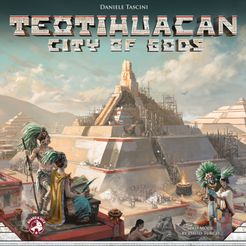
Move worker dice around the city, develop their strength and ascend, build the Pyramid of the Sun, and score construction, the Avenue of the Dead and masks at eclipses.
Teotihuacan: City of Gods supports 1–4 players; community best: 4 players; playing time: 90–120 minutes. A WANGO browser trial has not been confirmed.
Background & introduction
Teotihuacan: City of Gods, designed by Daniele Tascini, casts players as noble families seeking divine favor and lasting prestige in an ancient Mesoamerican city. Dice represent workers: their faces track power rather than randomly determining a fresh action each turn.
On a normal turn, move one unlocked worker clockwise by one to three Action Boards, then collect cocoa, worship or perform the destination’s Main action. Existing worker colors determine cocoa income and Main action fees, while your worker count and lowest power determine the efficiency of some actions. Gathering workers and planning their routes therefore go together.
Resource collection, technologies, buildings and pyramid decoration support one another. Main actions power workers up; reaching six causes an immediate Ascension, returns that worker to the Palace and advances the calendar. Eclipses repeatedly score construction, the Avenue of the Dead and mask collections while requiring wages. The third eclipse, or the final eclipse caused by completing the pyramid, decides the winner.
Core rules & scoring
Setup: use the player-count-specific pyramid and calendar setup. Players normally begin with three workers, with a fourth on the Ascension wheel. For standard setup, choose two of four Starting tiles and place workers at three distinct board numbers shown on them; the manual also provides a preset first-game setup.
Turn: move one unlocked worker clockwise by one to three boards and take one action, or spend the entire turn unlocking all your workers for free. During a normal turn you may instead pay three cocoa at any time to unlock them all, sliding them into the general areas of their current boards.
Cocoa and fees: before placing the arriving worker, count different colors already in the destination’s general area, ignoring locked workers. Collecting cocoa gives that count plus one; a Main action first costs that count in cocoa. Your own color counts if already present, but the arriving worker itself does not.
Worship: use an available Worship space and lock the arriving worker. Pay one cocoa to unlock another player’s worker occupying it; you cannot displace your own. A temple sidebar offers its advancement or a Discovery tile at its printed cost, or both for one extra cocoa. At the Palace you must activate the Royal tile and cannot take only the Discovery tile.
Main actions: the Palace has none. Forest, Quarry and Gold Deposits use your unlocked-worker count and lowest power to determine rewards. Alchemy spends gold on a Technology and awards three points to each other player already owning it. Nobles spends two wood on a Building and advances the Avenue; Decorations spends gold, while Construction spends stone and wood for higher levels. Worker-count benefits cap at three.
Construction and power-ups: place up to one Pyramid tile per worker there, with at least one required. Resolve payment, level and matching-icon points, temple advances and Pyramid-track advancement separately for each tile. Complete the board’s required power-ups on unlocked workers afterward. Power-ups are mandatory; where two are due, apply both to one worker or one each to two workers.
Ascension and timing: reaching six immediately advances the Avenue, moves that worker to the Palace at power one, grants a chosen Ascension reward and advances the calendar. One reward recruits the fourth worker at power three and grants two cocoa. The Last Player also advances the calendar after every turn. When the calendar discs meet, finish the current round and then play one full additional round before the eclipse.
Eclipse scoring: multiply Avenue steps by the lowest visible Building-row number. Pyramid-track leaders each gain four points; all players score four/three/two per step at the first/second/third eclipse, then reset only that track. Sets of one to seven different masks score 1/3/6/10/15/21/28 points, and masks remain. Pay one cocoa per worker plus one for each power-four-or-five worker; each unpaid cocoa costs three points, with a zero-point floor.
Ending: end after the third eclipse, or make the pending eclipse final when the pyramid’s top tile is built, retaining the standard remaining turns. Add qualified Temple Bonus tiles for reaching a temple’s penultimate or top step. Most points wins; ties favor more remaining cocoa, then the lower Player Order number.
Rules & gameplay questions
Are worker dice rolled each turn?
No. Their faces record worker power, normally increased by power-ups. You usually choose a movement of one to three Action Boards; the die value does not set that distance.
Does the Main action fee count workers or colors?
Different colors already in the general area before arrival, including your own color if already there. Several workers of one color count once, and locked workers do not count. Include the arriving worker when counting your workers for the action’s effect.
Can I refuse a power-up to preserve a strong worker?
No. The official FAQ makes power-ups mandatory and limits them to unlocked workers. Reaching six causes immediate Ascension. If that leaves no eligible worker on the original board, an additional power-up cannot be applied.
Does triggering an eclipse end play immediately?
Not in the standard rules. Finish the current round, then play one full round before scoring. If the pyramid is completed while an eclipse is already pending, that same eclipse becomes final; a second eclipse is not triggered.
Can a Technology trigger for every Pyramid tile I build?
No. Each Technology triggers at most once per turn. The construction discount applies to one tile only, and relevant Technology point or temple benefits resolve after all construction effects are complete.
Rules & introduction sources
- Edition
- Original 2018 base game, using the publisher-linked second-printing English manual and official FAQ dated 11 May 2019. This summary covers the standard 2–4-player eclipse procedure; the base box also includes Teotibot solo rules. Excludes the sudden-eclipse variant, expansions, promotional tiles and new Deluxe Master Set content.
- Rule references
- Introduction source
- BoardGameGeek
WANGO editorial
| Parameter | Recorded value |
|---|---|
| BGG overall rank (snapshot) | #113 |
| Complexity Weight | 3.78 / 5 |
| Best player count (community) | 4 |
| Player range | 1–4 |
| Playing time (minutes) | 90–120 |
| Core mechanisms | Area Movement · End Game Bonuses · Events · Grid Coverage · Layering · Ownership · Rondel · Score-and-Reset Game · Set Collection · Solo / Solitaire Game · Square Grid · Tile Placement · Track Movement · Variable Set-up · Victory Points as a Resource · Worker Placement with Dice Workers |
| Chinese publication | Unconfirmed |
| WANGO browser play | No confirmed WANGO trial |
| Year published | 2018 |
| Suggested age | 14+ |
BGG statistics are stored snapshots, not live rankings. Source checked:2026-09-27
Player questions
What is the best player count for Teotihuacan: City of Gods, and can I play online?
Teotihuacan: City of Gods supports 1–4 players; community best: 4 players; playing time: 90–120 minutes. A WANGO browser trial has not been confirmed. Recorded mechanism tags: Solo / Solitaire Game.
How complex is Teotihuacan: City of Gods, and which mechanisms does it use?
Weight: 3.78 / 5. Mechanisms: Area Movement · End Game Bonuses · Events · Grid Coverage · Layering · Ownership · Rondel · Score-and-Reset Game · Set Collection · Solo / Solitaire Game · Square Grid · Tile Placement · Track Movement · Variable Set-up · Victory Points as a Resource · Worker Placement with Dice Workers. Chinese publication: Unconfirmed.
Where can I learn Teotihuacan: City of Gods?
No rule guide, strategy article or WANGO trial has been confirmed for this record.