The Red Cathedral
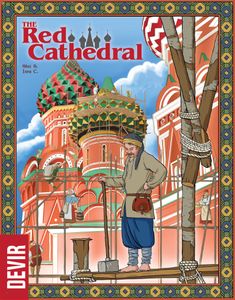
Use a shared dice market to claim and build cathedral sections, then compete for prestige through ornamentation and tower presence.
The Red Cathedral supports 1–4 players; community best: 3 players; playing time: 80 minutes. A WANGO browser trial has not been confirmed.
Background & introduction
The Red Cathedral puts rival construction teams to work on Saint Basil’s Cathedral. A turn allows one main choice: claim a section, deliver materials to build, or visit the market. Expanding your work sites and completing them therefore compete for action time.
The market is a shared dice system. A die’s face sets its movement, its destination determines resources and guild access, and the number of dice there multiplies normal resource production. Workshops add benefits for moving particular colors, while each move also changes opportunities for later players.
Completed sections provide cash and recognition, and ornamentations can be installed on other teams’ finished work. Final tower rewards depend on completed construction and decorations, then on each team’s presence there. Timing completion and choosing where to decorate matter alongside material collection.
Core rules & scoring
The base game supports 1–4. Use a player-count building plan to arrange bases, middle sections, and domes, with randomized Workshop tiles, resources, and influence cards. Each team has six banners and four ornaments, starts at scoring-track space 2, and receives 3, 4, 4, or 5 rubles in multiplayer order.
Take turns clockwise, performing one basic action: claim a section, deliver to build/decorate, or acquire market resources. Recognition moves ordinary track spaces; prestige moves to the next prestige space, so they are not a fixed one-to-one currency. Optional actions exchange prestige for rubles or reroll all dice in one space once per turn.
Claim an unclaimed base or a section immediately above any banner, without requiring the lower section to be finished. Move a banner there and take its Workshop tile into an empty slot. Pay that slot’s cost to install face up, receiving its benefit now and later through the matching moved die; unpaid face-down tiles cannot activate.
A Build action delivers at most three materials total, distributed among your claimed sections and/or ornaments. Section requirements may be delivered over several turns. On completion, return materials, gain the printed recognition and rubles, and flip the section while retaining its banner.
Completing an upper section penalizes owners of unfinished sections below it. For each unfinished card, lose recognition equal to completed sections above it belonging to other players, excluding your own completed sections. Upper construction is possible before lower work is finished.
Each completed section holds one ornament, regardless of who built it: lumber for a base door, stone for a middle arch, gold for a dome cross. Add zero to two jewels: one prestige each, or three total for two different colors. Deliver the whole ornament cost in one turn within the three-material allowance.
Move any market die exactly its face value along the arrows. Only white or your own color may move extra spaces at one ruble each; payment cannot shorten movement. A destination already holding three dice is illegal. Perform resource, influence, and Workshop actions once each in any order, then reroll every die at the destination.
Normal market resources multiply by dice at the destination. A Workshop showing another die grants that die’s resource tile only once, without a multiplier. Activate at most one of two white Workshop tiles. Materials require inventory space, initially six open slots; existing materials cannot be discarded to admit new ones. Claiming banners can expand storage.
The first to finish six sections gains three prestige; everyone else gets one final turn. Round down to your current or closest lower prestige space, then gain one prestige per five remaining materials and rubles combined. Towers are worth two per completed section plus one per ornament; rank banner/ornament presence on completed sections for full value, half rounded down, then half again. Tied ranks pool their awards and divide rounded down.
With two players, a present runner-up receives one-third of a tower rather than half; tied presence gives neither player points. No presence scores nothing. Final ties compare completed sections, then ornaments, then share victory. Official solo alternates player-first turns against Ivan; either sixth completion grants the other a final turn without the three-prestige trigger bonus. Use its procedures and two-player scoring.
Rules & gameplay questions
Can I decorate another player’s completed section?
Yes, if it has no ornament and you use the matching door, arch, or cross. Pay the complete material and chosen jewel cost that turn; jewels cannot be added later.
Do three dice also triple my Workshop benefit?
Normal market production multiplies by destination dice. A Workshop depicting a die grants its resource tile only once, without multiplying by dice there. Moving white also does not activate both white Workshop tiles.
Can I throw away old materials to make inventory room?
No. Keep only new materials that fit empty slots. Moving inventory banners to claim sections gradually releases space, so deliveries need planning.
How does tied tower presence score with two players?
Neither scores for that tower. Otherwise first receives full value and a present second receives one-third rounded down. A player without banners or ornaments there receives nothing.
Does Ivan skip his whole solo turn if his die cannot move?
No. A destination already holding three dice skips only that movement; execute the current Solitaire card action anyway. Ivan does not normally collect market materials but can gain recognition. Follow the handbook and Solitaire cards for the full sequence.
Rules & introduction sources
- Edition
- Original 2020 The Red Cathedral base game for 1–4, using the twenty-page English V9 publisher rules and Dized rules/FAQ explicitly maintained and verified by the publisher, including the supplied Ivan solo overview. Basic-side Workshops are the default; advanced-side fixed three-ruble installation and ornament-unlocking rules must be applied together. Excludes Contractors, promos, and fan variants; individual guild cards are not exhaustively detailed.
- Rule references
- Introduction source
- BoardGameGeek
WANGO editorial
| Parameter | Recorded value |
|---|---|
| BGG overall rank (snapshot) | #225 |
| Complexity Weight | 2.81 / 5 |
| Best player count (community) | 3 |
| Player range | 1–4 |
| Playing time (minutes) | 80 |
| Core mechanisms | Area Majority / Influence · Contracts · Dice Rolling · End Game Bonuses · Rondel · Solo / Solitaire Game · Victory Points as a Resource |
| Chinese publication | Unconfirmed |
| WANGO browser play | No confirmed WANGO trial |
| Year published | 2020 |
| Suggested age | 10+ |
BGG statistics are stored snapshots, not live rankings. Source checked:2026-09-27
Player questions
What is the best player count for The Red Cathedral, and can I play online?
The Red Cathedral supports 1–4 players; community best: 3 players; playing time: 80 minutes. A WANGO browser trial has not been confirmed. Recorded mechanism tags: Solo / Solitaire Game.
How complex is The Red Cathedral, and which mechanisms does it use?
Weight: 2.81 / 5. Mechanisms: Area Majority / Influence · Contracts · Dice Rolling · End Game Bonuses · Rondel · Solo / Solitaire Game · Victory Points as a Resource. Chinese publication: Unconfirmed.
Where can I learn The Red Cathedral?
No rule guide, strategy article or WANGO trial has been confirmed for this record.