Decrypto
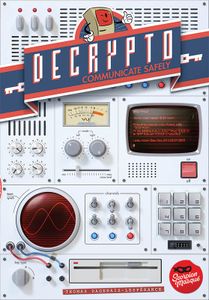
Send a three-number code to your own team through clues to fixed secret keywords, while preventing the opposing team from linking those clues to the right numbers.
Decrypto supports 3–8 players; community best: 4, 6 players; playing time: 15–45 minutes. A WANGO browser trial has not been confirmed.
Background & introduction
Decrypto divides players into two codebreaking teams. Each team keeps four numbered keywords behind its screen for the entire game. Opponents cannot see those words, but can hear the clues that are announced each round.
A rotating Encryptor privately draws a three-number code and supplies three clues in that order. Teammates interpret them using their known keywords, while opponents compare the new clues with their growing record to try to intercept the code.
Information accumulates over time: a clue that is too obscure risks a failed transmission, while a direct clue can help the opposition. The usual objective is correctly communicating or intercepting the numbered code, rather than simply shouting out one secret word.
Core rules & scoring
In the standard game, divide four to eight players into two teams. Each places four keyword cards in its screen, numbered 1–4 and unchanged throughout the game. Opponents cannot see them. Teams have separate code decks and note sheets. Rotate Encryptors each round and play at most eight rounds; three players use separate rules.
Both Encryptors simultaneously draw a private code card and write three clues in its numerical order without showing the code. White announces first; both teams discuss separately and write their complete guesses. The Encryptor must not help through reactions or extra information.
For White’s transmission, Black reads its interception guess first, then White reads its own decryption, and finally White’s Encryptor reveals the code. All numbers and their order must match. Neither side may intercept in round one. Record the correct number beside each clue and add it to that keyword’s history.
A correct interception earns one Interception token. Incorrectly decoding your own Encryptor earns one Miscommunication token. There is no penalty for a failed interception and no reward for correctly decoding your own code. One transmission can both fail for its own team and be intercepted by the opposition.
Reverse roles to resolve Black’s transmission. Finish both transmissions before checking victory or defeat; do not stop as soon as a second token appears. If the game continues, return code cards to their own decks and shuffle before selecting the next Encryptors, so a code can recur.
Clues concern keyword meanings and public information, not spelling, pronunciation, letter count, screen position or private knowledge. Do not use any keyword or its translation as a clue, even for another keyword, and do not reuse a clue during the game. Words or sentences are allowed; with group agreement, humming or mime is possible. Separate the three clues clearly and do not revise them once announced. Share all information with opponents too, and spell the clue itself if asked.
At round end, two Interception tokens win and two Miscommunication tokens lose. If one team both wins and loses, both teams reach the same ending condition that round, or eight rounds pass without a result, compare Interceptions minus Miscommunications. If tied, each team guesses the other’s four keywords; more correct words wins, and a remaining tie shares victory.
Rules & gameplay questions
Can we stop immediately on earning our second Interception token?
No. Finish both teams’ transmissions for the round before judging the outcome. Both sides can reach a threshold that round, or one team can simultaneously win and lose; use the round-end tiebreaker when required.
Can three players simply form a team against one person using the normal rules?
Use the special three-player game: two Encryptors face one Interceptor for at most five rounds. A successful interception or a failed transmission by the Encryptors gives the Interceptor an Interception token. No interception is allowed in round one. The Interceptor wins by earning two tokens within the five rounds; otherwise the Encryptor team wins.
Must an interception identify the opposing keywords?
No. A normal interception needs the correct three numbers in the correct order, not the keywords. Guessing all four opposing keywords is used only if the round-end points tiebreaker still leaves a tie.
Is the thirty-second timer a compulsory countdown every round?
The manual presents it as a pacing suggestion: after one Encryptor finishes writing, turn the timer and have the other finish before it runs out. It does not impose a universal thirty-second limit starting when codes are drawn.
Can a code recur in the next round?
Yes. If the game continues, return the code cards to their respective decks and shuffle. A previously used code is not removed from the possibilities for later rounds.
Rules & introduction sources
- Edition
- Decrypto base game using the official Le Scorpion Masqué English file decrypto_en_rules_20sep2019_1.pdf, dated 2019-09 in its filename and ©2017; seven PDF pages contain printed pages 1–12. Standard rules are for 4–8 players, with the printed-page 10 three-player game explained in the FAQ. Laser Drive is excluded.
- Introduction source
- BoardGameGeek
WANGO editorial
| Parameter | Recorded value |
|---|---|
| BGG overall rank (snapshot) | #117 |
| Complexity Weight | 1.83 / 5 |
| Best player count (community) | 4, 6 |
| Player range | 3–8 |
| Playing time (minutes) | 15–45 |
| Core mechanisms | Communication Limits · Paper-and-Pencil · Targeted Clues · Team-Based Game |
| Chinese publication | Unconfirmed |
| WANGO browser play | No confirmed WANGO trial |
| Year published | 2018 |
| Suggested age | 12+ |
BGG statistics are stored snapshots, not live rankings. Source checked:2026-09-27
Player questions
What is the best player count for Decrypto, and can I play online?
Decrypto supports 3–8 players; community best: 4, 6 players; playing time: 15–45 minutes. A WANGO browser trial has not been confirmed. Recorded mechanism tags: Team-Based Game.
How complex is Decrypto, and which mechanisms does it use?
Weight: 1.83 / 5. Mechanisms: Communication Limits · Paper-and-Pencil · Targeted Clues · Team-Based Game. Chinese publication: Unconfirmed.
Where can I learn Decrypto?
No rule guide, strategy article or WANGO trial has been confirmed for this record.