Codenames: Duet
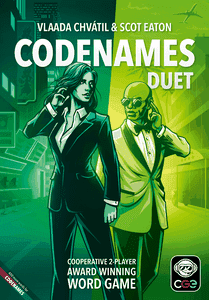
Codenames: Duet is a cooperative word game using one-word-and-number clues to find 15 agents and avoid assassins, with nine standard timer tokens and a final error-free sudden-death attempt if needed.
Codenames: Duet supports 2 players; community best: 2 players; playing time: 15–30 minutes. A WANGO browser trial has not been confirmed.
Background & introduction
Codenames: Duet casts players as covert operatives on a mission in a crowded city. Twenty-five word cards are laid out, but each player sees only one side of a double-sided key card. You know which words your partner needs to find, but cannot see how the other side classifies those same words. The team must communicate with limited clues and contact every agent before time runs out.
Each side of the key card shows nine green words and three assassins. Each player tries to guide the other to their nine green words, but three words are green on both sides, so the team has only 15 distinct agents to find. A word that is safe from your viewpoint may be an assassin from your partner’s. The challenge is to exchange useful information without revealing the hidden key.
The standard mission has nine timer tokens. Correct guesses move the team toward victory; a bystander ends the turn and spends time; an assassin on the clue-giver's side immediately defeats the team. After a correct guess, the guesser decides whether to stop or risk another. Information comes from legal clues and public results, not expressions, reactions or extra explanations. When time runs out, one sudden-death attempt can use prior information, but no new clues or guessing-strategy discussion are allowed.
Core rules & scoring
Edition and setup: Use the original June 2017 CGE rules. Deal 25 word cards into a 5×5 grid, set out 15 green agent cards and the assassin card, and place a random double-sided key so each opposite side sees only one face. The standard time bank contains nine bystander-side-up tokens; leave the other two in the box. Ten- or eleven-token easier missions are optional settings chosen before play, not extra time added midway.
Goal and judging side: Each face shows nine green words and three assassins, with three shared green positions making 15 distinct targets. Your visible green words are for your partner to guess. When you guess, only the clue-giver's face matters, regardless of whether your own face marks the word green, tan or black. A green-covered word is solved for both sides. Do not disclose which words overlap.
Clues: Either player may give the first clue; normally alternate afterward. Give exactly one word and one number without extra explanation. The number indicates associated words, not a second semantic clue. Use meaning rather than position, initials or word length. Letters or numbers can themselves be meaning-based clue words. Do not use forms or compound components of visible words, or add information through accents, inflection, singing or inappropriate foreign translations.
Guessing: The guesser must touch at least one word as an official guess. Green on the clue-giver's face receives an agent card and allows another guess; the clue number is not a maximum. Black immediately loses the game. Tan ends the turn: take a timer token from the bank, put it bystander-side up on that word and point its arrow from the clue-giver toward the guesser. Merely discussing a possible word does not make it an official guess.
Ending turns and switching: After one or more correct guesses, voluntarily stop by taking a bank token checkmark-side up. A bystander already spends the turn's token, so do not take an additional one. Normally switch clue and guessing roles. Once all nine green words on one face are covered, its holder must announce that the partner has no words left to guess. The partner then gives clues on all remaining turns so the other side can finish.
Marked words and earlier clues: A word marked as a bystander in one direction may still be guessed from the other direction. If later green, cover it with an agent and put the old token on top. If a bystander both ways, use a second opposite arrow and arrange the two tokens to cover it. One directional token does not remove a word. Guessers may use any earlier clue, not only the newest one.
Communication and larger groups: Never reveal your key colors, advise when to stop, use reactions to reveal an unintended correct guess, or report a remaining count before all your visible greens are covered. With more players, divide into two opposite sides, each seeing one face. Guessers may discuss without revealing their own face; clue-givers may quietly discuss or write suggestions without letting the opposite side hear. Group size does not add tokens or clues per turn.
Sudden death: When the last timer token is spent with targets left, give no new clue. If one side still has words to guess, it guesses; if both do, either may guess in any order without alternating, but no guessing-strategy discussion is allowed. Resolve one guess at a time using the other side's face. Any incorrect guess, including a bystander, loses immediately. Finding the final remaining green wins together.
Victory and standard-mission score: Covering all 15 agents wins; an assassin loses. For a successful standard nine-token mission, score three per token left in the bank and one per checkmark token taken after correct guesses. Subtract one if sudden death was needed. The final normal winning turn also spends a token, so do not leave that token in the bank for an extra three-point reward. This evaluates a successful team's performance, not a way to offset failure.
Invalid and zero clues: An accidental invalid clue first discards a bank token as a penalty, then the guesser proceeds as if the clue were valid; normal turn end usually spends another. If too much information was exposed, the rules suggest restarting. Zero is a legal number for words to avoid, but still requires at least one guess. Do not use it to skip without risk or encode another clue. Agree on any relaxed naming or wordplay rules in advance.
Optional Mission Map: Its two parameters set total turns and acceptable bystander mistakes. Set that many tokens, with the allowed-mistake number bystander-side up and the rest checkmark-side up. Voluntary stopping prefers checkmarks; a bystander uses a bystander token. Once none remain, a bystander costs two checkmarks from the bank, flipped and stacked on that word. Exactly exhausting the bank permits sudden death; needing two when only one remains loses immediately. Assassins still lose regardless of tokens.
Rules & gameplay questions
Which key-card face judges a guess, and can I trust my own green words?
Use only the current clue-giver's face, which the guesser cannot see. Your visible greens are targets for your partner, not a safety map for your own guesses. A word green on your face can be tan or black on the judging face; a word black on yours can be a valid target. Let the partner judge without revealing your side. The same viewpoint applies in sudden death.
Why do nine green words on each face make only 15 agents?
Three positions are green on both faces, leaving 15 distinct targets rather than 18. Covering a shared green solves it for both sides; never cover the same position twice. The guesser must not announce that the word was also green on their face. Completion means all 15 green agent cards are placed, not that the team has given a particular number of clues or accumulated 18 correct guesses.
Does the clue number cap guesses, and may we use earlier clues?
The number describes the clue's intended associations, not a hard cap. After each correct guess, the guesser may continue, including on words inferred from earlier clues. Each official guess is still judged on the current clue-giver's face. After at least one correct guess the guesser may stop by taking a timer token. Extra guesses do not gain protection: a bystander ends the turn and an assassin loses the game.
After a bystander, do we spend another token to end the turn?
Not in the standard mission. The bystander token already spends the turn's time and ends it. Point its arrow toward that guesser to record the direction; the other side may still need the word. A later green covers it with the token retained on top, while another bystander in the reverse direction receives a second token. Mission Map settings can charge two, but that is a separate parameter rule.
Once all my nine visible targets are covered, must we keep alternating empty clues?
No. You must tell your partner that they have no more words to guess. That partner then keeps giving clues so you can find the remaining targets on the other face. Before this complete-clear condition, do not report a remaining count or use it to tell your partner when to stop. This announcement is a specific information exception, not permission to discuss hidden key colors.
Can we discuss strategy, add a clue or survive a bystander during sudden death?
No. Once the bank is exhausted, use only existing information without another clue or guessing-strategy discussion. If both sides still need targets they may guess in any order, one official guess at a time, judged by the other face. Any error, even a bystander, immediately loses. In a map mission, needing a two-token penalty with only one token left loses directly without reaching sudden death.
Does an invalid clue or a zero clue let us skip guessing?
No. An invalid clue first costs an extra bank token, then the guesser continues under normal rules and usually spends the normal turn token as well. Zero is legal and can identify meanings to avoid, but the guesser still must guess at least one word. It is not a free pass. Any relaxation for multiword names or wordplay should be agreed before play rather than changed to rescue a particular clue.
How is a successful nine-token mission scored?
First confirm all 15 agents were found. Award three per token remaining in the bank and one per checkmark token taken after correct guesses, subtracting one for a sudden-death victory. The final normal winning turn spends its token too. Bystander tokens do not receive the voluntary-stop reward. Performance points cannot compensate for hitting an assassin or failing to complete the mission.
Rules & introduction sources
- Edition
- Original Czech Games Edition 2017 base game (BGG 224037), using the June 2017 twelve-page rules. Focuses on the standard nine-token mission, with larger groups and general Mission Map adjustments identified separately. Does not enumerate individual city challenges or include Duet XXL or 2025 edition changes.
- Rule references
- Introduction source
- BoardGameGeek
WANGO editorial
| Parameter | Recorded value |
|---|---|
| BGG overall rank (snapshot) | #278 |
| Complexity Weight | 1.36 / 5 |
| Best player count (community) | 2 |
| Player range | 2 |
| Playing time (minutes) | 15–30 |
| Core mechanisms | Communication Limits · Cooperative Game · Memory |
| Chinese publication | Unconfirmed |
| WANGO browser play | No confirmed WANGO trial |
| Year published | 2017 |
| Suggested age | 11+ |
BGG statistics are stored snapshots, not live rankings. Source checked:2026-09-27
Player questions
What is the best player count for Codenames: Duet, and can I play online?
Codenames: Duet supports 2 players; community best: 2 players; playing time: 15–30 minutes. A WANGO browser trial has not been confirmed.
How complex is Codenames: Duet, and which mechanisms does it use?
Weight: 1.36 / 5. Mechanisms: Communication Limits · Cooperative Game · Memory. Chinese publication: Unconfirmed.
Where can I learn Codenames: Duet?
No rule guide, strategy article or WANGO trial has been confirmed for this record.