Detective: A Modern Crime Board Game
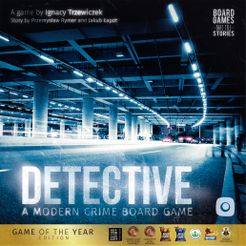
Detective: A Modern Crime Board Game is a fully cooperative investigation campaign. Work through five linked cases, manage time and stress, and connect evidence and suspects in the Antares database.
Detective: A Modern Crime Board Game supports 1–5 players; community best: 2 players; playing time: 120–180 minutes. A WANGO browser trial has not been confirmed.
Background & introduction
Detective: A Modern Crime Board Game puts players on a modern police investigation team working through five connected cases. Each case has Lead cards, people, locations, and a case-specific briefing. The team must identify which details matter across testimony, physical evidence, places, and timelines. Solving a case means more than naming a suspect: players enter evidence into the Antares database, match it to people, and answer the final report’s main and additional questions.
The investigation advances through team discussion rather than individual turns. Players decide together which Lead to follow, whether to travel to a location, how long to dig deeper, when to search the database or use an internet clue, and when to write a report. A normal workday runs from 8 a.m. to 4 p.m.; overtime adds Stress. Investigator skills, Consultant support, Authority, and Skill tokens unlock actions, but the schedule is limited, and too much overtime can end the case before the team reaches an answer.
The five cases form a campaign and the current retail rules require them to be played in sequence; Plot cards, clues, and notes may carry forward. If the team runs out of the case’s days or reaches its Stress limit, it submits an Antares Final Report. The case database scores answers, matched evidence, and Stress, and each case has its own passing threshold. Portal later updated the online scoring values and case thresholds, so use the current database. The game supports one to five cooperative players; a solo player runs the same investigation team without an AI opponent.
Core rules & scoring
Objective and players: Investigate five linked cases by following Leads, recording signature evidence, matching it to people, and answering the Final Report. The publisher lists 1–5 players, 120–180 minutes, and age 16+. Solo uses the same cooperative team rules and has no AI. The Casebook sets each case’s number of days and Stress limit; a full campaign can take considerably longer than the listed play time.
Case setup: Set out the map board with the team’s IT marker at Headquarters, set the time to 8 a.m. and the date to Day 1, and choose investigator roles. Unselected characters are flipped to their Consultant side and provide additional Skill tokens. Read the case’s Casebook introduction and special rules, log into the Antares Database, and prepare notes. Under the current retail rules, play the five base cases in order; clues, Plot cards, and notes can carry into later cases.
Team actions: The team discusses actions together during a day; players do not take separate turns. Options include Follow a Lead, Dig Deeper, search the Antares Database, use the internet when a Wi-Fi icon permits, use investigator abilities, Write a Report, and any actions a case or card specifically allows. Time costs depend on the card, location, and instructions. The team shares Skills, Authority, Stress, and the schedule.
Following Leads and locations: Check the visible Lead number and location before reading it. If the IT marker is elsewhere, move it to the location and spend an additional hour, then advance time by the number printed on the card. After following a Lead, continue as its instructions require; do not read it and then freely stop. If a card allows Dig Deeper, pay the required Skill token to read its back. Not every clue can be explored for free.
Time and online research: The regular workday runs from 8 a.m. to 4 p.m. Actions may take one or more hours. The team may work overtime, but each extra hour adds one Stress. Antares Database searches do not consume game time; internet searches marked by a Wi-Fi clue are also free, but require that access clue. At the end of the day, reset the time to 8 a.m., advance the date, return the IT marker to Headquarters, and clear used investigator ability markers.
Abilities and reports: Each investigator ability may be used once per day. The team may spend one work hour to Write a Report and gain one Authority token. Authority and Skill tokens pay for or enable actions and card effects. Unselected investigators provide their Consultant Skills. If a Lead requires a certain Skill, Authority, or team resource, the team must have it available before resolving the action. Writing a report is limited to once per day for the team and must use a regular working hour; it cannot be done during Overtime.
Evidence and Antares: Signatures on Lead cards are evidence that must be entered in the Antares Database according to the rules. The database matches evidence to people and reveals relationships that affect the Final Report score. Keep notes on times, people, locations, and clues to support discussion, but the team must still select an answer accepted by the case database; narrative guesses alone do not complete the investigation.
Ending a day and Stress: At day’s end, reset time to 8 a.m., advance the date, return the IT marker to Headquarters, and clear used ability markers. If the team uses the case’s final day or reaches its Stress limit, the case ends immediately and proceeds to the Final Report. Each overtime hour adds one Stress, which also reduces the final score; once the limit is reached, the team cannot use remaining time to continue investigating.
Final Report and scoring: When a case ends, answer its main, bonus, and campaign-story questions in the Antares Database. Portal’s 2019 update sets scoring at 6 points for the main question, 2 for bonus questions, and 3 for matched evidence; “unknown” scores 0, a wrong answer costs 1, and each Stress subtracts 1. Passing thresholds vary by case, so use the current case database rather than applying one case’s threshold to all five.
Campaign and edition boundaries: The current retail rules require playing the five base cases in order, with some clues and Plot cards carried forward. If the team fails, the rules allow resetting and replaying that case; a one-time narrative experience is a design feel, not a replay prohibition. The Game of the Year Edition remains the base game with character portrait cards. Season One, L.A. Crimes, Dig Deeper, and Petty Officers are separate products or expansions, not the five base cases.
Rules & gameplay questions
What is the goal, and do players have separate roles or turns?
The players work as one investigation team, following Leads, checking places and testimony, entering signature evidence in Antares, and answering the case Final Report. There is no personal competition or separate turn for each detective; the team shares action resources, time, Stress, and decisions about evidence. The five base cases form a campaign and the current retail rules require them to be played in order.
How does solo play work? Is there an automa?
The publisher lists one to five players. A solo player uses the same cooperative rules to run the investigation team; there is no separate solo AI or automa. Other investigators not selected by a player are flipped to their Consultant side and provide their listed Skills. With multiple players, the team still discusses actions together rather than taking separate detective turns.
What investigation actions are available during a day?
The team may Follow a Lead, Dig Deeper when a card allows it, search the Antares Database, use the internet when a Wi-Fi clue grants access, use investigator abilities, spend an hour to Write a Report, or take actions explicitly authorized by a case or card. Time costs vary. Database and permitted internet searches do not use game time; other actions advance the clock according to their text and location.
Do we have to be at the location to follow a Lead?
Check the location shown on the visible side of the Lead. If the IT marker is not there, move it to that location and spend one additional hour, then add the time cost printed on the card. After following a Lead, resolve the instructions it gives rather than reading it and freely stopping. If Dig Deeper is offered, pay the required Skill token to access the card’s back.
How do work hours and overtime work?
A regular workday runs from 8 a.m. to 4 p.m. Cards and actions may use one or more hours. The team can extend the day, but every overtime hour adds one Stress. At day’s end, time resets to 8 a.m., the date advances, the IT marker returns to Headquarters, and used investigator abilities refresh. If Stress reaches the case limit, the investigation ends immediately.
What are Skill and Authority tokens used for?
Skill tokens represent expertise required for certain investigative actions or card effects; unused investigators provide their listed Skills as Consultants. Authority can be gained by spending one work hour to Write a Report, and some actions or clues require it. Each investigator’s special ability can be used once per day. Check that the team has the required token and an available ability before committing to a Lead action. Writing a report is limited to once per day for the team and cannot take place during Overtime.
How does the Antares Database affect solving and scoring?
The team enters Signatures found on Leads into Antares. The database can connect evidence to people, helping the team evaluate relationships among the clues. At case end, it accepts answers to main and bonus questions. Portal’s 2019 update scores the main question at 6, bonus questions at 2, and matched evidence at 3; an unknown answer is 0, a wrong answer is -1, and each Stress also subtracts one point.
How does a case end, and can the five cases be played in any order?
A case ends when the team uses its final allowed day or reaches its Stress limit, then the team submits the Antares Final Report. The current retail rules and product page treat the five base cases as a connected campaign played in sequence; clues, Plot cards, and notes can continue into later cases. Early release publicity described cases as independently playable, but this entry follows the final retail rulebook for the campaign.
Can a failed case be replayed? What are GOTY, Season One, and expansions?
The rules allow the team to reset and replay a failed case; the narrative may feel like a one-time experience, but replay is not forbidden. The Game of the Year Edition is still the base game and adds character portrait cards. Detective: Season One is a separate, simplified game with different cases; L.A. Crimes, Dig Deeper, and Petty Officers are separate products or expansions, not part of the base box’s five cases.
Rules & introduction sources
- Edition
- This entry covers Portal Games’ 2018 English base game, BGG 223321, with the five cases played in order under the current retail rules. It excludes Detective: Season One and separate products such as L.A. Crimes and Dig Deeper. The publisher lists 1–5 players, 120–180 minutes, and age 16+; a case or campaign may take three hours or more. Play is fully cooperative; solo uses the same team rules and has no AI opponent. Scoring follows Portal’s 3 April 2019 Antares Database update: 6 points for the main question, 2 for bonus questions, 3 for matched evidence, 0 for unknown, and -1 for a wrong answer; each Stress also subtracts one point. Case thresholds vary in the database.
- Rule references
- Portal Games — Detective: A Modern Crime Board Game official English 2018 rulebook, pp. 2–15
- Portal Games — Detective: A Modern Crime Board Game product page
- Portal Games — official Antares Database scoring update, 3 April 2019
- Portal Games — Game of the Year Edition information
- Portal Games — Detective: Season One, separate game entry
- BoardGameGeek — Detective: A Modern Crime Board Game, game ID 223321
- Introduction source
- BoardGameGeek
WANGO editorial
| Parameter | Recorded value |
|---|---|
| BGG overall rank (snapshot) | #352 |
| Complexity Weight | 2.74 / 5 |
| Best player count (community) | 2 |
| Player range | 1–5 |
| Playing time (minutes) | 120–180 |
| Core mechanisms | Cooperative Game · Narrative Choice / Paragraph · Scenario / Mission / Campaign Game · Solo / Solitaire Game · Storytelling · Variable Player Powers |
| Chinese publication | Unconfirmed |
| WANGO browser play | No confirmed WANGO trial |
| Year published | 2018 |
| Suggested age | 16+ |
BGG statistics are stored snapshots, not live rankings. Source checked:2026-09-27
Player questions
What is the best player count for Detective: A Modern Crime Board Game, and can I play online?
Detective: A Modern Crime Board Game supports 1–5 players; community best: 2 players; playing time: 120–180 minutes. A WANGO browser trial has not been confirmed. Recorded mechanism tags: Solo / Solitaire Game.
How complex is Detective: A Modern Crime Board Game, and which mechanisms does it use?
Weight: 2.74 / 5. Mechanisms: Cooperative Game · Narrative Choice / Paragraph · Scenario / Mission / Campaign Game · Solo / Solitaire Game · Storytelling · Variable Player Powers. Chinese publication: Unconfirmed.
Where can I learn Detective: A Modern Crime Board Game?
No rule guide, strategy article or WANGO trial has been confirmed for this record.