Fantasy Realms
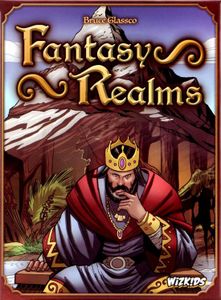
Fantasy Realms is Bruce Glassco’s fantasy card-combo game: build a seven-card kingdom by pairing bonuses while avoiding penalties that disable your own cards.
Fantasy Realms supports 2–6 players; community best: 2–3 players; playing time: 20 minutes. A WANGO browser trial has not been confirmed.
Background & introduction
Fantasy Realms is a fantasy card-combination game by Bruce Glassco. Each player is the ruler of a faraway land, trying to shape the mightiest kingdom from a tightly limited hand. You might build a force around armies and leaders, or let wizards, weapons, and artifacts support a different plan. There is no board where a fixed map is built; your final realm is the collection of cards whose relationships score best together.
The original 53-card deck mixes ten suits with three Wild cards. Armies, caverns, forests, volcanoes, floods, weather, and other fantasy elements can reward, punish, clear penalties, or blank other cards. A card with a high printed strength is not automatically a good fit: a powerful weather effect may suppress your own flames or lands, while an artifact can supply the exact condition another card needs.
On a turn, draw one card and discard one, normally keeping a seven-card hand while reshaping it toward a stronger combination. Players weigh a new possibility against the face-up cards already in the discard area, where an opponent’s abandoned card may become a useful piece of your realm. That public pile also acts as the game’s end counter. The puzzle is to preserve a coherent hand, and each player’s finished kingdom can look completely different.
Core rules & scoring
Version and setup: Use the original 2017 WizKids base game, SKU 72934, standard 3–6 players. Its 53 cards comprise ten suits and three Wilds. Deal seven each, choose a starting player randomly and continue clockwise. The opening discard area is empty, so the first turn draws from the deck. Exclude The Cursed Hoard suits, Deluxe promos and the separate two-player or Chaos setups.
Drawing and discarding: Take the top deck card or any face-up discard, then discard one face up at turn end, spreading discards for visibility. Normally seven becomes eight and returns to seven; explicit card abilities apply as written. Taking a discard first reduces that area's count before your own discard restores it. The ending is therefore not a fixed round count or a count of every discard ever made.
Scoring and ending: After a turn-ending discard leaves ten cards in the discard area, end without an extra round. Score each final hand by names, suits, base strengths and bonuses or penalties. Base strengths normally range from zero to forty. Opponents' hands do not directly change your score. Mirage and Shapeshifter have particular identity-selection rules, not permission to score an opponent's physical card as yours. Apply both rewards and penalties where required.
Clear versus Blank: Clear removes the specified penalty or part of it before penalties apply, preserving the target's suit, strength and bonus. Blank leaves a card with no suit, base strength, bonus or penalty for scoring, so its old attributes cannot support another combination. A successfully cleared penalty does not return merely because the clearing card is subsequently blanked. Blanked Unless With requires the named condition, rather than a choice to ignore an unwanted effect.
For Each versus With: For Each counts qualifying cards individually; With gives one bonus for the required association. The rulebook's Magic Wand example awards its Wizard bonus once even with two Wizards. Check whether a condition names a card or a suit, since changing suit does not change a name. Do not multiply an association reward unless the text does so, or count a blanked card's former suit toward a condition.
Effect order: The printed Q&A first resolves Doppelgänger, Mirage and Shapeshifter in that order, then Book of Changes, then penalty clearing, and finally penalties starting with cards not blanked by another. Do not rearrange the sequence for a better score. In its example, Cavern clears Blizzard, preserving Great Flood, which can then blank Wildfire and Cavern. Cavern's subsequent blanking does not undo the earlier clearing.
Wild boundaries: Mirage and Shapeshifter take an eligible name and suit within their printed suit restrictions, even when the physical target is not in hand, or may declare a legal generic suit. Those two retain zero base strength and do not copy the target's own bonus or penalty; declining their ability preserves their original identity. Do not generalize this zero-strength rule to every Wild. The Q&A separately rules that Doppelgänger copying Basilisk leaves both blanked unless the relevant penalties are cleared.
Book of Changes and exact wording: Change one other card's suit before general scoring effects, preserving its name, strength and own bonus or penalty. Name-based references still recognize its name; suit-based conditions may change. Similarly, Rangers clears the word Army from penalty text rather than every effect that can hurt armies. The Q&A says it does not protect armies from Wildfire, whose penalty does not use that word.
Winning and ties: After identity choices, suit changes, clearing and penalties, combine active base strengths and applicable modifiers. Highest total wins. Tied highest totals compare total base strength, with the lower total winning. Do not substitute hand size, suit count or who triggered the ending. The original booklet gives no next step when both totals tie; any additional agreement should be made before play rather than presented as a printed ruling.
Rules & gameplay questions
May I take any public discard, and why can that slow the ending?
Normally choose any face-up discard, not only a top card. The first turn must draw from the deck because no discard exists yet. Later taking a discard reduces the area by one before your own discard restores it, whereas a deck draw followed by a discard normally increases it. Count cards actually present, not rounds or historical discards. Drawing from the discard area still requires the normal discard afterward.
Does everyone receive another turn once the discard area reaches ten?
No extra round is provided. Check the actual discard area after the turn-ending discard and score the final hands when it contains ten. Discards are public options, not scoring cards owned by whoever discarded them, and triggering the end earns no special points. Taking one from an area of nine and then discarding leaves nine, not a cumulative tenth card that ends the game.
How do Clear and Blank differ, and can a blanked card still support combinations?
Clear removes a specified penalty while preserving the target's suit, strength and bonus. Blank removes its scoring suit, strength, bonus and penalty, so its former suit cannot qualify another effect. Neither term physically reduces your hand during the drawing phase; they concern final scoring. Do not interpret a cleared penalty as the whole card disappearing, or keep a blanked card's printed strength while treating its penalty as absent.
Does a cleared penalty return if its clearing card is later blanked?
Not merely for that reason. In the official example, Cavern clears Blizzard first, so Great Flood survives and then blanks Wildfire and Cavern. Although Cavern ends blanked, its earlier clearing remains effective. You cannot reconstruct everything from only the final surviving cards or select an advantageous order. Resolve identities, suit changes, clearing and penalties in the Q&A sequence, retaining clearing that has already occurred.
Does With double when I hold two matches, like For Each?
No. With awards an association bonus once; For Each counts qualifying cards separately. The rulebook gives Magic Wand with two Wizards as an example: its twenty-five-point Wizard bonus is still awarded once. Inspect each card's wording and whether it refers to a name or suit. Do not multiply every bonus because two similar cards are present, or undercount a genuine per-card effect. A blanked card's former suit does not count.
Do Mirage and Shapeshifter copy a target's strength and penalties?
No. Those two take a permitted name and suit, keeping zero base strength and not taking the target's own bonus or penalty. The target need not be in your hand, but the copy does not add another physical card to it. You may decline their abilities and retain their original identity. Do not extend that zero-strength statement to Doppelgänger; all three Wilds still follow their own text and specific rulings.
After Book of Changes changes a suit, do other cards still recognize the name?
Yes. Only the other card's suit changes; its name, base strength and own printed modifiers remain. Suit requirements may change, while a named-card association still recognizes the unchanged name. Resolve the choice before general bonuses and penalties, rather than changing it after seeing a result. The rulebook's high-scoring example uses a changed Wizard suit while retaining name-based combinations, illustrating why those checks are separate.
For tied highest scores, does the hand with greater base strength win?
The opposite: lower total base strength wins. For example, with both final scores at 180, base-strength sums of eighty and sixty-five favor sixty-five. Compare that sum rather than the largest single printed number or the final total again. The booklet does not supply a further step when both totals tie, so do not invent an official advantage for suit count, hand size or starting position after scoring.
Rules & introduction sources
- Edition
- WizKids original base game, SKU 72934 (2017), standard three-to-six-player rules only; excludes The Cursed Hoard, Deluxe Edition, and the rulebook’s two-player and Chaos variants.
- Rule references
- Introduction source
- BoardGameGeek
WANGO editorial
| Parameter | Recorded value |
|---|---|
| BGG overall rank (snapshot) | #273 |
| Complexity Weight | 1.82 / 5 |
| Best player count (community) | 2–3 |
| Player range | 2–6 |
| Playing time (minutes) | 20 |
| Core mechanisms | End Game Bonuses · Hand Management · Open Drafting · Set Collection · Tags |
| Chinese publication | Unconfirmed |
| WANGO browser play | No confirmed WANGO trial |
| Year published | 2017 |
| Suggested age | 14+ |
BGG statistics are stored snapshots, not live rankings. Source checked:2026-09-27
Player questions
What is the best player count for Fantasy Realms, and can I play online?
Fantasy Realms supports 2–6 players; community best: 2–3 players; playing time: 20 minutes. A WANGO browser trial has not been confirmed.
How complex is Fantasy Realms, and which mechanisms does it use?
Weight: 1.82 / 5. Mechanisms: End Game Bonuses · Hand Management · Open Drafting · Set Collection · Tags. Chinese publication: Unconfirmed.
Where can I learn Fantasy Realms?
No rule guide, strategy article or WANGO trial has been confirmed for this record.