Dinosaur Island
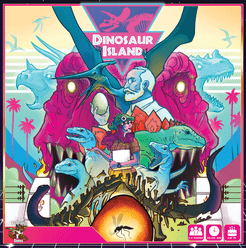
Dinosaur Island is a dinosaur-park management game. Research DNA, acquire recipes, breed dinosaurs, hire specialists, and build attractions before welcoming visitors, managing security, and racing for objectives.
Dinosaur Island supports 1–4 players; community best: 3 players; playing time: 90–120 minutes. A WANGO browser trial has not been confirmed.
Background & introduction
Dinosaur Island asks players to run their own dinosaur theme park. Research genetic material, acquire dinosaur recipes, build paddocks and attractions, then bring your creatures to life for visitors. A more exciting park draws more people and creates more chances for income and points. But dinosaurs and their species also raise the park's Threat, so a growing attraction needs enough Security or visitors can be eaten inside the park.
Each round follows five phases: Research, Market, Worker, Park, and Cleanup. Research assigns scientists to collect DNA, recipes, or upgrades; the Market buys specialists, attractions, lab upgrades, and DNA; the Worker phase assigns available workers to laboratory tasks; the Park phase draws visitors, fills attractions, and tests Threat; Cleanup refreshes the market and order for the next round. Some phases are sequential, while others ask players to plan simultaneously.
Objective cards set the competition and help determine when the game ends. Players must balance visitor excitement, Threat, capacity, facilities, and public goals. Dinosaurs increase both interest and danger, while DNA storage limits and board spaces constrain what a park can build. When only one objective remains unclaimed, the end is triggered, but players complete the current round before final scoring. Parks, dinosaurs, objectives, and leftover money all contribute to Victory Points.
Core rules & scoring
Setup and starting resources: Use two DNA dice per player plus one. Reveal player count plus one objectives from one chosen length deck and two nonconflicting Plot Twists, removing market tiles excluded at that count. Each player has three ranked Scientists, four available Workers and one starting Dinosaur. Basic DNA starts at one each with capacity four; Advanced DNA at zero with capacity two. Excitement, Threat and Security begin at one, VP at ten. First player gets $15 and each later player $1 more; reserve Workers are unavailable until gained.
Five phases: Every round follows Research, Market, Worker, Park, then Cleanup. The first round begins in setup order; later rounds set turn order during Cleanup based on Victory Points, with the lowest score first and previous order preserved for ties. Research assigns Scientists in sequence, Market gives each player two purchase actions in turn order, Worker assigns lab Workers simultaneously, Park resolves visitors and Threat in turn order, and Cleanup resets the market and pieces.
Research: Roll the DNA dice pool and place dice in the Research slots. Players take turns assigning each of their three Scientists to an unoccupied Research space, choosing a DNA result, Cold Storage increase, Dinosaur recipe, or Pass. A normal DNA face is multiplied by the Scientist's level, but cannot exceed that DNA type's storage limit. Increasing Cold Storage raises capacity; it does not give DNA. A recipe requires the listed Scientist level and is placed over two adjacent empty park zones. A Scientist passed here can become a Worker later this round. At the end of Research, set aside the remaining die with the most Threat pips; its pips raise every player's Threat in the Park phase.
Market costs: Take two actions each in order, or pass for $2 per action. Specialists and ordinary Lab Upgrades cost only their market row; Attractions also add their printed tile cost. A fourth Specialist requires firing one and losing its bonuses, including extra Workers. Put upgrades in construction spaces or cover an older upgrade when full; covered tiles remain but stop functioning. Dino Research II costs $3 and DNA Refinement II $5 from their special stacks and must cover the matching basic space. Buying DNA for $2–$5 follows the market table, then discards one item in that price row, excluding special upgrade stacks.
Worker phase: Resolve your own lab actions in any order, concurrently with others. Each passed Scientist is one Worker, not several based on its research level. Each workstation slot activates once per round unless marked Unlimited; a tile can have multiple distinct slots. Green-background one-time purchase effects cannot be activated again with Workers. Each DNA Refinement converts the specified two Basic DNA to one Advanced DNA; each Dino Research spends the recipe DNA to create one Dinosaur, provided its matching paddock has room.
Dinosaurs and capacity: Creation increases printed Excitement and Threat, with Excitement capped at twenty. Paddocks begin at one Dinosaur and upgrade stepwise to four; the normal cost equals the new capacity, so two to three costs $3 unless a card changes it. Security increases pay the indicated level cost on the lab chart. Rare die faces require the rank-three Scientist and resolve their paddock or Worker icon once, without tripling it. Cold Storage increases distribute the Scientist’s level across DNA capacities; raising capacity does not itself gain DNA.
Park and visitors: Draw visitors from the bag according to current Excitement: paying Patrons and non-paying Hooligans. Place them at the entrance and collect $1 per Patron. Then fill Attractions and Dinosaur exhibits within capacity, placing Hooligans first; an exhibit holds as many visitors as it has Dinosaurs. If Security is at least equal to Threat, no visitor is eaten. If Threat is higher, the difference is the number eaten. Remove Patrons before Hooligans, then take any shortfall from the entrance queue. Return eaten visitors to the bag and lose 1 VP for each.
Park scoring: After the Threat test, score 1 VP for every surviving Patron at an Attraction or Dinosaur exhibit. Hooligans and visitors still queued at the entrance score nothing. For each Patron at a food Attraction, choose either 1 VP or $2 instead. A visitor does not enter a full exhibit automatically; capacity is limited by Attraction rules or the current number of Dinosaurs. Excitement can create more customers, but visitor capacity and Security determine whether they become income and points safely.
Cleanup and end: Reorder from fewest VP, preserving previous order for ties. Discard the $2 row, slide remaining items into cheaper positions and refill, without re-sorting Attractions by printed price. Reveal recipes, return Workers and Scientists, put all visitors back, then resolve round-end Plot Twists. Claim an objective when met; simultaneous fulfillment can share it. English example P explicitly allows both players reaching the Dinosaur target in simultaneous Worker to claim. One unclaimed objective triggers the end after completing this round’s five phases; objective VP is scored at game end.
Final scoring and scope: Add printed Attraction VP to existing points; each exhibit scores printed VP times its Dinosaurs, or loses ten if empty. Score claimed objectives at their printed six to eight VP and leftover money at $5 per VP. Ties compare remaining money; no further tie procedure is supplied. This is the 2017 English multiplayer ruleset. The separate seven-round solo objective procedure, Predictable Systems without Plot Twists and Chaos Threat Theory rerolling the held Threat die are not automatically active.
Rules & gameplay questions
What is the order of phases in a round?
The base game uses Research, Market, Worker, Park, and Cleanup in that order. Players assign Scientists sequentially during Research, receive two Market actions each, assign lab Workers simultaneously, resolve visitors and Security in Park, and reset the Market and pieces in Cleanup. Scientist assignment and lab Worker placement are different phases with different timing.
Can I collect DNA beyond my Cold Storage limit?
No. Multiply an ordinary die’s DNA icons by Scientist rank, then gain only what fits; a gain of four with room for three yields three. Cold Storage divides the Scientist’s rank among capacities without increasing DNA amounts. Rare faces are different: only a rank-three Scientist can take them, resolving the Worker or paddock effect once rather than gaining three Workers or upgrades.
What happens to the unused Research die?
At the end of Research, take the remaining die with the most Threat pips and put it in the holding area. Those pips are added to every player's Threat during the Park phase. It is not a fresh roll, and it does not affect only the player who selected it; if no die remains, there is no shared-die Threat bonus.
What changes when I add another Dinosaur to a paddock?
Each successful Dino Research action adds one Dinosaur to its matching paddock, up to that paddock's capacity. The new Dinosaur also raises Excitement and adds Threat according to the tile symbols. Higher Excitement can draw more visitors, while higher Threat can cause them to be eaten if Security falls short. Plan DNA, paddock space, and Security together.
Which visitors are removed first when the park is unsafe?
First compare Threat and Security; if Threat exceeds Security, the difference is the number of visitors eaten. Remove Patrons from inside the park before removing Hooligans. If there are not enough visitors inside, remove the remaining amount from the entrance queue. Each eaten visitor costs 1 VP and returns to the bag. Hooligans do not earn admission money or park points.
Do Hooligans or visitors waiting in line score?
No. Each surviving Patron inside an Attraction or Dinosaur exhibit is worth 1 VP; a Patron still queued at the entrance has not entered a scoring area, and Hooligans do not score or pay admission. For each Patron at a food Attraction, choose 1 VP or $2 instead. Capacity affects whether a visitor can enter and become income or points.
Does the game stop as soon as one objective remains?
One unclaimed objective triggers the end, but finish the current round before scoring. Claim on fulfillment; later players cannot retroactively join, while simultaneous fulfillment can share. English example P has two players reach twelve Dinosaurs during simultaneous Worker and both mark the objective for final VP. Do not turn that example into a physical race to touch the card or extend eligibility into later phases.
Is each Dinosaur worth one point at the end?
No. A Dinosaur exhibit scores its printed value multiplied by the number of Dinosaurs in that paddock; an empty Dinosaur exhibit instead loses 10 VP. Dinosaurs also raise Excitement and Threat during play, but those uses are not a separate flat endgame point per Dinosaur. Calculate ongoing park effects and final exhibit scoring independently.
Do Attractions and Lab Upgrades both add a printed cost to the market row?
No. An Attraction adds its printed tile cost to the row price; an ordinary Lab Upgrade or Specialist costs only its row. The separate Dino Research II and DNA Refinement II stacks cost $3 and $5 and must cover their matching basic spaces. Covered upgrades remain underneath but cease working. Hiring a fourth Specialist also means firing one and losing its bonuses, including extra Workers.
Rules & introduction sources
- Edition
- Pandasaurus Games ©2017 Dinosaur Island base game, BGG221194, using the complete 20-page publisher-authored English manual and its key diagrams for 2–4 player play. The manual’s solo mode and variants, plus Fully Charged, Totally Liquid, Dinosaur World and Rawr ’n Write, are outside this multiplayer summary.
- Rule references
- Introduction source
- BoardGameGeek
WANGO editorial
| Parameter | Recorded value |
|---|---|
| BGG overall rank (snapshot) | #288 |
| Complexity Weight | 3.05 / 5 |
| Best player count (community) | 3 |
| Player range | 1–4 |
| Playing time (minutes) | 90–120 |
| Core mechanisms | Action Points · Dice Rolling · Income · Set Collection · Tile Placement · Worker Placement |
| Chinese publication | Unconfirmed |
| WANGO browser play | No confirmed WANGO trial |
| Year published | 2017 |
| Suggested age | 8+ |
BGG statistics are stored snapshots, not live rankings. Source checked:2026-09-27
Player questions
What is the best player count for Dinosaur Island, and can I play online?
Dinosaur Island supports 1–4 players; community best: 3 players; playing time: 90–120 minutes. A WANGO browser trial has not been confirmed.
How complex is Dinosaur Island, and which mechanisms does it use?
Weight: 3.05 / 5. Mechanisms: Action Points · Dice Rolling · Income · Set Collection · Tile Placement · Worker Placement. Chinese publication: Unconfirmed.
Where can I learn Dinosaur Island?
No rule guide, strategy article or WANGO trial has been confirmed for this record.