Pandemic Legacy: Season 2
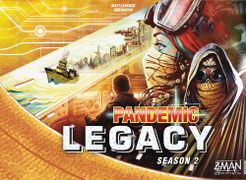
Set out from offshore havens to supply surviving cities, build supply centers and restore connections in an evolving cooperative campaign.
Pandemic Legacy: Season 2 supports 2–4 players; community best: 4 players; playing time: 60 minutes. A WANGO browser trial has not been confirmed.
Background & introduction
Pandemic Legacy: Season 2 begins in the seventy-first year after the catastrophe. Survivors live on offshore havens, and the known network of cities is small and fragile. Players cooperate to deliver supplies so those cities can withstand the next infection.
This season shifts the focus from removing disease in standard Pandemic to making, carrying and delivering supplies. City cards also support movement, construction and exploration. Limited actions, dwindling decks and city populations force the group to decide where help is most urgent.
Tasks across twelve months permanently change the map, characters and rules. Season 2 stands on its own and does not require completing Season 1. This overview covers only the initial public rules, without revealing sealed packages, later maps or story outcomes.
Core rules & scoring
Turn order: Check for exposure, take up to four actions and any number of legal free actions, draw two Player cards, then infect cities one card at a time at the current infection rate. Starting in a location with at least one Plague cube causes one exposure, regardless of the number of cubes. In the campaign, resolve scars or character death through the exposure track. There is no exposure in the prologue.
Supplies: Making supplies costs one action to move one cube from the stockpile onto your Character card. Delivering costs one action to place any number of your carried cubes in your current location. Picking up local supplies and transferring supplies to or from a consenting player in the same location are free actions, but only during your own action step; they cannot interrupt another action.
Movement: Spend one action to move along a line to an adjacent location. Sail discards the destination's City card; Charter Boat discards your starting city's card. Both require a sea route, rather than an unrestricted flight across land as in standard Pandemic. Observe whether an effect specifies cities or havens, since these are distinct location types.
Construction and exploration: In a city, discard five City cards of that city's color to build a supply center. Sharing Knowledge in the same city normally transfers only the card matching that city. To use a Produce Supplies card, you must be in a haven or supply center. Local Production fills that location to its population; System-Wide Production fills all havens and centers on the grid to their populations and checks a use box on the card. Recon must meet the map's location, facility and card requirements. Recon and System-Wide Production are unavailable in the prologue.
Infections and incidents: A normal infection removes one Supply cube from the city. Only if it had no supplies do you place a Plague cube, advancing the Incident marker once per cube actually placed. If a fourth Plague cube would be added, an outbreak instead removes supplies or adds plague in adjacent locations, with chain reactions resolved under the rules. A location that has already had an outbreak during this infection does not outbreak again.
Epidemics: Increase the infection rate, draw the bottom Infection card and remove all supplies from its city, then shuffle the Infection discard pile onto the deck. This Epidemic step does not add plague even if the city already had no supplies. Epidemic cards do not enter your hand and are not replaced. The usual hand limit is seven; discard or play Events when over the limit, resolving newly drawn Epidemics first.
Winning or losing a game: Win immediately upon completing the required number of objectives, including every mandatory objective. Lose immediately if the Incident marker reaches its final space or you cannot draw two Player cards. An empty supply stockpile is not an automatic loss: production allocates what is available. Stop as soon as victory or defeat occurs, without finishing remaining actions or outbreaks.
Months and persistence: After a campaign game, adjust population, check the Legacy deck and Game End cards, and spend production units on permanent upgrades. Units depend on the number of cities on the grid, with one extra for a win; unspent units do not carry over. A win advances to the next month and reduces rationing by two, to a minimum of zero. After the first loss, replay the month; after the second, advance. Each loss raises rationing by two, to a maximum of ten. After December, evaluate the campaign as instructed. The prologue does not apply permanent Game End steps.
Rules & gameplay questions
If an infection removes a city's last Supply cube, do I also add plague during that same infection?
No. That infection removes only one supply. A Plague cube is placed instead only if the city has no supplies when the infection is resolved. A later infection of that city uses its condition at that later time.
Does an Epidemic add plague if its city has no supplies left?
No. The Epidemic's infection step only removes all supplies from its city. If there are none, it removes none and adds no plague. The Infection discards still return to the top of the deck, so later normal infections may add plague.
Since picking up and transferring supplies are free, can I do them on someone else's turn or partway through sailing?
No. These free actions still belong to your own action step. They can happen before, after or between other actions, but cannot interrupt one. For example, sailing past a haven does not let you stop there temporarily to pick up supplies.
Do the supply centers we build remain permanently on the map?
No. They are facilities for the current game. They can increase their cities' populations during the Game End procedure, but the pieces are set up afresh next game. Population stickers, added rules and explicitly permanent upgrades carry over; do not apply another season's safehouse rules here.
Rules & introduction sources
- Edition
- The 2017 Pandemic Legacy: Season 2 base game, using Z-Man's official 20-page English rulebook. Covers the initial campaign rules for 2–4 players, with the prologue exceptions: no exposure, Recon, System-Wide Production or permanent Game End procedure. Excludes Season 0/1 rules, fan-made reset variants, later sealed packages and revealed-map story details. Unlocked stickers and specific objective instructions take precedence.
- Rule references
- Introduction source
- BoardGameGeek
WANGO editorial
| Parameter | Recorded value |
|---|---|
| BGG overall rank (snapshot) | #74 |
| Complexity Weight | 3.25 / 5 |
| Best player count (community) | 4 |
| Player range | 2–4 |
| Playing time (minutes) | 60 |
| Core mechanisms | Action Points · Cooperative Game · Hand Management · Legacy Game · Pick-up and Deliver · Point to Point Movement · Scenario / Mission / Campaign Game · Set Collection · Tags · Trading · Variable Player Powers |
| Chinese publication | Unconfirmed |
| WANGO browser play | No confirmed WANGO trial |
| Year published | 2017 |
| Suggested age | 14+ |
BGG statistics are stored snapshots, not live rankings. Source checked:2026-09-27
Player questions
What is the best player count for Pandemic Legacy: Season 2, and can I play online?
Pandemic Legacy: Season 2 supports 2–4 players; community best: 4 players; playing time: 60 minutes. A WANGO browser trial has not been confirmed.
How complex is Pandemic Legacy: Season 2, and which mechanisms does it use?
Weight: 3.25 / 5. Mechanisms: Action Points · Cooperative Game · Hand Management · Legacy Game · Pick-up and Deliver · Point to Point Movement · Scenario / Mission / Campaign Game · Set Collection · Tags · Trading · Variable Player Powers. Chinese publication: Unconfirmed.
Where can I learn Pandemic Legacy: Season 2?
No rule guide, strategy article or WANGO trial has been confirmed for this record.