Gaia Project
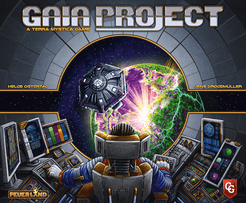
Fourteen alien factions colonize planets, upgrade structures, form federations and develop six research tracks.
Gaia Project supports 1–4 players; community best: 3–4 players; playing time: 60–150 minutes. A WANGO browser trial has not been confirmed.
Background & introduction
Gaia Project takes different factions into a galaxy where they colonize planets and develop technology. Terraforming requirements, faction abilities and the arrangement of structures give each player different opportunities to expand.
Building and upgrading provide income, research advances six technology paths, and power cycles between different areas. Keeping a suitable distance from opponents can offer opportunities to charge power, while also creating competition for space.
Forming federations, acquiring technology and matching each round’s scoring condition all contribute victory points. Range, QICs, satellites and federation requirements follow Gaia Project’s own rules, rather than Terra Mystica’s shipping and cult systems.
Core rules & scoring
Play six rounds, each with Income, Gaia, Actions and Clean-Up. Income comes from faction boards, round boosters, technology and research; ore and knowledge are capped at 15 each, credits at 30. In Actions, take one action per turn clockwise from the starting player until everyone passes. Free actions are allowed only before or after your main action, never during it or on another player’s turn. When passing, take a different booster before returning the old one; do not keep the same booster for consecutive rounds. Take no new booster in round six. The first player to pass takes the starting-player marker.
Building a mine normally costs 2 credits and 1 ore, and requires an available mine and an empty, accessible, habitable planet. Navigation sets basic range; each extra QIC spent adds 2 range for this action. Terraforming an ordinary non-home planet type costs additional ore according to its required steps and your technology. Unconverted Transdim Planets cannot be colonized directly. A normal Gaia Planet costs 1 extra QIC, but a converted planet with your Gaiaformer is accessible and needs no extra QIC. Terraforming and building must be fully paid and completed in the same action.
To start a Gaia Project, have an available Gaiaformer and an accessible, empty Transdim Planet. Place the Gaiaformer and move a total of 6, 4 or 3 power tokens from areas I, II and/or III into your Gaia area, depending on Gaia research level. This is not simply spending area III power. During the next round’s Gaia phase, the planet becomes a Gaia Planet and Gaia-area power normally returns to area I. The Gaiaformer stays until a mine is built there. Projects started in round six never complete; faction exceptions follow their boards.
Each upgrade takes one step: mine → trading station → research lab → academy, or trading station → planetary institute. Return the old structure to the rightmost open space of its row, take the new one from the left and pay its listed cost. A trading station normally costs 6 credits and 2 ore, reduced to 3 credits and 2 ore if an opponent’s structure is within range 2. A planetary institute immediately unlocks its faction ability; a research lab or academy immediately grants a technology tile.
A research action spends 4 knowledge to advance one level on any research track. Moving from level 2 to 3 charges 3 power; it does not add 3 new tokens. Only one player may reach level 5 on each track, and doing so requires flipping a green federation token gray. A standard technology advances its associated track or one of your choice, and you cannot own duplicate tiles. An advanced technology requires level 4 or 5 on its track, flipping a green federation token and covering an uncovered standard technology, disabling that tile.
A federation normally requires structures with total power value at least 7: mines are 1, trading stations and research labs 2, planetary institutes and academies 3. Connect the selected planets using as few satellites as possible, discarding 1 power token per satellite, never from the Gaia area. Satellites occupy non-planet spaces. A new federation cannot directly adjoin planets or satellites of your existing federations, and each planet or satellite belongs to only one federation. Gain an available federation token and its rewards immediately; faction exceptions apply.
To charge power, move area I tokens to II first, then II to III once I is empty. Spending power moves III tokens to I; new tokens enter I. When an opponent builds or upgrades within range 2, your highest-power structure in that area sets your passive charge amount. Pay victory points equal to power actually charged minus 1. Normally accept all or none; reduce the amount only under the rules for insufficient charge capacity or points. Passed players may still accept. Each shared power/QIC action space and each of your special action spaces is usable only once per round.
After round six’s Action phase, score each of the two final tiles by rank: 18, 12, 6 and 0 points. Ties divide the occupied ranks’ points equally; include the neutral ranking in two-player games. Each research level 3, 4 and 5 reached or passed on each track gives 4 points. Every 3 remaining credits, ore and knowledge combined gives 1 point. Add these to points earned during play from round scoring, federations and technology. Highest total wins; tied players share victory.
Rules & gameplay questions
How much power can I charge when an opponent builds nearby?
Use the highest power value among your own structures within range 2 of the building site, not their sum or the opponent’s new structure. Charging 1, 2, 3 or 4 power costs 0, 1, 2 or 3 points. Normally accept all or none; only insufficient charge capacity or points allows the corresponding reduction. You may accept even after passing.
Must I build a research lab before a planetary institute?
No. A mine upgrades to a trading station, which can become either a research lab or a planetary institute. A research lab can then become an academy. Each action upgrades only one step; faction cost and ability exceptions follow their boards.
Is connecting seven power enough for a federation, and can Gaia-area tokens pay for satellites?
You must also obey minimum-satellite, single-federation membership and separation-from-existing-federations rules. Each satellite discards 1 power token from areas I, II or III, never the Gaia area. Connecting existing federations does not grant another token. Specific factions have their own exceptions.
Does starting a Gaia Project spend area III power back into area I?
No. The official correction moves the required number of tokens from any combination of areas I, II and III into the Gaia area, normally 6, 4 or 3 according to current Gaia research. They return under faction rules in the following Gaia phase. The Gaiaformer itself becomes available again only after a mine is built on its planet.
Does reaching research level 3 add three new power tokens? Do advanced technology and level 5 each need a federation token?
Moving from level 2 to 3 charges 3 power by cycling existing tokens, rather than adding new ones. Taking an advanced technology and entering level 5 have independent requirements, each needing a still-green federation token. Once flipped gray, the same token cannot pay again.
Rules & introduction sources
- Edition
- Original Gaia Project (2017) base multiplayer game for 2–4 players, standard six rounds. Uses Feuerland’s official 24-page English rules, applicable base corrections in Z-Man’s official Errata/FAQ v1.0 (2017-11-14, public mirror), and Feuerland’s current official FAQ. Faction exceptions follow their boards. Excludes Automa, advanced setup variants and The Lost Fleet expansion.
- Rule references
- Introduction source
- BoardGameGeek
WANGO editorial
| Parameter | Recorded value |
|---|---|
| BGG overall rank (snapshot) | #13 |
| Complexity Weight | 4.40 / 5 |
| Best player count (community) | 3–4 |
| Player range | 1–4 |
| Playing time (minutes) | 60–150 |
| Core mechanisms | End Game Bonuses · Hexagon Grid · Income · Modular Board · Network and Route Building · Solo / Solitaire Game · Tags · Tech Trees / Tech Tracks · Turn Order: Pass Order · Variable Player Powers · Variable Set-up · Victory Points as a Resource |
| Chinese publication | Unconfirmed |
| WANGO browser play | No confirmed WANGO trial |
| Year published | 2017 |
| Suggested age | 12+ |
BGG statistics are stored snapshots, not live rankings. Source checked:2026-09-27
Player questions
What is the best player count for Gaia Project, and can I play online?
Gaia Project supports 1–4 players; community best: 3–4 players; playing time: 60–150 minutes. A WANGO browser trial has not been confirmed. Recorded mechanism tags: Solo / Solitaire Game.
How complex is Gaia Project, and which mechanisms does it use?
Weight: 4.40 / 5. Mechanisms: End Game Bonuses · Hexagon Grid · Income · Modular Board · Network and Route Building · Solo / Solitaire Game · Tags · Tech Trees / Tech Tracks · Turn Order: Pass Order · Variable Player Powers · Variable Set-up · Victory Points as a Resource. Chinese publication: Unconfirmed.
Where can I learn Gaia Project?
No rule guide, strategy article or WANGO trial has been confirmed for this record.