The Quest for El Dorado
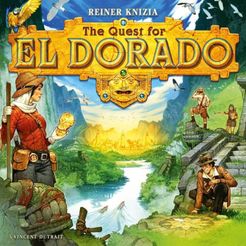
The Quest for El Dorado combines deck building with a jungle race. Use cards to cross terrain, recruit a stronger expedition and reach the city of gold.
The Quest for El Dorado supports 2–4 players; community best: 2, 4 players; playing time: 30–60 minutes. A WANGO browser trial has not been confirmed.
Background & introduction
The route contains jungle, water and villages, with impassable black mountains and other adventurers blocking spaces. Your hand determines how far you can travel rather than a die roll.
Everyone starts with the same eight-card deck and allocates cards between movement and purchases. New cards enter the discard pile and must cycle into your hand. Trimming weak cards and preparing for the terrain ahead affect your speed later in the race.
The first expedition through a blockade pays its cost and keeps it as a tie-breaker. Reaching the finish triggers the end of the round, leaving later players an equal number of turns to arrive. In a two-player game, both adventurers must finish.
Core rules & scoring
Setup: 2–4 players. The 2023 manual uses eight starting cards per player—one Sailor, three Explorers and four Travelers—and 54 market cards, three each of 18 types. Shuffle your starting deck and draw four. Six designated types start on the market board; assemble a route with terrain tiles and blockades. Cave tokens are optional.
Turn: play movement cards first, then buy up to one card with the remaining cards. Discard played cards; individually keep or discard unplayed cards, then draw up to four. If already holding four or more, draw none. Reshuffle discards only when needed to complete a draw.
Movement: a single card must match a landscape space’s symbol and meet its power. Remaining power may pay for further adjacent spaces of that type, but weak cards cannot combine to enter one expensive landscape space. Stop at any time and lose unused power. Mountains and occupied spaces are forbidden.
Special spaces: rubble requires the printed number of arbitrary cards, which are discarded normally. Base camps require that many cards to be permanently removed from the game. The two costs have different effects on your deck.
Market: coin cards contribute their printed power; other cards contribute half a coin each, with no change. Buy at most one card and put it in your discard pile. Only when a market slot is vacant may you buy from an off-board type, moving that pile into the slot.
Items and actions: using a crossed-out item’s function removes it permanently; using it as half a coin or a rubble payment discards it normally. Purple actions may be played during movement or buying as instructed. Native ignores an adjacent space’s requirement or clears a blockade, but cannot enter mountains or occupied spaces.
Blockades and finish: pay a blockade like a space and keep it; later players pass freely. Reaching a finish space triggers the last round; move the piece onto the gate to free the space. Finish the current round. Among finishers, most blockades wins, then highest numbered blockade; if none has one, earliest arrival wins.
Two players: use two adventurers each, with the starting player on spaces 1 and 3 and the other on 2 and 4. Both pieces must finish. Each movement card applies to one piece only and cannot split its power between them. Your own pieces block each other; if both players finish, apply the usual tie-breakers.
Rules & gameplay questions
Can two power-one jungle cards enter a power-two jungle space?
No. One sufficiently powerful card must pay for a landscape space. Gray rubble instead counts cards and uses a different payment rule.
Can I move with a card I just bought?
No. Purchased cards enter your discard pile, then must be shuffled and drawn later. Normal buying follows your movement for that turn.
Must an item used as money be removed?
No. Permanent removal applies when using its function. Paying half a coin or discarding it to enter rubble sends it to the discard pile normally.
Must I discard every unplayed card?
No. Individually keep or discard them, then draw up to four. Do not draw if you already hold four or more. Only reshuffle when the draw pile cannot supply a required draw.
Can I freely mix the 2017 edition, refreshed edition and The Golden Temples?
This entry follows the 2023 base manual: 32 personal starting cards plus 54 market cards. Ravensburger identifies refreshed artwork, larger cards and a mini-expansion in the updated product, and warns that old expansion card sizes are incompatible. Extra mini-expansion content and the standalone The Golden Temples are outside this summary.
Rules & introduction sources
- Edition
- Ravensburger official English manual 665012.pdf, ©2023, 240157-A, 12 pages; 2–4-player base game with 32 starting cards and 54 market cards, including two-adventurer play for two. Excludes the page-11 caves variant, mini-expansions, old expansions and standalone The Golden Temples.
- Rule references
- Introduction source
- BoardGameGeek
WANGO editorial
| Parameter | Recorded value |
|---|---|
| BGG overall rank (snapshot) | #120 |
| Complexity Weight | 1.94 / 5 |
| Best player count (community) | 2, 4 |
| Player range | 2–4 |
| Playing time (minutes) | 30–60 |
| Core mechanisms | Deck, Bag, and Pool Building · Delayed Purchase · Grid Movement · Hand Management · Hexagon Grid · Modular Board · Multi-Use Cards · Once-Per-Game Abilities · Open Drafting · Race · Resource to Move · Variable Set-up · Zone of Control |
| Chinese publication | Unconfirmed |
| WANGO browser play | No confirmed WANGO trial |
| Year published | 2017 |
| Suggested age | 10+ |
BGG statistics are stored snapshots, not live rankings. Source checked:2026-09-27
Player questions
What is the best player count for The Quest for El Dorado, and can I play online?
The Quest for El Dorado supports 2–4 players; community best: 2, 4 players; playing time: 30–60 minutes. A WANGO browser trial has not been confirmed.
How complex is The Quest for El Dorado, and which mechanisms does it use?
Weight: 1.94 / 5. Mechanisms: Deck, Bag, and Pool Building · Delayed Purchase · Grid Movement · Hand Management · Hexagon Grid · Modular Board · Multi-Use Cards · Once-Per-Game Abilities · Open Drafting · Race · Resource to Move · Variable Set-up · Zone of Control. Chinese publication: Unconfirmed.
Where can I learn The Quest for El Dorado?
No rule guide, strategy article or WANGO trial has been confirmed for this record.