Clans of Caledonia
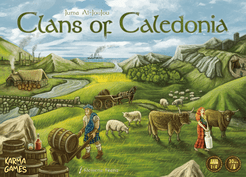
Manage a Scottish clan’s farming and processing economy, expand across the map, trade at changing market prices, and fulfil export contracts for imported goods and glory.
Clans of Caledonia supports 1–4 players; community best: 4 players; playing time: 30–120 minutes. A WANGO browser trial has not been confirmed.
Background & introduction
Set during Scotland’s nineteenth-century economic transition, the game links agriculture with processing. Sheep and cows provide wool and milk, fields provide grain, and dairies, bakeries, and distilleries turn raw materials into other goods. Each clan has abilities that can change trade, production, or expansion.
Your units provide both production and starting points for further expansion. Rivers and lochs interrupt access, while shipping upgrades extend your reach. Building beside another player’s production unit can also create an opportunity to buy the corresponding goods at a discount.
Market trading and exports are separate systems. Domestic goods trade at market prices, while export contracts require specific deliveries in return for imports and immediate bonuses. Final scoring also compares completed contracts and shipping-connected settlements, making more than one pattern of expansion useful.
Core rules & scoring
Rounds and clans: Play five rounds of preparation, actions, production, and scoring, skipping preparation in round one. Take one action per turn until everyone passes. Passing gives money and sets next round’s order, and ends your actions for this round. Clan abilities modify setup, construction, trading, or production under their individual rules.
Market: Buy or sell just one type of good per action, assigning one available merchant per unit. Settle the whole trade at the current unit price, then adjust the price by the number traded: buying raises it and selling lowers it. Merchants return during next round’s preparation. You cannot have merchants on both sides of the same good.
Expansion and neighbors: Pay the unit and land costs to deploy one unit to an empty neighboring space or one within shipping reach, observing grassland, forest, and mountain restrictions. Neighboring spaces share an edge without an intervening river; shipping never jumps over land. Beside an opponent’s producer, merchants can buy its goods at a discount of £2 per basic good or £3 per processed good, up to three of each type per turn, or four with two players.
Upgrades and ports: A shipping step costs £4, a technology upgrade costs £10 and adds £2 income per corresponding worker, and hiring a merchant costs £4. A neighboring port or one within shipping reach can be used before or after your main action, once per player per port per game. Port 7’s unit exchange must respect terrain and can grant building and neighborhood bonuses when eligible.
Contracts and delivery: Normally hold one unfinished contract, with Buchanan as an exception, and never voluntarily discard it. Taking one uses the round’s cost, except round one gives £5 instead. Deliver all goods on its left side to collect the imports and immediate bonuses on its right, then put the completed contract beside your export box. Meat requires slaughtering animals on the map during delivery and returning them to your board, ending their production.
Production and round scoring: Collect worker income, produce wool, milk, and grain, then optionally process milk into cheese or grain into bread or whisky. Newly produced raw goods can be processed immediately. Each field produces two grain, while each other basic producer produces one good. Round five still includes production and glory from its public scoring tile.
Stock and import scoring: After round five, score one point per glory, basic good, and imported hop, two per processed good, and one per £10. Cotton, tobacco, and sugar cane are worth three to five points each according to total imports by all players; score the quantities on your own completed contracts.
Rankings and ties: With three or four players, completed-contract ranks award 12/6 points and shipping-connected settlement ranks award 18/12/6. With two players, only first place scores, for eight and twelve respectively. Tied ranks share the points for the occupied places, rounding down. Remaining money breaks a final-score tie.
Rules & gameplay questions
Does settlement scoring reward occupied spaces or the largest continuous territory?
Neither. Neighboring units of one color form a settlement when no river separates them; an isolated unit also forms one. Compare the number of settlements in your largest group connected by shipping reach. Slaughtering animals can split settlements or break their connection.
Do imported goods become more valuable as players import more?
The opposite: the most-imported type is worth three points each, the middle type four, and the least-imported type five. For equal totals, cotton is treated as rarer than tobacco, and tobacco rarer than sugar cane.
Does a tied ranking give every player the full first-place award?
No. Pool the awards for the places occupied by the tied players and divide equally, rounding down when necessary. For example, two players tied first for contracts in a three- or four-player game receive (12+6)/2 = 9 each; the next player receives no second-place award.
Can one-loch shipping combine a loch crossing and a river crossing in one expansion?
No. A single expansion can use the permitted loch crossing or cross a river to adjacent land, but cannot combine both into a longer route. No shipping level permits jumping over land.
Is base-game solo play the same as Industria’s Automa?
No. Base solo play is a score challenge on a restricted map, using dice to adjust the market in rounds two to five, with no neighborhood bonus and threshold scoring for contracts and settlements. Import values still depend on your relative import totals. This quick reference covers two to four players; follow pages 8–9 for base solo procedures. Industria and its Automa are outside this scope.
Rules & introduction sources
- Edition
- Karma Games’ current complete 12-page English base rulebook, version 2026-06-03-EN, copyright 2025. This quick reference covers two to four players using pages 1–8 and 10–12, the current official FAQ, and the Port 7 erratum. Base solo play on pages 8–9 is mentioned only to identify its separate procedure. Excludes Industria, its Automa, clan auctions, and other variants. The rules specify remaining money as the final-score tiebreaker; no further result is inferred if money is also equal.
- Rule references
- Introduction source
- BoardGameGeek
WANGO editorial
| Parameter | Recorded value |
|---|---|
| BGG overall rank (snapshot) | #78 |
| Complexity Weight | 3.47 / 5 |
| Best player count (community) | 4 |
| Player range | 1–4 |
| Playing time (minutes) | 30–120 |
| Core mechanisms | Commodity Speculation · Contracts · Hexagon Grid · Income · Market · Modular Board · Network and Route Building · Solo / Solitaire Game · Turn Order: Pass Order · Variable Player Powers |
| Chinese publication | Unconfirmed |
| WANGO browser play | No confirmed WANGO trial |
| Year published | 2017 |
| Suggested age | 12+ |
BGG statistics are stored snapshots, not live rankings. Source checked:2026-09-27
Player questions
What is the best player count for Clans of Caledonia, and can I play online?
Clans of Caledonia supports 1–4 players; community best: 4 players; playing time: 30–120 minutes. A WANGO browser trial has not been confirmed. Recorded mechanism tags: Solo / Solitaire Game.
How complex is Clans of Caledonia, and which mechanisms does it use?
Weight: 3.47 / 5. Mechanisms: Commodity Speculation · Contracts · Hexagon Grid · Income · Market · Modular Board · Network and Route Building · Solo / Solitaire Game · Turn Order: Pass Order · Variable Player Powers. Chinese publication: Unconfirmed.
Where can I learn Clans of Caledonia?
No rule guide, strategy article or WANGO trial has been confirmed for this record.