Tichu
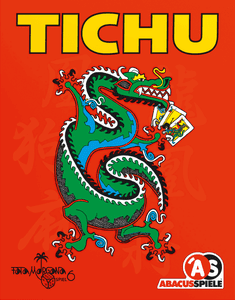
Two partnerships compete to shed their cards, support a teammate and stake extra points on a Tichu declaration.
Tichu supports 3–10 players; community best: 4 players; playing time: 30–90 minutes. A WANGO browser trial has not been confirmed.
Background & introduction
Classic Tichu seats partners opposite each other. Their hands remain hidden, yet card passing, control of the lead and reserves of strength must serve a shared goal. Taking a trick is only a local gain: who finishes first, and whether a partner follows immediately, can transform the hand's score.
Ordinary cards form singles, pairs, triples, full houses, consecutive pairs and straights. Four of a kind or a straight flush creates a bomb that can interrupt normal play order. Four special cards alter the opening lead, requested ranks, control of the lead or ownership of a winning trick.
Small and Grand Tichu turn a promise to finish first into a scoring commitment. The caller must personally succeed; a partner cannot fulfill the declaration for them. Timing and partnership support therefore matter alongside the strength of individual cards.
Core rules & scoring
Classic four-player play uses one 56-card deck, with partners opposite and 14 cards per player. The booklet has players take cards individually counterclockwise. Each then passes one card face down to each other player; send all three before picking up received cards.
Call Grand Tichu before taking the ninth card: personally finishing first earns the team an additional 200 points, otherwise it loses 200. Call Small Tichu before playing your own first card for an additional plus or minus 100. Declaration points are independent of ordinary card points.
After passing, the Mah Jong holder leads, without having to lead that card. Normally play proceeds counterclockwise: pass or play a higher combination of the same type and size. Straights need at least five cards; full houses compare their triples. Bombs are an exception.
After the last play, three players passing in order closes the trick. Its highest player takes it and leads again; if that player has finished, the lead passes right to someone still holding cards. Passing does not permanently exclude a player from the trick; they may play when their turn comes again.
The Mah Jong ranks 1 and can join a straight. Playing it permits a wish for an ordinary rank, lasting until fulfilled. On a normal turn, a player holding that rank must fulfill the wish if legally possible, even through a bomb or a legal combination using the Phoenix. The Phoenix alone does not count as holding the wished rank.
The Dog can only be led as a single card, immediately giving the lead to the partner. If the partner has finished, pass the lead to the next player on the partner's right still holding cards. The Dog cannot be bombed.
The Phoenix substitutes for an ordinary card in combinations but cannot form a bomb. As a single it ranks half a step above the card it beats, or 1.5 when led, and cannot beat the Dragon. The Dragon is the highest non-bomb single and cannot join a straight; if it actually wins a trick, give the entire trick including the Dragon to an opponent of its holder's choice.
A bomb is four of a kind or a straight flush of at least five cards. It beats any non-bomb; compare bombs by card count first, then rank. Bombs may be played out of turn or led. The official FAQ requires an existing table combination when interrupting rather than leading, and resolves simultaneous bombs in normal play order.
The hand ends immediately when only one player holds cards. That player gives the remaining hand to the opponents and collected tricks to the first finisher. Fives score 5 each, tens and kings 10 each, the Dragon plus 25 and Phoenix minus 25, totaling 100 ordinary points. The last trick closes immediately when the third player finishes; a winning Dragon still gives it away.
If partners finish first and second, the hand ends immediately with a double victory: skip card counting and award their team 200 points, with Tichu declarations scored separately. At a hand's end, if a team has at least 1000 points, the higher total wins. A tie continues until the threshold is met without a tie.
Rules & gameplay questions
Must Small Tichu be called before anyone plays?
No. Its deadline is before the caller plays their own first card, not before the table's first card. It may also be called before card passing. Grand Tichu must be called before taking the ninth card.
Can my partner fulfill my Tichu by finishing first?
No. Both declarations require the caller to finish first personally. A partner finishing first still makes the declaration fail and lose its corresponding points.
Must an out-of-turn bomb fulfill a Mah Jong wish?
The official FAQ distinguishes normal turns from interruptions: an out-of-turn bomb need not fulfill the wish. If its player wins and leads next, the outstanding wish still applies and must be fulfilled on that normal action when legally possible.
Does a bombed Dragon still give away the trick?
No. Only a Dragon that actually wins the trick gives it away. A winning bomb takes ownership instead.
Does this cover five- or six-player rules?
No. It covers classic four-player partnerships. The Rio Grande booklet titles that chapter TICHU NANKING (4 PLAYERS); its later three-player, six-player and Grand Seigneur chapters are excluded.
Rules & introduction sources
- Edition
- Classic four-player partnerships, using pages 1-3 of the official Rio Grande PDF: TICHU NANKING (4 PLAYERS) on pages 1-2 and applicable FAQ on page 3. Read these pages and visually inspected rendered pages 1-2 for special cards and combinations. Page 4 variants for three, six and Grand Seigneur are excluded. The Fata Morgana rules credit a 1992 English translation and revisions in 1993 and 2004.
- Rule references
- Introduction source
- BoardGameGeek
WANGO editorial
| Parameter | Recorded value |
|---|---|
| BGG overall rank (snapshot) | #253 |
| Complexity Weight | 2.34 / 5 |
| Best player count (community) | 4 |
| Player range | 3–10 |
| Playing time (minutes) | 30–90 |
| Core mechanisms | Hand Management · Ladder Climbing · Predictive Bid · Team-Based Game |
| Chinese publication | Unconfirmed |
| WANGO browser play | No confirmed WANGO trial |
| Year published | 1991 |
| Suggested age | 10+ |
BGG statistics are stored snapshots, not live rankings. Source checked:2026-09-27
Player questions
What is the best player count for Tichu, and can I play online?
Tichu supports 3–10 players; community best: 4 players; playing time: 30–90 minutes. A WANGO browser trial has not been confirmed. Recorded mechanism tags: Team-Based Game.
How complex is Tichu, and which mechanisms does it use?
Weight: 2.34 / 5. Mechanisms: Hand Management · Ladder Climbing · Predictive Bid · Team-Based Game. Chinese publication: Unconfirmed.
Where can I learn Tichu?
No rule guide, strategy article or WANGO trial has been confirmed for this record.