Combat Commander: Europe
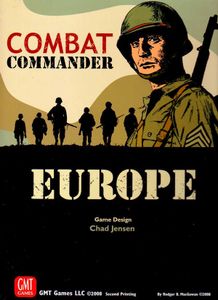
Combat Commander: Europe is a two-player tactical wargame in which Fate cards drive orders, reactions, combat, time, and victory across scenario maps in the European theatre of World War II.
Combat Commander: Europe supports 2 players; community best: 2 players; playing time: 60–180 minutes. A WANGO browser trial has not been confirmed.
Background & introduction
Combat Commander: Europe depicts infantry-centred tactical engagements in the European theatre of World War II. Two players oppose one another: one commands German Axis forces, while the other commands American or Soviet Allied forces as specified by the scenario. Players command squads, teams, and leaders on a hex map to seize objectives, suppress or eliminate enemy units, and sometimes exit their forces from the opposing map edge. The selected scenario defines the map, forces, setup, and mission, so the game is not a single fixed campaign narrative.
Players do not receive the same fixed number of action points every turn. Instead, they use their national Fate-card hand to choose Orders and Actions. An Order activates units for tasks such as movement, fire, or advance; either player may use a qualifying Action at the appropriate moment, including during the opponent's turn. Events and time triggers come from revealing cards off the deck. An Event is not a third type of card that a player may freely play from hand. Each nation has its own 72-card Fate Deck, and scenario posture sets the hand size.
The map uses an abstract scale of roughly 100 feet, or 30 metres, per hex. Units represent a leader, a five-person team, or a ten-person squad, while game time advances through card draws and Time! triggers rather than fixed real-world minutes. Movement, terrain cover, line of sight, range, morale, and command range shape each engagement. Victory Points come from eliminating enemy units, exiting friendly units from the enemy map edge, and controlling scenario objectives. Several different conditions can end a game, with final results determined by the scenario and the FAQ's revised end-game rules.
Core rules & scoring
Edition and scenario: This entry covers GMT Games' Combat Commander: Europe base game and follows rulebook v1.1 plus General Consolidated FAQ v10 as currently linked by GMT. The product page lists a fifth printing and says known errata have been corrected; where the downloadable v1.1 text conflicts with explicit FAQ corrections, this summary follows the FAQ. A scenario defines the map, forces, posture, objectives, and Order capability, so no single setup applies to every game.
Units, map, and Victory Points: Units include Leaders, Teams, and Squads with firepower, range, movement, and morale values. Terrain provides cover and may change line of sight or movement costs. Germany, America, and Russia each have a national Fate Deck; the scenario determines which armies oppose one another. The usual sources of Victory Points are eliminating enemy units, exiting friendly units from the opponent's map edge, and controlling Objective hexes. Objective chits assign values; an objective with no value does not award points automatically.
Fate cards and hand size: A Fate card in hand can be used only for the Order or Action printed at its top. Events are handled when revealed from the draw pile under the trigger rules; they are not a third command that a player may choose from hand. The scenario's posture sets the starting hand and refill limit: Attack is six cards, Recon five, and Defend four. Initiative and player aid cards are not Fate cards and do not count toward hand size. Drawing the last card in a deck is treated as a Time! trigger under the official FAQ.
Turns and Orders: The players alternate Turns. On a Turn, the active player may play one or more Orders or Pass. Each Order is played from hand and resolved completely before another is chosen, allowing the player to react to its result. The number of Orders is limited by the scenario or army Order Capability. Orders activate eligible friendly units: Move spends movement points hex by hex, Fire attacks a visible target within range, and Advance moves an activated unit one adjacent hex and may enter an enemy-occupied hex. The card, activation rules, and relevant sections determine who may act and where.
Actions and reactions: Either player may play an Action during either player's Turn when its condition and timing are met. An Action is not an extra Order reserved for the active player, and it has no separate fixed per-turn limit; the hand and card requirements still constrain use. The defender may respond to an opponent's movement with qualifying Opportunity Fire, Mines, Wire, or other reactions. The rules and FAQ specify windows in which such responses must be resolved before movement or melee continues; they cannot be added after the entire movement is over.
Fire, cover, and morale: A Fire Order requires at least one activated unit or weapon that can spot and reach the target hex. Ordinary weapons proceed to a Fire Attack; Ordnance first makes a Targeting Roll. Eligible pieces firing at the same target may form a Fire Group. The attacker combines firepower with permitted modifiers and a card die roll; each target unit separately compares its morale, cover modifiers, and defence die. An attack total higher than defence breaks the unit. On an equal total, a moving target is broken while a non-moving target is Suppressed; a lower total has no effect. Broken and Suppressed status reduce what a unit can do.
Melee, recovery, and rout: Units entering a hex with enemy units may cause Melee under the scenario and rulebook procedure. The official FAQ says a Melee has no further effect if a trigger leaves no units in that hex. A Recover Order first removes Suppression as instructed, then attempts to rally previously broken friendly units. A Rout Order selects a side and uses the rules' morale and draw values to set how far broken units must retreat toward their own map edge. Terrain, enemy positions, and the map edge can prevent a legal retreat; an impossible retreat may eliminate the unit. A unit broken again is eliminated and can yield Victory Points to its opponent.
Time and game end: A Time! trigger advances the Time Marker. FAQ v10 also treats revealing the final card of the draw pile as a Time! trigger. The FAQ lists four general endings: a player is forced to place an eliminated unit on the Surrender marker's Casualty Track space; a player's last unit on the map is eliminated; a player's last unit voluntarily Moves or Advances off the map; or a Sudden Death Roll is lower than the number on the current Time Marker space. The first two conditions cause an immediate automatic loss; the other endings normally reveal secret objectives and score Victory Points. Some scenarios add a special Sudden Death objective condition.
Final scoring and ties: If the game ends through surrender or the last unit being eliminated, the FAQ's revised rule declares the affected player the automatic loser without ordinary Victory Point comparison. If both players lose through those conditions simultaneously, the Initiative card holder breaks the tie. If the last unit exits or Sudden Death ends the game and neither automatic-loss condition applies, reveal the secret Objective chits and add their values. The higher total wins. If both Victory Point markers remain at zero after scoring, the Initiative card holder wins the tie. Use the FAQ correction where it replaces older wording in the v1.1 PDF.
Rules & gameplay questions
Can I play an Event from my hand?
No. When playing a Fate card from hand, choose only the Order or Action printed at its top. Events are resolved when cards are revealed from the draw pile under the trigger rules; a player cannot select the Event as a third type of hand play. Plan around the Orders and Actions actually available in your hand. Initiative and player aid cards are not Fate cards and do not count toward your hand limit.
Can only the active player play Actions?
No. Either player may play a qualifying Action at the appropriate moment during either player's Turn, while the active player performs Orders on their own Turn. Actions have no separate fixed per-turn limit, but the player must have a suitable card and meet its timing and target requirements. Opportunity Fire and similar responses during an enemy move must be resolved in the specified movement window rather than added after the full move has ended.
Must I discard a card when I Pass?
No. GMT's official FAQ v10 clarifies that a player may discard any number of cards when passing, including zero, subject to the nation's discard capability and the applicable rules. Passing means the player chooses not to issue another Order that Turn; it does not require discarding at least one Fate card. The active player may also continue with a legal Order if the scenario or army Order limit has not been reached.
When does the Time Marker advance?
It advances when a Time! trigger is rolled, and FAQ v10 also says that revealing or drawing the last card of the draw pile counts as a Time! trigger. Advance the marker only once for that trigger, then complete the required Time Advance and Sudden Death steps before normal play resumes. Do not treat the last card as an ordinary draw with no time effect or advance the marker twice for the same trigger.
What can end a game?
FAQ v10 lists four general endings: a player is forced to put an eliminated unit on the Surrender marker space; a player's last unit on the map is eliminated; a player's last unit voluntarily Moves or Advances off the map; or a Sudden Death Roll is lower than the current Time Marker number. The first two cause an immediate automatic loss for that player. The latter two normally reveal secret objectives and score Victory Points, subject to any scenario-specific condition.
How are attack and defence totals compared in Fire?
First confirm that at least one firing unit has line of sight and range; Ordnance also needs a Targeting Roll. Combine eligible firepower with the permitted modifiers and card die roll for the attack total. Each unit in the target hex separately adds morale, cover modifiers, and its defence die. A higher attack total breaks that target; on equality, a moving target is broken and a non-moving target is Suppressed; a lower attack has no effect.
Does the player whose last unit exits the map automatically lose?
Not necessarily. FAQ v10 distinguishes a player's last unit being eliminated from the last unit voluntarily Moving or Advancing off the map. Elimination is an automatic-loss condition; voluntary exit is a separate game-end trigger that normally reveals secret Objective chits and scores Victory Points. Exiting from the enemy map edge may also award the unit's Victory Points. Do not confuse it with being forced off the player's own edge during a Rout.
Who wins if the final score is tied?
If normal end-game scoring leaves both Victory Point markers at zero, FAQ v10 says the player holding the Initiative card wins. The Initiative holder also breaks a simultaneous tie if both players meet an automatic-loss condition involving surrender or their last unit being eliminated. This tiebreak applies only to those specified ties; if one player has the higher ordinary Victory Point total, that player wins.
What if the FAQ differs from the current rulebook PDF?
Follow the explicit GMT General Consolidated FAQ v10 errata or clarification for the affected rule. For example, the downloadable v1.1 PDF still says the active player chooses a Squad in E52.1, while FAQ v10 changes that word to the receiving player. GMT's product page says the fifth printing corrects known errata, but the page alone does not verify every printed line in that physical printing. Cite the FAQ correction and identify the files used.
Rules & introduction sources
- Edition
- BGG 21050: GMT Games' Combat Commander: Europe base game. This entry uses the rulebook v1.1 and General Consolidated FAQ v10 (February 8, 2017) currently linked by GMT, and applies Europe-specific FAQ entries only. It excludes Mediterranean, Pacific, Battle Packs, and other expansions. GMT lists a fifth printing and says known errata were corrected, but the downloadable v1.1 PDF retains a few old wordings that the FAQ explicitly corrects; this entry follows the FAQ where they conflict. Scenario details vary by scenario booklet.
- Rule references
- Introduction source
- BoardGameGeek
WANGO editorial
| Parameter | Recorded value |
|---|---|
| BGG overall rank (snapshot) | #282 |
| Complexity Weight | 3.26 / 5 |
| Best player count (community) | 2 |
| Player range | 2 |
| Playing time (minutes) | 60–180 |
| Core mechanisms | Advantage Token · Campaign / Battle Card Driven · Grid Movement · Hexagon Grid · Line of Sight · Movement Points · Simulation · Variable Phase Order |
| Chinese publication | Unconfirmed |
| WANGO browser play | No confirmed WANGO trial |
| Year published | 2006 |
| Suggested age | 12+ |
BGG statistics are stored snapshots, not live rankings. Source checked:2026-09-27
Player questions
What is the best player count for Combat Commander: Europe, and can I play online?
Combat Commander: Europe supports 2 players; community best: 2 players; playing time: 60–180 minutes. A WANGO browser trial has not been confirmed.
How complex is Combat Commander: Europe, and which mechanisms does it use?
Weight: 3.26 / 5. Mechanisms: Advantage Token · Campaign / Battle Card Driven · Grid Movement · Hexagon Grid · Line of Sight · Movement Points · Simulation · Variable Phase Order. Chinese publication: Unconfirmed.
Where can I learn Combat Commander: Europe?
No rule guide, strategy article or WANGO trial has been confirmed for this record.