Ethnos
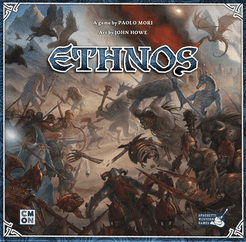
Ethnos is a fantasy card-and-area-control game. Players recruit allies, play same-tribe or same-kingdom bands, and compete for six kingdoms; the most Glory after the Ages wins.
Ethnos supports 2–6 players; community best: 4 players; playing time: 45–60 minutes. A WANGO browser trial has not been confirmed.
Background & introduction
Ethnos is a contest among tribes across six fantasy kingdoms. Players recruit allies from different tribes, form a band of cards that share a tribe or kingdom color, and send that band to compete for control. Each tribe has its own leader ability, so choosing the leader when a band is played changes what the action can do. Players balance control markers on the map with Glory gained from the size of their bands.
In each Age, players take turns recruiting one ally from the deck or face-up display, or playing a qualifying band from their hand. A band can be built around one tribe or one kingdom color. Its leader determines the ability, and its size helps determine whether it can place a control marker in a kingdom. Dragon cards move the Age toward its end; the third Dragon ends the current Age and triggers scoring.
The core decisions connect recruiting, band-building, and kingdom control. Playing cards can improve a kingdom position and earn Glory at the end of the Age, but those cards leave the hand and reduce future recruiting options. After the Ages, players total kingdom Glory and band points; the highest score wins. Two- and three-player games use dedicated two-Age scoring and tribe setup, so the full three-Age structure does not apply to every player count.
Core rules & scoring
Objective and edition: Players compete for control of six kingdoms and earn Glory by playing bands. CMON’s 2017 original supports two to six players and lists about 60 minutes; its rules do not include official solo or cooperative play. Each game uses a selection of the twelve base tribes, and the highest Glory total wins. Do not import the second edition’s solo rules or Merchant Clan into the original box.
Tribes and Ages: Select the tribes for the game: six in the usual larger-player setup, or five for two- and three-player games. Shuffle their cards into the Ally deck and prepare control and Glory markers for the six kingdoms. Standard games use three Ages; two- and three-player games follow a special setup for two Ages and adjust Glory markers. At each Age start, prepare the starting hands, face-up display, and three Dragon cards as the rules specify.
Two choices on a turn: Recruit one Ally from the face-up cards or the top of the deck, or play a band. A face-up card taken is not automatically replaced. With ten cards in hand, you cannot recruit and must play a band. A band contains one to ten cards of the same tribe or kingdom color; choose one card as its leader.
Playing a band and kingdom control: Normally the leader’s color identifies the kingdom. With three to six players, the band must contain more cards than your own existing markers there to add one. In a two-player game it must exceed both players’ combined markers in that kingdom: with two yours and one opposing, a band of at least four is needed. You may play a smaller band for end-of-Age band Glory without adding a marker. Then you may use the leader ability and normally discard remaining hand cards face up; tribe powers can alter these steps.
Leader abilities and tribes: Tribe powers may change marker placement, hand retention, or scoring. An Elf leader may keep up to the band’s size in remaining cards; a Minotaur needs one fewer card for a marker; a Wingfolk may choose another kingdom. Skeletons can join any band but cannot lead, and are discarded before band Glory is scored. A Dwarf leader makes a band count as one card larger for scoring. Apply the original rules for the tribes selected this game.
Drawing and Dragons: The face-up supply consists of the opening display and cards discarded by players; taking one does not automatically refill it. You can instead recruit the deck’s top card, up to a ten-card hand. Reveal the first or second Dragon and draw again from the deck; the third ends the Age immediately. At each Age start, everyone draws one card, twice the player count is revealed, then three Dragons are shuffled into the lower half of the remaining deck.
Band scoring at an Age end: Players discard their hands and score the bands in front of them. Unless a tribe ability changes it, a one-card band scores zero Glory; two cards score one; three score three; four score six; five score ten; and six or more score fifteen. This is added to the player’s Glory total. Larger bands score more, but require more cards and create a greater risk of waiting too long to play them.
Kingdom control rankings: For each kingdom, compare the players’ control markers and award the Age’s Glory markers to the leading ranks. Marker values change across the first, second, and third Ages, so gaining control early can secure a different pattern of later rewards. Tied players combine the Glory available for their tied ranks and divide it evenly, rounding down. Two-player Age-two scoring has an additional rule: a sole controller receives both Glory markers; when both players have control, first place takes the higher marker and second receives none. If Trolls are in play, their tokens can break a kingdom-control tie according to that tribe’s rules before sharing.
End of the Ages and winner: In a standard three-Age game, total kingdom Glory and band Glory after the third Age; most Glory wins. On a tie, compare control markers on the board, then the largest band played in the last Age, then the next-largest bands. Two- and three-player games end after two Ages and use their special markers and scoring; they do not add a third Age.
Mode and edition boundary: The original 2017 rules are a competitive game and do not provide a team objective or automated opponent. CMON’s Ethnos 2nd Edition is a separate entry with solo rules, a Merchant Clan, and revised rules. The original contains twelve tribes as variable setup choices, but only a subset is used in one game.
Rules & gameplay questions
How many players can play the original Ethnos? Is solo included?
CMON lists the 2017 original for two to six players and about sixty minutes. It is a competitive game where each player seeks kingdom control and Glory; the original rulebook does not list official solo or cooperative play. Ethnos 2nd Edition is a separate entry that adds solo rules and a new Merchant Clan, so those features do not apply to BGG 206718.
Do players use all twelve tribes in every game?
No. The base box contains twelve tribes, but each game uses only a selection: six in larger-player setups and five in two- or three-player games. Tribal powers vary the game, but the tribes are not twelve expansions that must all be added. During setup, choose the correct tribe set, kingdom markers, and Glory tokens for player count rather than mixing the two- and six-player setups.
What can I do on a turn?
On your turn, recruit one Ally or play a same-tribe or same-color band. Recruit from the face-up cards or deck top; the display does not automatically refill, and a ten-card hand must play a band. Choose a leader, check its color and band size to place a marker if eligible, use its ability, and normally discard your other hand cards face up. With two players, compare band size with both players’ markers in the kingdom, not only your own.
Which cards can make up a band?
A band can contain cards from the same tribe or cards of different tribes that share a kingdom color. Choose one card as the leader; its tribe ability affects the play, and the leader’s color normally determines where the band competes. Do not freely mix unrelated tribes and colors except that Skeletons may join any band, cannot lead, and are discarded before Age-end scoring.
When does a Dragon end an Age?
Three Dragon cards are mixed into the Ally deck. Reveal the first or second Dragon and draw another card from the deck. The third Dragon immediately ends the current Age and triggers scoring; players do not continue ordinary recruiting or band-building afterward. The timing is uncertain, so players need to judge whether to spend cards for band Glory before the deck runs out.
How many points does a band score at the end of an Age?
Score the number of cards in each played band: one card is zero Glory, two are one, three are three, four are six, five are ten, and six or more are fifteen. Players also receive Glory markers from kingdom rankings. Bigger bands can earn much more, but playing them uses cards that could have been retained for later recruiting or another kingdom. Tribe abilities can change this: discard Skeletons first, and count a Dwarf-led band as one card larger.
Do two- and three-player games use three Ages?
No. Under the original rules, two- and three-player games use five tribes, play two Ages, and adjust Glory markers and some two-player scoring. Larger-player games use six tribes and three Ages. The two-player game also has a special rule for kingdom rankings in the second Age. Check the player-count section before setup instead of applying all three-Age rules to every game. In two-player games, a band must exceed both players’ combined markers in the kingdom to add a marker; three-player games use the usual personal-marker threshold.
How do kingdom control and band Glory relate?
Control markers decide each player’s ranking in a kingdom at the end of an Age and award the corresponding Age Glory markers. Band size scores separate fixed Glory. A played band can help control a kingdom and earn band points, but victory depends on the combined total, not one kingdom’s lead. Players should consider both control positions and the value of each band.
Are the original Ethnos rules the same as Ethnos 2nd Edition?
No. The original is BGG 206718 and its rules cover a two-to-six-player competitive game. Ethnos 2nd Edition has a separate BGG entry; CMON describes revised and simplified rules, a solo mode, and the new Merchant Clan. Use the original tribes, Age structure, and scoring for the original box, without importing second-edition solo or clan content.
Rules & introduction sources
- Edition
- This entry covers CMON’s 2017 original Ethnos (BGG 206718), following the original 16-page rulebook and product page: 2–6 players, about 60 minutes. A game selects only some of the 12 base-game tribes; two- and three-player games use five tribes and two Ages, while larger games use six tribes and three Ages. The original rules do not list solo or cooperative play. Ethnos 2nd Edition (BGG 432527) is a separate entry with solo rules, a new Merchant Clan, and updated rules, all outside scope.
- Rule references
- Introduction source
- BoardGameGeek
WANGO editorial
| Parameter | Recorded value |
|---|---|
| BGG overall rank (snapshot) | #341 |
| Complexity Weight | 2.11 / 5 |
| Best player count (community) | 4 |
| Player range | 2–6 |
| Playing time (minutes) | 45–60 |
| Core mechanisms | Area Majority / Influence · Hand Management · Open Drafting · Push Your Luck · Set Collection |
| Chinese publication | Unconfirmed |
| WANGO browser play | No confirmed WANGO trial |
| Year published | 2017 |
| Suggested age | 14+ |
BGG statistics are stored snapshots, not live rankings. Source checked:2026-09-27
Player questions
What is the best player count for Ethnos, and can I play online?
Ethnos supports 2–6 players; community best: 4 players; playing time: 45–60 minutes. A WANGO browser trial has not been confirmed.
How complex is Ethnos, and which mechanisms does it use?
Weight: 2.11 / 5. Mechanisms: Area Majority / Influence · Hand Management · Open Drafting · Push Your Luck · Set Collection. Chinese publication: Unconfirmed.
Where can I learn Ethnos?
No rule guide, strategy article or WANGO trial has been confirmed for this record.