Rising Sun
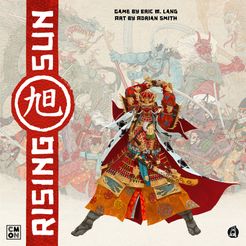
Lead a clan in mythical Japan, using alliances, political mandates, worship and battle bidding to build the prestige that will decide victory when winter arrives.
Rising Sun supports 3–5 players; community best: 4–5 players; playing time: 90–120 minutes. A WANGO browser trial has not been confirmed.
Background & introduction
Across spring, summer and autumn, negotiate alliances and use shared mandates to recruit, move, train and harvest. Allies share mandate bonuses while still pursuing their own winning score; a betrayal can dissolve the partnership and change the balance on the map.
Honor is a relative ranking rather than an accumulating resource. It usually decides tied force, worship and bids. Sending Shinto to shrines removes them from the map but can earn divine favors that change a crucial contest.
Before battle, secretly divide coins among Seppuku, Hostage, Ronin and Poets advantages. Taking the province is only one possible reward: sacrifice, capture and commemoration can also score. The winner's committed coins then flow to the losers, redistributing resources for later battles.
Core rules & scoring
Setup and seasons: The 3–5-player base game seats clans and arranges Honor by starting rank. Each begins with a Daimyo, Bushi and Stronghold in its home province. Use 4 shrines and core season cards plus one base set. In spring, summer and autumn, draw player count plus 2 war provinces, display cards, collect clan income and return hostages for 1 bank coin each. Winter only returns hostages and scores.
Alliances and negotiation: During the Tea Ceremony, two consenting players may ally for the season until Betray breaks it; no new alliance forms midseason. Allies share selected mandate bonuses and do not battle when they alone occupy a province, but participate separately when enemies are present. Deals are nonbinding. Coins and Ronin may be freely given only during Tea Ceremony and politics, never during war.
Mandates and Kami: Each season follows 3 mandates, Kami, 2 mandates, Kami, 2 mandates, Kami, then war. The current player privately examines the top 4 tiles, chooses one and returns the other 3 to the top without shuffling. Usually resolve clockwise starting to their left, with the selector last; Train instead starts with its selector. Resolve shrines left to right, awarding each benefit to greatest force, breaking ties by Honor.
Four shared mandates: Recruit summons one figure per Stronghold, plus one extra for the selector and ally; Shinto may enter shrines only when summoned. Marshal moves each figure once to an adjacent or shipping-connected province, with an optional 3-coin Stronghold for the selector and ally. Train buys one season card each, discounted by 1 to a minimum of zero for selector and ally. Harvest gives everyone 1 coin, with province rewards where selector and ally individually have greatest force. Clan and card powers can modify these basics.
Betray: Only the selector acts. An existing alliance immediately breaks and costs one Honor step; an unallied selector loses none. Replace up to two map figures, one each from two different opponents, using same-type figures from your reserve; monsters count as one type. Daimyo and shrine Shinto are ineligible. Replacement is neither a kill nor a summon and cannot send Shinto to worship.
War and bidding: Resolve only numbered war provinces in order. With no force discard the token; with one clan or only two allies, greatest force takes it. At least two nonallied clans with force trigger battle involving everyone with force there. Participants simultaneously bid secretly across four advantages and may leave coins uncommitted. Highest bid wins each, current Honor breaks ties, and all-zero bids skip an advantage. Its winner may decline the effect.
Battle sequence: Seppuku may kill all your local figures for 1 point and one Honor step each. Hostage may capture one non-Daimyo figure, including an ally's, until next season and steal 1 point if its owner has any. The Ronin winner adds all reserve Ronin to force without spending them. Compare force to decide victory; kill losing figures except the winner's ally's. Then Poets awards its winner points equal to all figures killed during this battle.
Reparations and participation: Losers discard all coins committed to the four advantages. The battle winner distributes all their committed coins equally among losers, choosing recipients of remainders; uncommitted coins remain. Participants remain involved even if Seppuku, capture or an effect removes all their figures, and may still bid, use advantages and win. If all participants finish with zero force, highest Honor wins.
Cleanup and Honor: Discard all reserve coins and Ronin, return shrine Shinto and reshuffle mandates. Map figures and Strongholds remain. Each Honor gain or loss swaps one step with the adjacent clan, stopping at the top or bottom. Resolve force, shrine and advantage ties using the ranking as it changes during successive steps.
Endgame: In winter, add Winter Upgrade points, each war token's season value of 1/2/3 for spring/summer/autumn, and distinct-province bonuses: 10 for 3–4 types, 20 for 5–6, or 30 for 7–8. Highest total wins. Normally Honor breaks a score tie; the rulebook separately grants shared victory to two still-allied players tied for first.
Rules & gameplay questions
Do allies combine force in a province?
No. Compare clans separately. When only two allies are present there is no bidding and greater force takes the token. If an enemy is also present both allies participate, but a winner does not kill their ally's losing figures.
Must Betray replace a former ally's figure?
No. The alliance still breaks first and Honor is lost, but other opponents may be targeted. Targets come from at most two different opponents and require matching reserve types. Daimyo and shrine Shinto are immune to this mandate.
Can I take a hostage or win after Seppuku?
Yes. The official FAQ keeps participants in battle after all their figures are removed. They may use later advantages, such as hiring Ronin to regain force. If everyone finishes with zero force, Honor decides the winner.
Do I pay bids only for advantages I win?
No. Every coin on the four advantage spaces is committed regardless of who wins that advantage. Losers discard committed coins and the battle winner divides theirs among losers. Only coins left off the War tile remain unspent.
Do war tokens immediately award their season points?
Their season values score together during winter: 1 for spring, 2 for summer and 3 for autumn. Distinct provinces provide another bonus; repeated tokens from the same province do not increase that variety.
Rules & introduction sources
- Edition
- Uses the CMON base rules and official FAQ 2.0 for the 3–5-player core box, its five clans and base season-card sets. Excludes Kami Unbound, Dynasty Invasion, Daimyo Box, Monster Pack and other promotional expansions. Specific clan and card powers override general rules.
- Introduction source
- BoardGameGeek
WANGO editorial
| Parameter | Recorded value |
|---|---|
| BGG overall rank (snapshot) | #155 |
| Complexity Weight | 3.30 / 5 |
| Best player count (community) | 4–5 |
| Player range | 3–5 |
| Playing time (minutes) | 90–120 |
| Core mechanisms | Action Drafting · Alliances · Area Majority / Influence · Area Movement · Auction: Sealed Bid · Betting and Bluffing · Closed Drafting · End Game Bonuses · Follow · Force Commitment · Negotiation · Set Collection · Simultaneous Action Selection · Take That · Variable Phase Order · Variable Player Powers · Variable Set-up |
| Chinese publication | Unconfirmed |
| WANGO browser play | No confirmed WANGO trial |
| Year published | 2018 |
| Suggested age | 14+ |
BGG statistics are stored snapshots, not live rankings. Source checked:2026-09-27
Player questions
What is the best player count for Rising Sun, and can I play online?
Rising Sun supports 3–5 players; community best: 4–5 players; playing time: 90–120 minutes. A WANGO browser trial has not been confirmed.
How complex is Rising Sun, and which mechanisms does it use?
Weight: 3.30 / 5. Mechanisms: Action Drafting · Alliances · Area Majority / Influence · Area Movement · Auction: Sealed Bid · Betting and Bluffing · Closed Drafting · End Game Bonuses · Follow · Force Commitment · Negotiation · Set Collection · Simultaneous Action Selection · Take That · Variable Phase Order · Variable Player Powers · Variable Set-up. Chinese publication: Unconfirmed.
Where can I learn Rising Sun?
No rule guide, strategy article or WANGO trial has been confirmed for this record.