Mansions of Madness: Second Edition
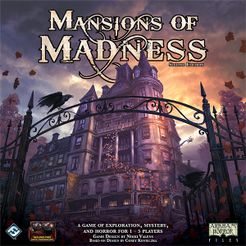
Investigate a cooperative horror mystery guided by an app, exploring unfolding locations and handling monsters and mental strain before the objective changes.
Mansions of Madness: Second Edition supports 1–5 players; community best: 3–4 players; playing time: 120–180 minutes. A WANGO browser trial has not been confirmed.
Background & introduction
Mansions of Madness: Second Edition sends investigators into Arkham's houses, streets, and other unsettling places. Players search for clues, examine people and objects, and confront emerging monsters together. The app manages the map, story, and enemies, so no player needs to serve as the Keeper.
Each scenario has its own mystery and objective. Players discuss plans and allocate actions during the investigator phase; the mythos phase then brings events and danger. Spending too much time fighting, or neglecting Damage and Horror, can leave the investigation unfinished. This overview explains the base system without revealing scenario solutions or endings.
Core rules & scoring
Use the companion app to select a scenario and register the products and investigators in play, then set up starting locations and possessions as instructed. A solo player controls two investigators; in multiplayer, each player normally controls one. Do not enable expansions whose components are not prepared for this game.
Each round has an investigator phase followed by a mythos phase. Investigators choose their turn order, with each taking one turn of up to two actions. An action may be repeated. App options with the action icon cost an action; simply inspecting an option without that icon does not.
A move action allows up to two spaces. You may interrupt it with your other action, then finish the remaining movement. Exploring, searching, interacting, attacking, and trading have their own position requirements and conditions. Melee attacks normally target a monster in your space; ranged attacks require a target within range.
Before voluntarily leaving a monster's space, or taking an action there other than attacking or moving, resolve an evade check against the monster in that space with the highest awareness. Its effects may forfeit your action. Attacking itself does not require an evade check, and moving through a monster's space does not waive the check when leaving it.
For a test, determine the dice pool from the skill, modifier, and other effects. Roll at least one die even if the pool would be smaller, then resolve successes as instructed. Each Clue spent converts one investigation result to a success, not a blank. Darkness restrictions and explicit card effects take precedence.
The mythos phase resolves events, monster activations, then horror checks. Each investigator checks only against the monster within range with the highest horror rating, and makes no check if none is in range. Investigators affected by the same monster each resolve the same check instruction generated for it by the app.
Record Damage and Horror with cards, counting both faceup and facedown cards. Reaching health or sanity first makes you Wounded or Insane and discards the corresponding facedown cards; reaching that threshold again while already in that condition eliminates you. Scenario objectives and timing determine the outcome, rather than a kill count. After an investigator is eliminated, the group loses if the investigation is still incomplete at the end of the next investigator phase; eliminating everyone causes an immediate loss. Insanity and other special effects may change an individual's victory conditions, and eliminated investigators normally cannot win with the group.
Rules & gameplay questions
Can a solo player choose just one investigator?
The base solo setup requires two investigators. Each has a separate turn, possessions, Damage, and Horror. Enter both characters in the app.
Can I move one space, search, then use my remaining movement?
Yes. You may interrupt a move action with your other action, then finish its unused movement, up to two spaces in total. Searching still costs that other action and must meet its location and evade requirements.
Can I spend a Clue to convert a blank, or hand Clues to another investigator like items?
Normally, neither is allowed. The basic Clue conversion changes an investigation result into a success, not a blank. Clues are also not possessions that can be exchanged with the trade action. Follow any explicit special effect that allows otherwise.
If three monsters are within range, do I make three horror checks?
No. Check only against the one with the highest horror rating; if that rating is tied, choose one of those monsters. Resolve the instruction generated by the app. With no monsters within range, make no horror check.
Rules & introduction sources
- Edition
- Fantasy Flight Games' 2016 Mansions of Madness Second Edition base rules, using the 24-page English Rules Reference entries for Setup, Action, Damage & Horror, Evade Check, Investigator Phase, Mythos Phase, Test, and Winning & Losing. Covers common base-scenario play for 1–5 players, with a solo player controlling two investigators. Excludes scenario solutions, first-edition Keeper rules, expansion-specific mechanisms, and exhaustive Insane Condition or item interactions. Explicit app and component exceptions take precedence.
- Rule references
- Introduction source
- BoardGameGeek
WANGO editorial
| Parameter | Recorded value |
|---|---|
| BGG overall rank (snapshot) | #79 |
| Complexity Weight | 2.69 / 5 |
| Best player count (community) | 3–4 |
| Player range | 1–5 |
| Playing time (minutes) | 120–180 |
| Core mechanisms | Action Points · Area Movement · Cooperative Game · Dice Rolling · Hand Management · Map Addition · Modular Board · Role Playing · Scenario / Mission / Campaign Game · Solo / Solitaire Game · Stat Check Resolution · Traitor Game · Variable Player Powers |
| Chinese publication | Unconfirmed |
| WANGO browser play | No confirmed WANGO trial |
| Year published | 2016 |
| Suggested age | 14+ |
BGG statistics are stored snapshots, not live rankings. Source checked:2026-09-27
Player questions
What is the best player count for Mansions of Madness: Second Edition, and can I play online?
Mansions of Madness: Second Edition supports 1–5 players; community best: 3–4 players; playing time: 120–180 minutes. A WANGO browser trial has not been confirmed. Recorded mechanism tags: Solo / Solitaire Game.
How complex is Mansions of Madness: Second Edition, and which mechanisms does it use?
Weight: 2.69 / 5. Mechanisms: Action Points · Area Movement · Cooperative Game · Dice Rolling · Hand Management · Map Addition · Modular Board · Role Playing · Scenario / Mission / Campaign Game · Solo / Solitaire Game · Stat Check Resolution · Traitor Game · Variable Player Powers. Chinese publication: Unconfirmed.
Where can I learn Mansions of Madness: Second Edition?
No rule guide, strategy article or WANGO trial has been confirmed for this record.