Sagrada
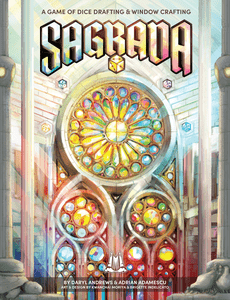
A dice-drafting puzzle inspired by the Sagrada Familia’s stained glass: colour identifies the glass and die values its shade, as players build windows and pursue objectives over ten rounds.
Sagrada supports 1–4 players; community best: 2 players; playing time: 45 minutes. A WANGO browser trial has not been confirmed.
Background & introduction
Players are stained-glass artisans choosing materials from a shared rolled pool and fitting them into their windows. Each die has both a colour and a value, so a placement must fit the space while leaving legal options for later. Window difficulty also determines starting Favor Tokens.
Each round gives every player two turns, first clockwise and then back in reverse order. The last player to make a first choice immediately makes a second. Taking the first suitable die and seeing what others leave behind offer different tradeoffs; tools can adjust the situation at a Favor Token cost.
Scoring combines shared public objectives, a private colour objective and unspent Favors, with a penalty for empty spaces. A full window therefore does not automatically win: colours, values and objective combinations all matter. This entry uses original base rules and distinguishes official solo play, without importing remastered objective rules.
Core rules & scoring
Original standard play supports2–4 players and lasts ten rounds. Deal each player one private objective and two double-sided window cards; choose one of the four patterns and take Favor Tokens equal to its difficulty. Reveal three Tools and three public objectives.
Each round draw and roll two dice per player plus one:5/7/9 dice for2/3/4 players. This is the shared Draft Pool. Use all90 original dice in the bag; do not import remastered player-count reductions.
Turns run clockwise from the start player, then reverse from the last player back to the first. On each turn you may draft and place one die and use one Tool in either order, do only one, or pass both actions.
Your first die must touch an edge or corner of the window. Every later die must touch an existing die orthogonally or diagonally. It must match any printed colour or value restriction on its space.
Dice sharing an edge may never have the same colour or value. Diagonal neighbours may match, and white spaces remove only the printed-space restriction, not adjacency rules.
To use a Tool, place one Favor Token on it if it has none, otherwise two, then resolve its ability. The tokens stay for the whole game. A Tool waives only the restrictions it explicitly identifies; other placement rules remain.
After both turns per player, put every remaining pool die on that round’s track space, even if multiple dice remain. Pass the bag clockwise to set the next start player. After round ten, proceed to scoring.
Score public objectives, the sum of values on dice matching your private objective colour, and one point per unspent Favor; lose one per empty space. Row/column objectives require completed rows/columns. Ties compare private-objective points, remaining Favors, then reverse player order in the final round.
For official solo, use no Favors, reveal two public and two private objectives, and choose1–5 Tools to set difficulty. Roll four dice per round and take two turns. A Tool is paid with a matching-colour pool die; that die and Tool leave play after the single use.
Solo still lasts ten rounds. Put unused dice on the round track without changing their values; their total is your target. Choose only one private objective for your score, lose three per empty space, and win only by strictly beating the target. Dice spent on Tools do not contribute to the target.
Rules & gameplay questions
Can diagonally touching dice share a colour or value?
Yes. Diagonal contact connects a later die to your window, while the matching-colour/value prohibition applies only across shared edges.
Must I take a die if nothing fits?
No. Drafting/placement and Tool use are optional. You may do either, both or neither, but a drafted die must be legally placed.
Do Tool costs reset each round, or can I gain extra Favors?
No. The publisher-verified Dized FAQ confirms that tokens remain on Tools for the game and no additional Favor Tokens are gained in the base game.
What happens if a window is found to break a placement rule?
Immediately remove dice of that player’s choice until every restriction is satisfied. Those dice leave play, and the resulting empty spaces incur the normal scoring penalty.
Is an original private colour objective worth three points per matching die?
No. In the original rules it scores the sum of the matching dice’s values. Solo chooses one of its two revealed private objectives; remastered scoring changes are outside this entry.
Rules & introduction sources
- Edition
- Original Sagrada base standard2–4 and official solo, checked against Floodgate’s Second Printing and original v1.2 four-page rules plus publisher-verified Dized FAQ. Excludes Sagrada Remastered, Artisans,5–6 players, private dice pools and all Great Facades/other expansion modules. Original private objectives sum die values; solo uses target-score play, no Favors and three-point empty-space penalties.
- Rule references
- Introduction source
- BoardGameGeek
WANGO editorial
| Parameter | Recorded value |
|---|---|
| BGG overall rank (snapshot) | #228 |
| Complexity Weight | 1.92 / 5 |
| Best player count (community) | 2 |
| Player range | 1–4 |
| Playing time (minutes) | 45 |
| Core mechanisms | Contracts · Dice Rolling · End Game Bonuses · Grid Coverage · Open Drafting · Pattern Building · Set Collection · Solo / Solitaire Game · Turn Order: Progressive · Variable Set-up |
| Chinese publication | Unconfirmed |
| WANGO browser play | No confirmed WANGO trial |
| Year published | 2017 |
| Suggested age | 14+ |
BGG statistics are stored snapshots, not live rankings. Source checked:2026-09-27
Player questions
What is the best player count for Sagrada, and can I play online?
Sagrada supports 1–4 players; community best: 2 players; playing time: 45 minutes. A WANGO browser trial has not been confirmed. Recorded mechanism tags: Solo / Solitaire Game.
How complex is Sagrada, and which mechanisms does it use?
Weight: 1.92 / 5. Mechanisms: Contracts · Dice Rolling · End Game Bonuses · Grid Coverage · Open Drafting · Pattern Building · Set Collection · Solo / Solitaire Game · Turn Order: Progressive · Variable Set-up. Chinese publication: Unconfirmed.
Where can I learn Sagrada?
No rule guide, strategy article or WANGO trial has been confirmed for this record.