Santorini
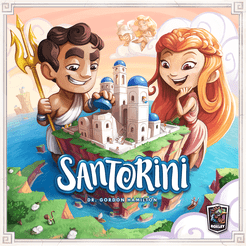
Santorini is an abstract strategy game about movement and construction on a Greek island. In the basic two-player game, move one worker and then build with that worker; moving up onto the third level wins immediately.
Santorini supports 2–4 players; community best: 2 players; playing time: 20 minutes. A WANGO browser trial has not been confirmed.
Background & introduction
Santorini combines tactical movement and construction on a five-by-five island. Each player controls workers that navigate empty spaces and growing buildings. The basic objective is direct: on your turn, move one of your workers up onto a third-level building space. A player can also lose by being unable to complete the required move and build.
A basic turn has two steps. Select one worker, move it to an adjacent empty space, and use that same worker to build in an adjacent unoccupied space. Diagonal spaces count as adjacent. A worker can climb at most one level at a time, move along the same level, or descend any number of levels. Buildings rise through three block levels; a dome placed above level three closes the space to ordinary movement.
Movement changes the starting point for construction, and construction changes the routes available on later turns. A player can prepare a staircase toward level three or place a dome over a dangerous tower to prevent an opponent from entering. The workers themselves occupy spaces, so positioning and the relationship between both workers matter as much as the individual blocks.
Once everyone understands the basic game, God Powers offer asymmetric changes to movement, construction, restrictions, or winning conditions. A power changes only what it specifies; other ordinary rules still apply. This guide refers to the classic rulebook, so consult the cards and player-count instructions supplied with your own edition.
Core rules & scoring
Goal: In the basic two-player game, each player controls two workers. Move one of your workers up onto level three during your turn to win immediately, without completing a build. If you cannot complete the required move and build, you lose. The basic game has no points tally.
Setup: Assemble the ocean board, cliff pedestal, and five-by-five island. The youngest player is the starting player and places two workers of one color on unoccupied spaces. The other player then places their two workers. Begin with an empty island and building pieces beside the board.
Move: Select one of your workers and move it to one of the up to eight neighboring spaces, including diagonals. The destination must contain neither a worker nor a dome. A worker may move up at most one level, stay at the same height, or move down any number of levels. Moving directly from ground to level two is not permitted under the basic rules.
Build: The worker you just moved builds in a neighboring unoccupied space, including diagonals. Use the next appropriate piece: level one on ground, then level two, then level three, and finally a dome above level three. A space occupied by a worker or dome cannot be built on under ordinary rules. The space the worker just vacated can be used if otherwise legal.
Winning and getting stuck: Moving up onto level three on your own turn wins at once. Moving from one level-three space to another is not moving up, and being forced onto level three is not considered moving. Unless already victorious, you must be able to perform both the required move and build; inability to do so loses the game.
God Power setup: Assemble the island, then the challenger selects as many God Powers as players and checks that they are compatible with the player count. Players choose powers clockwise, with the challenger taking the last one. The challenger chooses the start player, then players place workers in order and follow any power-specific setup instructions.
Using powers: Follow the timing and text on each power. Normal rules continue except where the power explicitly changes them. Restrictions using 'cannot' or 'must' must be obeyed; failing to do so loses the game. Domes are not blocks, and a power affecting blocks does not automatically affect domes. Some powers add a separate winning condition.
Three and four players: Both variants require God Powers marked for that player count. In a three-player game, a player who loses removes their workers, tokens, and power; the last player remaining wins. Four players form two teams, alternating turns and sharing two workers per team. Each player uses their own power, and a player's win or loss applies to the team. During setup, each team's first player places the workers and its second player takes the first turn.
Piece supply: Blocks are considered unlimited in the classic rules. If a type runs out, remove a complete tower from the board and replace it with a dome on the ground, releasing the blocks for reuse. A complete tower consists of three blocks and a dome.
Rules & gameplay questions
How do you win Santorini?
In the basic two-player game, you win immediately when your worker moves up onto level three during your own turn. You do not need to build afterward. Your opponent also loses if unable to complete the required move and build. God Powers may add other winning conditions, so read the particular power in use.
How far can a worker climb or descend?
Under the basic movement rules, a worker can move to a neighboring space at the same height, climb one level, or descend any number of levels. The destination cannot contain a worker or dome. Diagonal spaces are neighbors. A worker cannot normally move directly from ground level to a level-two space.
Can I build where my worker just stood?
Yes, if that vacated space is unoccupied and neighboring the worker after its move, it can be a legal build location. In a basic turn the same worker must move first and then build the appropriate next piece in an adjacent unoccupied space. Check any God Power restrictions before choosing the location.
Does placing a dome on level three win?
No. The normal victory condition requires your worker to move up onto level three during your own turn. Placing a dome above a level-three block instead closes that space to ordinary worker movement, which can prevent an opponent from climbing there. Individual God Powers may create different options or winning conditions.
Does being forced onto level three win?
No. The classic rules distinguish a worker being forced from that worker moving. The ordinary victory requires your worker to move up onto level three during your turn. Moving horizontally from one level-three space to another also does not satisfy the upward move. A power with a separate win condition should be read on its own terms.
What happens if I cannot move or build?
In the basic game you must move one worker and then build with that same worker. If you cannot complete the required move and build, you lose. Consider whether a legal build will remain after a potential move. If the move itself reaches the ordinary level-three victory, you win immediately before the build step.
Do God Powers replace every basic rule?
No. A God Power changes the parts of play described in its text; other normal rules continue to apply. Follow the specified timing, any mandatory or prohibited actions, and any additional setup or win conditions. For multiplayer games, select powers marked as compatible with the player count.
Can we play without God Powers?
Yes. The classic rulebook recommends starting with several basic two-player games without God Powers. Each player places two workers, and turns consist of moving one worker and then building with it. Once the movement, building, and victory rules are familiar, introduce powers to explore their specific exceptions.
Rules & introduction sources
- Edition
- This guide follows Roxley's 2017 classic rulebook. It explains the basic two-player game first and then introduces God Powers and multiplayer adjustments. Cards and components can differ between editions.
- Rule references
- Introduction source
- BoardGameGeek
WANGO editorial
| Parameter | Recorded value |
|---|---|
| BGG overall rank (snapshot) | #317 |
| Complexity Weight | 1.72 / 5 |
| Best player count (community) | 2 |
| Player range | 2–4 |
| Playing time (minutes) | 20 |
| Core mechanisms | Grid Movement · Map Reduction · Race · Square Grid · Team-Based Game · Three Dimensional Movement · Variable Player Powers |
| Chinese publication | Unconfirmed |
| WANGO browser play | No confirmed WANGO trial |
| Year published | 2016 |
| Suggested age | 8+ |
BGG statistics are stored snapshots, not live rankings. Source checked:2026-09-27
Player questions
What is the best player count for Santorini, and can I play online?
Santorini supports 2–4 players; community best: 2 players; playing time: 20 minutes. A WANGO browser trial has not been confirmed. Recorded mechanism tags: Team-Based Game.
How complex is Santorini, and which mechanisms does it use?
Weight: 1.72 / 5. Mechanisms: Grid Movement · Map Reduction · Race · Square Grid · Team-Based Game · Three Dimensional Movement · Variable Player Powers. Chinese publication: Unconfirmed.
Where can I learn Santorini?
No rule guide, strategy article or WANGO trial has been confirmed for this record.