Great Western Trail
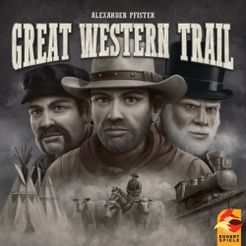
Alexander Pfister’s cattle-ranching game sends herds from Texas to Kansas City, combining a personal cattle deck, trail buildings and railway development in a race for victory points.
Great Western Trail supports 2–4 players; community best: 3 players; playing time: 75–150 minutes. A WANGO browser trial has not been confirmed.
Background & introduction
Great Western Trail combines cattle-deck management, route movement and railway development. Players repeatedly travel to Kansas City, using buildings along the trail to improve the value of their next delivery.
Cowboys improve cattle-buying options, craftsmen support construction, and engineers increase locomotive movement. A larger herd is not automatically a better delivery: only distinct breeds in your current hand count, so discarding for rewards competes with keeping valuable cattle.
Delivery income, railway progress and city discs shape long-term plans. Removing discs from your player board unlocks abilities; stations, buildings, cattle and objectives offer several scoring routes, while the advancing job market determines the final sprint.
Core rules & scoring
Each turn consists of movement, actions at the destination, then drawing up to your hand limit. On your first turn, start directly at any neutral building. Subsequently move forward along the arrows at least one step and no farther than your step limit. Each tiled location costs one step, empty spaces cost none, and Kansas City is a mandatory stop.
Pay hand-symbol fees when entering or passing a location: pay an opposing building’s owner, or the bank for hazards and teepees. Green/black hands cost $2/$2 with two players, $2/$1 with three, and $1/$2 with four. Only these fees allow you to pay what you have and continue; all other costs must be paid in full.
At a neutral or your own building, perform each available local action once, or forgo all local actions for one unlocked single auxiliary action. At an opposing building, hazard or teepee, only a single auxiliary action is available; stopping does not automatically collect its tile.
Pay to hire cowboys, craftsmen or engineers from the job market, excluding the row containing its token. Cowboys and money determine cattle purchases, with new cards entering your discard pile. Craftsmen determine construction requirements and costs; replacing your own building uses the difference in craftsmen required. Engineers support forward locomotive movement.
Each player starts with 14 cattle cards and a four-card hand limit, expandable to six. Refill only at turn end; shuffle your discard pile only when you need to draw and your draw stack is empty. In Kansas City, first move one tile from each of the three foresight groups to its section. Reveal your hand, count each distinct breed once, add permanent certificates and any temporary certificates you choose to spend, collect that many dollars, then discard your entire hand.
Choose a delivery city whose value does not exceed that total breeding value. You normally cannot revisit a city containing your disc; Kansas City and San Francisco are exceptions. Move a disc from your player board to the city, unlocking its former space while observing corner restrictions and additional costs. Green-arrow rewards and points require your discs on both adjacent cities.
After delivery, pay $1 per railroad cross between your locomotive’s nose and the city; delivery is free if the locomotive has reached or passed it. Stopping at a station turnout permits a paid upgrade and disc placement; only when upgrading may you also leave the rightmost hired worker of one of your worker rows to take an available station master tile. After delivery, return the cattleman to the start, refill foresight spaces, then refill your hand.
Placing a worker in Kansas City that pushes the job market token beyond its final space triggers the end. Finish that turn, then every other player takes one final turn. Score 1 VP per $5, buildings, cities, stations, hazards, cattle, objectives and station master bonuses, among other categories. Workers in the fifth/sixth row spaces score 4 VP each, the relevant unlocked space scores 3 VP, and the end-trigger token scores 2 VP. Played objectives must score, including printed penalties for failure; objectives still in your deck may be omitted. Highest total wins; ties share victory.
Rules & gameplay questions
Can duplicate cattle breeds increase a delivery’s value?
No. Count each distinct breed in your current hand once, not every card or your entire deck. Printed cattle victory points score separately at game end, and objective cards add no breeding value.
Can newly purchased cattle help with an immediate delivery?
Purchased cattle normally go to your discard pile, not your hand. They enter a new draw stack only when you must draw from an empty stack. Refill at turn end, not after each action.
Are green hands free, and does running out of money block movement?
Both green and black hands charge fees, with amounts depending on player count. If short, pay the cash you have and continue. This exception does not cover transport, construction, hiring or other costs.
Must my locomotive reach a city before I can deliver there?
Delivery eligibility depends on total breeding value and the city-disc restrictions. A locomotive behind the city creates transport costs of $1 per cross. Receive delivery income before paying transport.
Does filling my personal worker rows end the game?
No. The trigger is a worker added in Kansas City pushing the public job market token beyond its last space. The active player finishes the turn and every other player gets one final turn.
Rules & introduction sources
- Edition
- Uses the 2016 eggertspiele English original base rules for 2–4 players, read in a public 1jour-1jeu mirror of the official 16-page ©2016 rulebook. Excludes Rails to the North, Second Edition, Argentina, New Zealand and solo variants. This overview does not replace the full building illustrations and objective details.
- Introduction source
- BoardGameGeek
WANGO editorial
| Parameter | Recorded value |
|---|---|
| BGG overall rank (snapshot) | #21 |
| Complexity Weight | 3.70 / 5 |
| Best player count (community) | 3 |
| Player range | 2–4 |
| Playing time (minutes) | 75–150 |
| Core mechanisms | Contracts · Deck, Bag, and Pool Building · Hand Management · Income · Ownership · Rondel · Set Collection · Track Movement · Variable Set-up |
| Chinese publication | Unconfirmed |
| WANGO browser play | No confirmed WANGO trial |
| Year published | 2016 |
| Suggested age | 12+ |
BGG statistics are stored snapshots, not live rankings. Source checked:2026-09-27
Player questions
What is the best player count for Great Western Trail, and can I play online?
Great Western Trail supports 2–4 players; community best: 3 players; playing time: 75–150 minutes. A WANGO browser trial has not been confirmed.
How complex is Great Western Trail, and which mechanisms does it use?
Weight: 3.70 / 5. Mechanisms: Contracts · Deck, Bag, and Pool Building · Hand Management · Income · Ownership · Rondel · Set Collection · Track Movement · Variable Set-up. Chinese publication: Unconfirmed.
Where can I learn Great Western Trail?
No rule guide, strategy article or WANGO trial has been confirmed for this record.