Sushi Go Party!
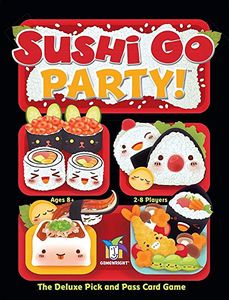
Sushi Go Party! is a three-round simultaneous pick-and-pass card game. Build a menu before play, then choose sushi, appetizers, desserts, and special cards from passing hands to score combinations and earn the highest total.
Sushi Go Party! supports 2–8 players; community best: 4–5 players; playing time: 20 minutes. A WANGO browser trial has not been confirmed.
Background & introduction
Sushi Go Party! turns a sushi feast into a quick, simultaneous card-selection contest. Before each game, players choose the menu for that session, deciding which sushi, appetizers, special cards, and desserts will enter the deck. A different menu changes the combinations and scoring routes players must watch, so the same box supports varied games instead of one fixed set of cards.
A game lasts three rounds. In each round, everyone receives a hand, secretly chooses one card, reveals together, passes the remaining hand to the left, and takes a new hand from the right. Players must predict what others are collecting while trying to build sets such as Tempura, Sashimi, or Onigiri. Special cards may provide extra picks, take a card from another player's hand, or transform cards already played into another kind of score.
Most ordinary cards score at the end of each round and then return to the deck; Desserts stay with players until the end of all three rounds. Scoring varies: some cards reward sets, some compare majorities, and some race toward a threshold during play. If the menu includes special effects, resolve them in the order stated by the rules. Add the three round scores to the final Dessert score; the highest total wins, with Dessert count breaking a score tie.
Core rules & scoring
Edition and menu: This entry follows Gamewright's 2016 Sushi Go Party! Rules of Play, product #419, for BGG 192291. The game supports 2–8 players. Choose a fixed menu or make a custom menu following the rulebook; a custom menu includes Nigiri, one of the three Roll types, three Appetizers, two Specials, and one Dessert. Put only the selected cards in the game. Menu and Special Order are for 2–6 players; Spoon and Edamame are for 3–8 players, so neither is used in a two-player game.
Setup and deal: Put the scoring board in the center and set each player's pawn to zero. Place the tiles for the chosen menu where everyone can see the card rules. Shuffle the selected non-Dessert cards together and keep selected Desserts separate. Play three rounds; shuffle the round's specified Desserts into the main deck before dealing. Hand size is 10 cards for 2–3 players, 9 for 4–5, 8 for 6–7, and 7 for 8 players. Use 5/3/2 Desserts in rounds one/two/three for 2–5 players, or 7/5/3 for 6–8 players.
Simultaneous pick and pass: Each round, everyone secretly chooses one card from their hand and places it face down. When all players are ready, reveal choices together. Pass the remaining hand face down to the player on the left, then take the new hand from the right. Repeat until all hands are empty. Ordinary cards stay in front of their owner for round scoring; special cards are discarded, copied, or moved aside when their text instructs.
Same-turn order: Reveal the normal pick first, resolve extra actions, then pass hands. Chopsticks and Spoon cannot activate on their initial turn; call them during a later reveal. Resolve these bonuses and simultaneous Menu/Takeout Box effects in ascending lower-right number. Menu draws four unused cards, immediately plays one that is not another Menu, returns and shuffles the other three, and discards itself beside the board. It cannot chain into another Menu.
Common sets: Egg, Salmon, and Squid Nigiri score 1, 2, and 3; Nigiri placed on an unused Wasabi is tripled, and each Wasabi can hold one Nigiri. A pair of Tempura scores 5; three Sashimi score 10; incomplete sets score zero. Dumplings score 1/3/6/10/15 for one/two/three/four/five or more. Exactly one Eel loses 3, while two or more score 7. Tofu scores 2 for one, 6 for two, and zero for three or more.
Majorities and races: Maki icon totals award 6/3 for 2–5 players or 6/4/2 for 6–8. Ties get full points and the next distinct total gets the next scoring tier; at least one Maki is required. Temaki most gets four and fewest, including zero, loses four, with no two-player penalty. Uramaki reaching ten icons immediately takes the next 8/5/2 place and discards its rolls. Same-turn finishers compare icons, then share a still-tied place and skip following places accordingly. Most icons remaining at round end earns the next unawarded place; one player can score multiple places.
Appetizers and colors: Each Edamame scores opponents with any Edamame, up to four per card, or zero if alone. Count Miso Soup across the entire pick turn, including normal reveal and every later bonus action, not just one instant. Exactly one Soup stays to score three at round end; multiple Soups played that turn are all discarded, leaving earlier-turn Soups unaffected. Soy Sauce counts this round’s background colors including itself and only this round’s Desserts; most or tied-most earns four per Soy Sauce. Each Tea scores the card count of your largest same-color group. Onigiri sets of one to four distinct shapes score 1/4/9/16, allowing multiple sets.
Spoon, copies and flipping: Spoon searches leftward for a named general type or exact variant; the holder chooses among variants for a general request. Play the received card and hand over Spoon, or discard Spoon if nobody has it. A Special Order played normally from hand points at its previously played target before reveal. Copying Nigiri does not copy the original Wasabi tripling; copied Wasabi starts empty. Takeout Box flips cards played on earlier turns this round into identity-less two-point cards. An established Special Order copy stays its chosen type even if the original is later flipped.
Round and final scoring: Set aside played Desserts, score other cards, then reshuffle non-retained cards and add the next dessert allotment. After round three, Pudding most scores six and fewest, including zero, loses six, ties taking full amounts; no two-player fewest penalty. Green Tea Ice Cream scores twelve per complete four-card set. Fruit icons score each of watermelon, orange and pineapple separately: 0/1/2/3/4/5+ icons yield −2/0/1/3/6/10, summed across all three. Highest total round plus dessert points wins, then most dessert cards. Special Order copying a Dessert is retained too, not reshuffled next round.
Rules & gameplay questions
Is the menu fixed, or can players choose the cards?
The menu is not fixed. Players can choose a preset menu from the rulebook or construct one following the custom-menu rules, which include Nigiri, one Roll type, three Appetizers, two Specials, and one Dessert. Only cards selected for that menu enter the game. Keep the menu tiles visible so players can check the effects; do not mix every card in the box into one deck.
How many cards does each player receive each round?
The deal depends on player count: 10 each for two or three players, 9 for four or five, 8 for six or seven, and 7 for eight. Desserts are shuffled into the round's deck beforehand: use 5, 3, and 2 across the three rounds with 2–5 players, or 7, 5, and 3 with 6–8 players. Deal the hands before simultaneous picks begin.
Which way do hands move after a pick?
Each player secretly chooses one card and places it face down; once everyone has chosen, all reveal together. Pass the remaining cards face down to the left, then take the next hand from the right. Repeat until the hands are empty. Picks are simultaneous rather than sequential, so decide before seeing the other players' revealed choices and remember which hand you will receive next.
How do Wasabi and Nigiri work together?
After a Wasabi is played, it waits for the next Nigiri; that Nigiri must be placed on the Wasabi and scores triple. Egg, Salmon, and Squid Nigiri therefore score 3, 6, and 9 on Wasabi. Each Wasabi can hold one Nigiri, and an unused Wasabi scores nothing. If a bonus effect plays a Nigiri while you have an empty Wasabi, the Nigiri must go on it.
What if multiple Miso Soups are revealed at once?
Count the whole pick turn: the ordinary reveal and all later numbered bonus actions, including Chopsticks, Spoon, Menu and Special Order. A second Soup appearing later in that turn still discards both, even though not revealed at the same instant. Only a sole Soup survives to score three at round end; Soups retained from earlier turns are unaffected. Discarded ones wait beside the board until the next reshuffle.
Do Chopsticks and Spoon both give me another pick?
Both provide an extra play, but Chopsticks chooses from your current remaining hand and goes back into that hand before passing. Spoon searches opponents leftward for a named general type or exact variant; a general request lets the holder choose the variant. Play what you receive and hand over Spoon. If nobody has it, discard Spoon rather than drawing a replacement. Neither works on its initial play turn.
Does Maki scoring change with six or more players?
Yes. With two to five players, the most Maki icons scores 6 and second-most scores 3. With six to eight players, first, second, and third score 6, 4, and 2. Tied players receive the full points for the place they tie rather than splitting later-place points. A player must have played at least one Maki card to score; zero icons do not earn a place.
When are Dessert cards scored?
At each round end, set played Desserts aside instead of scoring them with the other cards or shuffling them back into the deck. Score them only after all three rounds. Pudding compares most and fewest, Green Tea Ice Cream scores complete sets of four, and Fruit counts each of its three icon types. Do not add Dessert points into the intermediate round-end total.
Does a Special Order keep the copied card's icons and effects?
It copies the chosen identity and icons with specific interactions. Point at the target before revealing a normal Special Order. A copied Nigiri on Wasabi does not copy the tripling, while copied Wasabi is empty. Copied Dessert stays until final scoring and a copy of an already flipped card is also flipped for two. If the original is flipped by Takeout later, an established copy keeps its earlier identity.
Rules & introduction sources
- Edition
- Gamewright Sushi Go Party! (2016 Rules of Play, product #419; BGG 192291), summarized from the publisher's English rules. Supports 2–8 players, with fixed or custom menus. This entry is not a review of the original Sushi Go!, Sushi Roll, other similarly titled games, or the separately listed Chef's Special. A card is used only if selected for the menu, and player-count restrictions follow the Party rules.
- Rule references
- Introduction source
- BoardGameGeek
WANGO editorial
| Parameter | Recorded value |
|---|---|
| BGG overall rank (snapshot) | #289 |
| Complexity Weight | 1.33 / 5 |
| Best player count (community) | 4–5 |
| Player range | 2–8 |
| Playing time (minutes) | 20 |
| Core mechanisms | Closed Drafting · End Game Bonuses · Hand Management · Push Your Luck · Score-and-Reset Game · Set Collection · Simultaneous Action Selection · Variable Set-up |
| Chinese publication | Unconfirmed |
| WANGO browser play | No confirmed WANGO trial |
| Year published | 2016 |
| Suggested age | 8+ |
BGG statistics are stored snapshots, not live rankings. Source checked:2026-09-27
Player questions
What is the best player count for Sushi Go Party!, and can I play online?
Sushi Go Party! supports 2–8 players; community best: 4–5 players; playing time: 20 minutes. A WANGO browser trial has not been confirmed.
How complex is Sushi Go Party!, and which mechanisms does it use?
Weight: 1.33 / 5. Mechanisms: Closed Drafting · End Game Bonuses · Hand Management · Push Your Luck · Score-and-Reset Game · Set Collection · Simultaneous Action Selection · Variable Set-up. Chinese publication: Unconfirmed.
Where can I learn Sushi Go Party!?
No rule guide, strategy article or WANGO trial has been confirmed for this record.