Too Many Bones
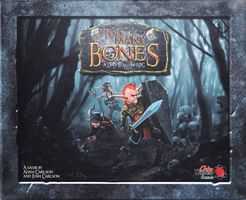
Too Many Bones sends Gearloc adventurers against a chosen Tyrant using distinctive skill dice and growing attributes. Daily encounters provide progress and training, but the party must defeat its target within a limited number of days.
Too Many Bones supports 1–4 players; community best: 2 players; playing time: 60–120 minutes. A WANGO browser trial has not been confirmed.
Background & introduction
Gearlocs leave Obendar for northern lands occupied by hostile creatures. Each adventure begins with a Tyrant whose card determines the required progress, available days, and enemy types. The party wins by defeating that Tyrant rather than comparing individual scores.
Daily encounters offer peaceful or battle choices, with rewards earned through success. Training can improve health, dexterity, attack, defense, or unlock skill dice. Each Gearloc has different specialties and prerequisites, so the same training budget can support different builds.
Battles take place on a compact grid where dexterity pays for both movement and dice. Bones can accumulate for a Backup Plan, defense dice can remain active to absorb damage, and skill dice are usually usable once per battle. Choosing when to spend a useful result matters alongside the roll itself.
Core rules & scoring
Setup: Choose a Tyrant and difficulty, build enemy stacks from its listed creature types, and give each player a Gearloc with its starting skills. Use Solo encounters for one Gearloc or General encounters for multiple Gearlocs; mix in that Tyrant’s encounters and put Special encounters 001–003 on top in order.
Daily sequence: Advance the day counter, draw an encounter and choose an option, collect its specific and general rewards if successful, then recover. Failure skips rewards but still leads to recovery. The next day advances regardless of the previous result.
Training: Health, dexterity, and skill training always succeed. Attack and defense require their prescribed dice checks; a failed attempt lets you spend that point elsewhere. Follow skill arrows and prerequisites on the Gearloc mat. Consumables cannot be acquired through ordinary training.
Battle setup: A standard enemy-point total is the current day multiplied by the number of Gearlocs, adjusted by the encounter. Build the queue using the largest point values possible. Normally four enemies can be on the mat; replacements enter after the end of a round and receive initiative positions according to their type.
Gearloc turn: Resolve start-of-turn effects, pay dexterity for movement, choose one target, then roll selected dice simultaneously using remaining dexterity. Melee attacks require an adjacent legal target; skill damage is not an Attack. Resolve results as needed, allocate active or locked dice and Bones, and use at most one Backup Plan skill per turn.
Enemy turn: Melee enemies pursue the closest reachable opponent, moving up to two spaces, then use their strongest/weakest targeting icon to break distance ties. Ranged enemies stay put and select opponents using their targeting icon. Resolve skills, roll dice, apply defense, attack damage, and Bones-triggered skills in order; a Tyrant then resolves its special die.
Fatigue and failure: After round five, fatigue rounds remove one health from all units on the mat at the start of each round, normally without prevention. A full-party knockout immediately ends the battle and forfeits its rewards, but the adventure continues. During recovery, each Gearloc chooses full healing, a loot search, or scouting as its individual option.
Final objective: After reaching the required progress, the party can challenge the Tyrant instead of drawing an encounter in a later encounter phase. The challenge uses a day. Defeating the Tyrant ends the final battle without clearing other enemies. A failed challenge may be retried while days remain; exceeding the day limit without victory loses the adventure.
Rules & gameplay questions
Does dealing damage with skill dice count as an Attack?
No. An Attack means rolling white attack dice against a target; skill damage is separate. Apply effects that require an Attack accordingly. Without an adjacent legal target, a melee Gearloc cannot roll attack dice merely to collect Bones.
Does a party wipe permanently kill the Gearlocs?
No. A failed battle leads to recovery rather than immediately ending the adventure. Gearlocs retain training and loot, but receive no encounter rewards and still spend the day. The adventure is lost if its Tyrant deadline expires before the objective is completed.
How does one Gearloc differ from a larger party?
One Gearloc uses the Solo encounter set, while two or more use General encounters. Both include the chosen Tyrant’s encounters and the first three Special encounters. Calculate enemy points using the number of Gearlocs, not the number of human players.
Do defense dice or Bones reduce the dice available on later turns?
Defense dice in active slots reduce available defense dice. White attack or defense dice in the Backup Plan do not reduce the number provided by those stats. White dice are normally reusable; skill dice normally exhaust after use for the battle. A skill die rolled but not used can return to its skill slot unless its rules say otherwise.
Which resolves first when Poison and recovery occur at the start of a turn?
Players choose the order of simultaneous effects. For example, Poison can defeat an enemy with one health before it recovers. Fatigue affects all units simultaneously at the start of a round, so it cannot be rearranged with start-of-turn effects.
Rules & introduction sources
- Edition
- Original Too Many Bones box, 1–4 players cooperatively or solo; Chip Theory Games English base rules Version 2.2 (32 pages, PDF dated May 19, 2023) and official rules FAQs. Select difficulty using page 23; individual Gearloc and Tyrant abilities require their reference sheets and cards. Excludes Undertow, Unbreakable, Splice & Dice, and campaign expansions.
- Rule references
- Introduction source
- BoardGameGeek
WANGO editorial
| Parameter | Recorded value |
|---|---|
| BGG overall rank (snapshot) | #37 |
| Complexity Weight | 3.87 / 5 |
| Best player count (community) | 2 |
| Player range | 1–4 |
| Playing time (minutes) | 60–120 |
| Core mechanisms | Cooperative Game · Dice Rolling · Die Icon Resolution · Grid Movement · Narrative Choice / Paragraph · Resource to Move · Role Playing · Scenario / Mission / Campaign Game · Solo / Solitaire Game · Square Grid · Stat Check Resolution · Tech Trees / Tech Tracks · Turn Order: Role Order · Variable Player Powers |
| Chinese publication | Unconfirmed |
| WANGO browser play | No confirmed WANGO trial |
| Year published | 2017 |
| Suggested age | 12+ |
BGG statistics are stored snapshots, not live rankings. Source checked:2026-09-27
Player questions
What is the best player count for Too Many Bones, and can I play online?
Too Many Bones supports 1–4 players; community best: 2 players; playing time: 60–120 minutes. A WANGO browser trial has not been confirmed. Recorded mechanism tags: Solo / Solitaire Game.
How complex is Too Many Bones, and which mechanisms does it use?
Weight: 3.87 / 5. Mechanisms: Cooperative Game · Dice Rolling · Die Icon Resolution · Grid Movement · Narrative Choice / Paragraph · Resource to Move · Role Playing · Scenario / Mission / Campaign Game · Solo / Solitaire Game · Square Grid · Stat Check Resolution · Tech Trees / Tech Tracks · Turn Order: Role Order · Variable Player Powers. Chinese publication: Unconfirmed.
Where can I learn Too Many Bones?
No rule guide, strategy article or WANGO trial has been confirmed for this record.