Aeon's End
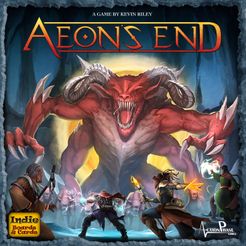
Cooperate as breach mages to defeat a nemesis and protect Gravehold, planning spell preparation and deck order while a separate turn-order deck keeps the timing uncertain.
Aeon's End supports 1–4 players; community best: 2 players; playing time: 60 minutes. A WANGO browser trial has not been confirmed.
Background & introduction
Designed by Kevin Riley, Aeon’s End casts players as breach mages defending Gravehold. Gems provide aether, relics have immediate effects, and spells normally need to be prepared in breaches before being cast on a later turn. The team confronts one nemesis with its own special mechanisms.
When a player deck runs out, the normal procedure flips the discard pile rather than shuffling it. Purchases, cast spells and end-of-turn discards therefore influence the next cycle. The separate turn-order deck does shuffle, making player and nemesis turns unpredictable and sometimes consecutive.
The chosen mages, nemesis and shared supply create a different challenge each game. This entry covers the original core box’s cooperative system and solo options; mechanisms exclusive to later standalone boxes, expeditions and Legacy campaigns are not general rules.
Core rules & scoring
Normally each mage starts with 10 life and Gravehold with 30. Follow the mage mat for starting hand, deck order and four breach orientations. Build a shared supply of three gems, two relics and four spells. Mix basic and nemesis-specific cards within tiers according to player count, then stack tier 1 above tier 2 above tier 3 and follow the nemesis setup.
Draw turn-order cards to determine each turn. Shuffle their discards only when a draw or reveal is needed and the deck is empty. Two players each have two player cards; four players each have one. Three players each have one plus a wild card whose recipient the team chooses. Add two nemesis cards in each case; true solo uses its own configuration.
A mage’s turn has casting, main and draw phases. During casting, spells prepared in open breaches are optional, while those in closed breaches must be cast. Choose their order, discarding each spell before resolving it. A spell’s damage normally targets one minion or the nemesis and cannot be freely split.
In the main phase, repeatedly play gems or relics, buy cards, gain charges, focus or open breaches, prepare spells and resolve applicable prepared effects or power-discard conditions in any order. Gained cards normally go immediately atop your discard. Two aether buys one charge for yourself, up to the mat’s limit. Activate a fully charged ability only at its stated time, removing all charges. Unspent aether expires at turn end and cannot simply be transferred to an ally. Each main-phase “while prepped” effect may be used once per turn.
Pay a closed breach’s focus cost to rotate it clockwise, or pay its currently displayed opening cost to flip it permanently open. Normally prepare at most one spell per breach, using an open breach or a closed breach focused this turn. A newly prepared spell normally waits for your next casting phase rather than resolving its cast effect immediately.
During the draw phase, put played gems and relics atop your discard in any order, keep unplayed cards, and draw up to five; there is no general maximum hand size. If your deck cannot complete a draw or reveal, use its remaining cards, then flip the whole discard pile to make a new deck without normally shuffling. Do not freely rearrange discards; specific card effects take precedence.
The nemesis resolves existing minion persistent effects and power countdowns from oldest to newest, resolving and discarding powers when their counters reach zero, then draws one card. Attacks resolve immediately and are discarded. Minions and powers resolve immediate text and enter play; their persistent effects or countdowns normally wait until a later nemesis turn. If a draw is required from an empty nemesis deck and the game has not ended, resolve Unleash three times using that nemesis mat.
At zero life a mage becomes exhausted: resolve Unleash twice, destroy one of that mage’s breaches and discard any spell on it, then remove all charges. The mage keeps taking turns but cannot regain life. Damage beyond the amount causing exhaustion, and subsequent damage to that mage, instead deals double damage to Gravehold. All mages exhausted means defeat.
The team immediately wins when the nemesis reaches zero life, or its deck is empty with no minions or powers in play. Zero Gravehold life, all mages exhausted, or a nemesis-specific loss condition causes defeat. Stop immediately when an ending condition is met, without finishing a turn-order cycle.
Rules & gameplay questions
Does the no-shuffling rule also apply to turn-order cards?
No. The turn-order deck shuffles its discards when it needs replenishing; player decks normally flip their discard piles. A card or nemesis effect explicitly instructing a player to shuffle takes precedence over the normal procedure.
Must I discard all unused hand cards at turn end?
No, and you cannot freely discard them. Keep unplayed cards, put played gems and relics into your discard, then draw up to five. Discarding other cards requires an applicable rule or effect.
Does a newly drawn power immediately lose a counter?
Normally not. The nemesis main phase handles cards already in play before its draw phase adds a new one. Resolve the new power’s immediate text and place its counters; its countdown starts on later nemesis main phases. A player may also remove it by fully meeting its discard condition.
Is an exhausted mage eliminated?
No. The mage still takes turns and fights, but loses one breach and all charges, cannot heal, and redirects subsequent damage to Gravehold at double value. Effects targeting the lowest-life player choose a non-exhausted player instead. The team loses immediately when all mages are exhausted.
Can the original game be played solo?
Yes. Control several separate mages using their normal player-count setup, or use true solo: three player turn-order cards and two nemesis cards, the solo nemesis-card table, and treat yourself as your own ally. These configurations are expressly in the ©2016 core rulebook used here; expedition content is not added.
Rules & introduction sources
- Edition
- Original Aeon’s End core box, using the Lone Oak Games ©2016 English core rules, a 20-page PDF containing credits and printed pages 1–19. Covers 1–4 mages and that document’s core/solo configurations. War Eternal, Legacy and later expedition-specific mechanisms are excluded; this is not an exhaustive audit of later card errata.
- Rule references
- Introduction source
- BoardGameGeek
WANGO editorial
| Parameter | Recorded value |
|---|---|
| BGG overall rank (snapshot) | #109 |
| Complexity Weight | 2.80 / 5 |
| Best player count (community) | 2 |
| Player range | 1–4 |
| Playing time (minutes) | 60 |
| Core mechanisms | Chit-Pull System · Cooperative Game · Deck, Bag, and Pool Building · Delayed Purchase · Hand Management · Open Drafting · Solo / Solitaire Game · Variable Phase Order · Variable Player Powers · Variable Set-up |
| Chinese publication | Unconfirmed |
| WANGO browser play | No confirmed WANGO trial |
| Year published | 2016 |
| Suggested age | 14+ |
BGG statistics are stored snapshots, not live rankings. Source checked:2026-09-27
Player questions
What is the best player count for Aeon's End, and can I play online?
Aeon's End supports 1–4 players; community best: 2 players; playing time: 60 minutes. A WANGO browser trial has not been confirmed. Recorded mechanism tags: Solo / Solitaire Game.
How complex is Aeon's End, and which mechanisms does it use?
Weight: 2.80 / 5. Mechanisms: Chit-Pull System · Cooperative Game · Deck, Bag, and Pool Building · Delayed Purchase · Hand Management · Open Drafting · Solo / Solitaire Game · Variable Phase Order · Variable Player Powers · Variable Set-up. Chinese publication: Unconfirmed.
Where can I learn Aeon's End?
No rule guide, strategy article or WANGO trial has been confirmed for this record.