Star Wars: Rebellion
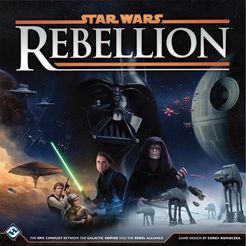
The Empire and Rebellion pursue different goals across the galaxy: find the hidden base, or survive until the uprising gathers strength.
Star Wars: Rebellion supports 2–4 players; community best: 2 players; playing time: 180–240 minutes. A WANGO browser trial has not been confirmed.
Background & introduction
The Empire and Rebel Alliance compete for the galaxy with different strengths and objectives. The Empire excels at direct warfare, while the Rebels rely on secrecy, selective strikes and support from friendly systems. The Rebel base's location lies at the heart of the contest.
The Empire must find and destroy the base before the Rebellion gains enough reputation. The Rebels must survive, disrupt Imperial plans and build their reputation, turning resistance into a wider uprising. Moving forces and winning battles matter to both sides, but serve different purposes.
Familiar leaders give the strategic struggle a personal dimension. Their missions can gather intelligence, win system support or create turning points away from the main fleets. Assigning these characters is therefore as important as deploying ships and ground forces. The game supports two to four players.
Core rules & scoring
Each round has Assignment, Command and Refresh phases. During Assignment, the Rebels assign first, then the Empire: place mission cards face down with one or two leaders on each, leaving other leaders in the pool. To reveal a mission, its assigned leaders must collectively meet the printed matching-skill requirement; otherwise it cannot be revealed.
The Rebels take the first Command turn, then sides alternate revealing missions or activating systems with pooled leaders who have tactic values. Ships can enter from multiple adjacent systems, carrying ground units and transport-restricted fighters within capacity. Units normally cannot leave a system containing a friendly leader; captured Rebel leaders do not impose this restriction. After passing, you cannot reveal missions or activate systems again that phase, but pooled leaders can still oppose missions or join a defense.
A mission saying “attempt” can be opposed; one saying “resolve” cannot. An opponent may send one pooled leader to the chosen system. If no opposing leader is there, the mission succeeds automatically; otherwise each side rolls for its matching skill icons. The acting side must obtain strictly more successes: a tie fails. A matching assigned leader portrait can add successes. Starting missions return to hand after use; other missions are normally discarded.
Combat requires opposing units in the same system and theater. Each combat round resolves space battle, ground battle, then possible retreats under the rules. Roll red and black dice according to unit attack values. Normal hits target matching-color health, direct hits can target either health color, and special results are used for tactic cards. Units destroyed in that theater during the round still attack. Remove surviving units' damage at the end of combat.
The Rebels gain reputation by fulfilling and playing objectives at their specified times, at most one objective per combat and one per Refresh Phase. Move reputation toward time by the value on the card. The Rebels win immediately when the markers share a space. Imperial victory requires a revealed base, Imperial units in its system and no Rebel units there at all; eliminating ground forces alone may not be enough. The Death Star destroying the base's system is a separate immediate-victory exception.
The hidden base is recorded by a secret probe card; the Rebel Base space is distinct from the actual system. Imperial loyalty or ground units in the system force the base to be revealed, moving every unit and leader from the Rebel Base space into that system. Imperial ships alone do not reveal it. Revealing the base does not itself mean Imperial victory.
Rapid Mobilization relocates the base only at the end of Command, before Refresh. Draw four probe cards and optionally choose one legal new system. It cannot contain Imperial loyalty, Imperial units or a destroyed system marker. Give the old base card to the Empire; units and leaders from the old Rebel Base space stay in the old system rather than teleporting to the new base. This mission can establish a new base even after the old one is revealed.
During Refresh, retrieve leaders; each side draws two missions and reduces its mission hand to ten; the Empire draws two probe cards and the Rebels one objective. Advance time one space and recruit or build if its icons allow. Build only in systems not blocked by enemy units or sabotage. Use all resource icons in loyal systems, but only the leftmost icon in subjugated systems, placing units on the indicated build-queue spaces. Then slide the whole queue down one; units leaving space one can deploy, only to your loyal or subjugated systems, or the hidden Rebel Base space for the Rebels, at most two per system that phase, never into systems containing enemy units or sabotage markers.
Rules & gameplay questions
Can the Rebels relocate a base after it is revealed?
Yes, but still through Rapid Mobilization, resolved at the end of Command before Refresh. Draw four probe cards, then choose a legal new location or decline. It cannot contain Imperial loyalty, Imperial units or a destroyed system marker. Units and leaders from the old Rebel Base space move to the old system, rather than teleporting to the new base. Assignment does not grant an immediate unrestricted relocation.
Does an opposed mission succeed on a tie, and can a leader without the matching skill oppose it?
A tie fails: the acting side needs more successes. With an opposing leader present, a roll is still required. Even if that leader has no matching skill and rolls zero dice, the acting side needs at least one success. A mission saying “resolve” cannot be opposed, and assigned leaders must first meet the mission's skill requirement.
Can I act again after passing during Command?
You cannot reveal more missions or activate systems until the next round. You can still use leaders in your pool to oppose enemy missions or join a defense at the start of combat as permitted. Passing does not make all later enemy missions automatically succeed.
Why can I be unable to move forces even though I have ships?
A friendly leader already in a system normally prevents your units from leaving it, even without tactic values; captured Rebel leaders are an exception. The leader activating a destination must have tactic values. Movement must also respect adjacency, transport capacity, transport restrictions and immobile icons; a leader is not an unrestricted fleet move.
Does the Empire win immediately by locating the base and eliminating its ground forces?
Not necessarily. The base must be revealed, its system must contain Imperial units and it must contain no Rebel units of any kind, including ships. A Death Star destroying the base's system instead grants immediate Imperial victory as a special case. Imperial ships alone entering a hidden base's system do not force revelation; Imperial loyalty or ground units do. The Rebels win immediately when the time and reputation markers share a space.
Rules & introduction sources
- Edition
- 2016 Star Wars: Rebellion base game, using the official 20-page Learn to Play and 16-page Rules Reference, with applicable base-game clarifications in the May 2019 official FAQ and Errata (pages 1–5). Rules here cover two players, each controlling one faction; the introduction's three- and four-player teams use separate team rules. Rules Reference takes precedence over conflicting Learn to Play text. Excludes Rise of the Empire and its cinematic-combat changes.
- Rule references
- Introduction source
- BoardGameGeek
WANGO editorial
| Parameter | Recorded value |
|---|---|
| BGG overall rank (snapshot) | #10 |
| Complexity Weight | 3.75 / 5 |
| Best player count (community) | 2 |
| Player range | 2–4 |
| Playing time (minutes) | 180–240 |
| Core mechanisms | Area Majority / Influence · Area Movement · Card Play Conflict Resolution · Contracts · Delayed Purchase · Dice Rolling · Die Icon Resolution · Events · Hand Management · Hidden Movement · Income · Once-Per-Game Abilities · Tags · Take That · Team-Based Game · Variable Player Powers · Variable Set-up · Worker Placement, Different Worker Types |
| Chinese publication | Unconfirmed |
| WANGO browser play | No confirmed WANGO trial |
| Year published | 2016 |
| Suggested age | 14+ |
BGG statistics are stored snapshots, not live rankings. Source checked:2026-09-26
Player questions
What is the best player count for Star Wars: Rebellion, and can I play online?
Star Wars: Rebellion supports 2–4 players; community best: 2 players; playing time: 180–240 minutes. A WANGO browser trial has not been confirmed. Recorded mechanism tags: Team-Based Game.
How complex is Star Wars: Rebellion, and which mechanisms does it use?
Weight: 3.75 / 5. Mechanisms: Area Majority / Influence · Area Movement · Card Play Conflict Resolution · Contracts · Delayed Purchase · Dice Rolling · Die Icon Resolution · Events · Hand Management · Hidden Movement · Income · Once-Per-Game Abilities · Tags · Take That · Team-Based Game · Variable Player Powers · Variable Set-up · Worker Placement, Different Worker Types. Chinese publication: Unconfirmed.
Where can I learn Star Wars: Rebellion?
No rule guide, strategy article or WANGO trial has been confirmed for this record.