Viticulture Essential Edition
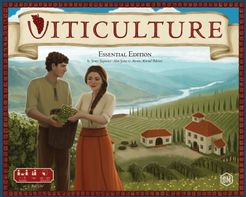
Manage a Tuscan vineyard by allocating workers across summer and winter, developing vines and wine production into fulfilled orders and reputation.
Viticulture Essential Edition supports 1–6 players; community best: 3–4 players; playing time: 45–90 minutes. A WANGO browser trial has not been confirmed.
Background & introduction
Viticulture Essential Edition gives each player a modest inherited vineyard. Mama and Papa cards determine starting resources; players then build structures, plant vines, and host visitors. Each spring, players choose wake-up positions: earlier positions act first, while later positions offer compensation.
Summer focuses on construction, planting, and summer visitors. Fall brings visitor cards, and winter brings harvesting, winemaking, worker training, and order fulfillment. Workers normally act only once each year, so summer commitments determine what remains possible in winter. The grande worker can perform a board action even when its ordinary spaces are full.
Grapes and wines have separate value tracks. Annual aging improves their values, while cellar upgrades limit the wine values you can store. Orders require particular wine types at minimum values and reward reputation and residual income; visitors and structures offer alternative development paths. Multiplayer and standard solo Automa have different end conditions.
Core rules & scoring
Setup and year: Mama and Papa cards determine starting resources. Each year proceeds through spring wake-up selection, summer worker placement, fall visitor draws, winter worker placement, and year-end upkeep. Wake-up order governs summer, fall, and winter turns.
Workers and spaces: Place 1 worker and perform its action, or pass for the season. Normally, each worker acts once per year. Use only the left space at 2 players, left and middle at 3–4, and all three at 5–6. A grande worker can use a full board action but does not automatically receive an occupied bonus.
Planting and structures: Meet each vine’s trellis and irrigation requirements and keep total planted vine value within field capacity. You cannot plant on sold fields or sell planted fields. Build the medium cellar before the large cellar.
Harvest: Harvest each field at most once per year. Combine its red yield into 1 red grape token and its white yield into 1 white grape token; vines remain planted. If the matching crush-pad space is occupied, devalue the new grape to the highest available lower space.
Making wine: The basic action makes up to 2 wine tokens. Red or white wine uses 1 matching grape; blush uses 1 red and 1 white totaling at least 4; sparkling uses 2 red and 1 white totaling at least 7. Appropriate cellars are required. You cannot combine two same-color grapes into one wine of that color.
Orders and income: Supply exactly 1 wine of the required type and at least the stated value for each order icon. Discard the order, score its points immediately, and raise residual income. Collect that income at every year end without resetting its track, up to 5 lira per year.
Year end: Age grapes and wines by 1, up to 9, subject to cellar upgrades and occupied spaces; tokens unable to age remain. Retrieve workers, collect residual income, discard down to 7 cards, and pass the first-player token counterclockwise.
End conditions: In multiplayer, reaching at least 20 points triggers completion of the year and upkeep; highest score wins. Break ties by lira, total wine value, then total grape value. Standard solo Automa lasts 7 years: beat its 20-point marker to win, or tie it for a draw.
Rules & gameplay questions
Does a grande worker using a full action also receive its occupied bonus?
In multiplayer, no. A grande worker can perform the base action when ordinary spaces are full, but gains its bonus only by occupying an available bonus space. In standard solo Automa, a bonus-action token can grant the bonus even when using a grande worker on a full action. The worker normally acts once per year, subject to explicit visitor exceptions.
Can a newly trained worker act immediately?
Normally no. Leave it near the training area this year and use it from next year. An explicit visitor permission to use it immediately overrides that rule.
Can I supply a value-2 and a value-3 red wine for a value-5 requirement?
No. Each wine icon requires exactly 1 token. A higher-value wine of the same type is allowed, but two lower-value wines cannot be combined. The order’s lira increases residual income rather than paying immediate cash.
Does solo play end when I reach 20 points?
No. Standard Automa lasts 7 years. Finish ahead of its 20-point marker to win; a tie is a draw. Automa cards block actions with workers but do not perform those actions. Difficulty variants and campaigns are outside this overview.
Rules & introduction sources
- Edition
- Stonemaier Viticulture Essential Edition, ©2015 English rulebook, 20 pages; 2–6-player multiplayer and standard solo Automa on page 18. Includes this edition’s Mama and Papa cards; excludes Tuscany’s extended board, World, Bordeaux, visitor expansions, and solo difficulty or campaign variants. Explicit visitor exceptions follow card text.
- Rule references
- Introduction source
- BoardGameGeek
WANGO editorial
| Parameter | Recorded value |
|---|---|
| BGG overall rank (snapshot) | #44 |
| Complexity Weight | 2.90 / 5 |
| Best player count (community) | 3–4 |
| Player range | 1–6 |
| Playing time (minutes) | 45–90 |
| Core mechanisms | Contracts · Hand Management · Race · Solo / Solitaire Game · Turn Order: Auction · Victory Points as a Resource · Worker Placement · Worker Placement, Different Worker Types |
| Chinese publication | Unconfirmed |
| WANGO browser play | No confirmed WANGO trial |
| Year published | 2015 |
| Suggested age | 13+ |
BGG statistics are stored snapshots, not live rankings. Source checked:2026-09-27
Player questions
What is the best player count for Viticulture Essential Edition, and can I play online?
Viticulture Essential Edition supports 1–6 players; community best: 3–4 players; playing time: 45–90 minutes. A WANGO browser trial has not been confirmed. Recorded mechanism tags: Solo / Solitaire Game.
How complex is Viticulture Essential Edition, and which mechanisms does it use?
Weight: 2.90 / 5. Mechanisms: Contracts · Hand Management · Race · Solo / Solitaire Game · Turn Order: Auction · Victory Points as a Resource · Worker Placement · Worker Placement, Different Worker Types. Chinese publication: Unconfirmed.
Where can I learn Viticulture Essential Edition?
No rule guide, strategy article or WANGO trial has been confirmed for this record.