Codenames
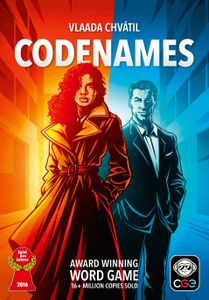
Red and blue spymasters give a single-word clue and a related number while teammates identify agents in a grid and avoid the deadly assassin.
Codenames supports 2–8 players; community best: 6, 8 players; playing time: 15 minutes. A WANGO browser trial has not been confirmed.
Background & introduction
Codenames is Vlaada Chvátil’s team word-association game. Two rival spy teams face a five-by-five grid of twenty-five word cards. Each chooses a spymaster who knows the identities, while the other players act as operatives trying to identify their agents.
The two spymasters share a secret key showing the red agents, blue agents, bystanders and assassin. Under ordinary clue rules, a spymaster gives one word and one number, linking meanings and indicating how many words belong to that clue. Operatives discuss and select cards while the spymaster remains neutral.
Correct agents let a team continue, normally up to the clue number plus one; zero and unlimited clues have separate expert rules. A bystander or opposing agent ends the turn, while touching the assassin loses immediately. The first team whose agents are all identified wins.
Core rules & scoring
Setup: at least four players form two teams, each with one spymaster and the remaining operatives. Randomly arrange twenty-five words in a five-by-five grid. Only spymasters see the key, whose edge marks the starting team. That team has nine agents, the other eight; seven bystanders and one assassin fill the rest.
Teams alternate clues: the spymaster gives one word about the intended words’ meanings and one number stating how many it connects. No extra explanations, expressions, voice cues or gestures are permitted. Operatives discuss and confirm guesses by touching cards one at a time.
Reveal every guess according to the actual key. A friendly agent permits another guess; a bystander ends the turn, and an opposing agent ends it while helping the opponents. The assassin loses immediately. A friendly word found accidentally still counts as correct.
Ordinary guesses: make at least one guess, then stop or continue after each correct one, up to the clue number plus one. A guess may address an earlier clue, even as the first guess, but does not grant a new clue.
Valid clues concern meaning rather than letters, spelling, card position, melodies or accents. Letters and numbers can themselves be meaningful clues. Do not use a form of an uncovered word or part of its compound; covering that word removes the restriction.
Language and agreements: the English examples depend on English meanings. Traditional soundalikes require a meaning connection; the app’s unrestricted soundalikes are not automatic tabletop rules. Agree on abbreviations, multiword names/titles and similar flexibility; spymasters can privately settle doubts. Spell a clue when asked.
Expert clues: zero warns against words related to the clue; unlimited replaces the number. Both remove the ordinary plus-one ceiling while correct friendly guesses continue. At least one guess remains required, and wrong identities still end the turn or lose the game.
Invalid clues normally end the team’s turn without guesses, and the opposing spymaster may cover a friendly word before giving the next clue. They may allow a harmless disputed clue instead; a clue not noticed as invalid until later counts as valid without rewinding play.
Victory and neutrality: finding all a team’s agents wins immediately, even if the opponents reveal its last one. Spymasters cannot remind operatives about missed earlier words, react to discussion or reach for tiles before a card is touched. Operatives must not seek extra information from their reactions.
Rules & gameplay questions
With a clue of two, must we guess twice? What about zero?
An ordinary clue requires at least one guess; after each correct guess you may stop, with a maximum of number plus one, so two allows three. Zero and unlimited are expert exceptions without that ceiling, but wrong guesses still stop and the assassin still loses.
Do we cover a guess according to the intended clue target?
No: always follow the key’s actual identity. An opposing word gains its team an agent and ends your turn; if it is their last, they win immediately. A bystander ends the turn and the assassin immediately loses for the guessing team.
Is a clue legal whenever it avoids the complete printed word?
No. It must relate to meaning rather than letters or position, and restrictions include forms and compound parts of uncovered words. For example, broken cannot clue uncovered BREAK, nor horse uncovered HORSESHOE. Traditional soundalikes also need a meaning connection; app rules are different.
May the spymaster nod or remind us that we missed a word earlier?
No. Apart from the clue and requested repetition/spelling, give no extra information. Do not identify missed earlier words, react to discussion or reveal that a correct friendly guess was not the intended target.
Must we rewind the game after an invalid clue?
Normally end that team’s turn and let the opponents cover one friendly word first. Their spymaster may accept a harmless clue; if nobody notices until later, it counts as valid rather than being retrospectively undone.
Rules & introduction sources
- Edition
- Codenames word base game using the ©2015–2025 refreshed English rules: standard two-team play plus printed zero/unlimited expert clues. Excludes Duet, Pictures, themed boxes and app-specific soundalike rules.
- Rule references
- Introduction source
- BoardGameGeek
WANGO editorial
| Parameter | Recorded value |
|---|---|
| BGG overall rank (snapshot) | #163 |
| Complexity Weight | 1.25 / 5 |
| Best player count (community) | 6, 8 |
| Player range | 2–8 |
| Playing time (minutes) | 15 |
| Core mechanisms | Communication Limits · Deduction · Memory · Race · Team-Based Game |
| Chinese publication | Unconfirmed |
| WANGO browser play | No confirmed WANGO trial |
| Year published | 2015 |
| Suggested age | 10+ |
BGG statistics are stored snapshots, not live rankings. Source checked:2026-09-26
Player questions
What is the best player count for Codenames, and can I play online?
Codenames supports 2–8 players; community best: 6, 8 players; playing time: 15 minutes. A WANGO browser trial has not been confirmed. Recorded mechanism tags: Team-Based Game.
How complex is Codenames, and which mechanisms does it use?
Weight: 1.25 / 5. Mechanisms: Communication Limits · Deduction · Memory · Race · Team-Based Game. Chinese publication: Unconfirmed.
Where can I learn Codenames?
Available resources: Strategy https://wangogame.com/wiki/analysis/codenames