Isle of Skye: From Chieftain to King
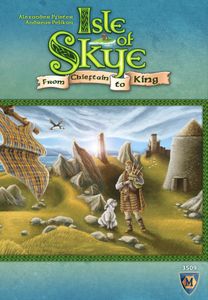
Isle of Skye: From Chieftain to King is a 2–5 player tile-laying and price-setting game. Players grow clan territories, secretly price tiles, then buy from rivals or absorb unsold costs. Four randomly selected scoring goals change each game; coins are only part of the final score.
Isle of Skye: From Chieftain to King supports 2–5 players; community best: 3–4 players; playing time: 30–50 minutes. A WANGO browser trial has not been confirmed.
Background & introduction
Isle of Skye: From Chieftain to King asks each player to build a clan territory from landscape tiles, arranging pastures, mountains, and coastline across the island. Every game randomly uses four of sixteen scoring conditions, and the round track determines when each condition scores. Players cannot follow the same fixed plan every time; they must watch which public goals are approaching and shape their territory accordingly.
Each round, players draw tiles from a bag, secretly price two of them, and discard one. After revealing the prices, players take turns deciding whether to buy a tile from someone else. The seller receives the buyer's coins and retrieves the deposit placed next to the tile, while an unsold deposit goes back to the supply. Players then add their remaining tiles to their own lands, joining matching terrain and connecting roads to the castle when they want income from whisky barrels.
The game usually lasts six rounds, with five-player games lasting five. Final points come from round objectives, scroll tiles, remaining money, and the way the territory has been built. Coins help players purchase tiles, but they are only one source of end-game points. Lookout lists the base game for two to five players and about an hour; Journeyman, Druids, and Big Box modules add separate rules and should not be mixed into the base-game procedure.
Core rules & scoring
Edition and goal: This entry covers Lookout Games' 2015 standalone Isle of Skye: From Chieftain to King base game, BGG 176494, using the publisher's official English rules. It is for 2–5 players; use the front of the board for two to four and the reverse for five. Players build clan territories and compete for the most VP. Four of the game's sixteen scoring tiles are selected at random, creating different public goals each game.
Set up: Shuffle the sixteen scoring tiles and place four at spaces A–D, returning the others to the box. The round track shows which scoring tiles are assessed in each round. Each player chooses a color and takes the matching castle starting tile, screen, scoring marker, and discard marker. Set the marker to zero and place the castle as the start of the player's territory. The youngest player takes the first-player marker. Play six rounds except in a five-player game, which lasts five rounds.
Income: At the start of each round, each player receives five coins from their castle. They also gain one coin for each landscape tile with a whisky barrel that is connected to the castle by a continuous road. From round three onward, players ahead of you on the score track provide additional income according to the round track; the catch-up amount depends on the number of players ahead, not the size of the VP gap. Coins are used for secret pricing, tile purchases, and end-game scoring. For example, round five grants three per player ahead; two opponents with higher VP give six extra coins. A tied score is not ahead.
Draw and secretly price tiles: Each player draws three regular landscape tiles from the bag and places them in front of their screen. Behind the screen, mark one tile for discard and place a price of at least one coin beside each of the other two. Keep any remaining coins hidden in your hand. When everyone is ready, all players reveal their tiles, prices, and discard markers at the same time. Return the discarded tile to the bag and shake it; it is not available for purchase or building this round.
Buy a tile: Starting with the first player and going clockwise, each player may buy one tile from another player or pass. No one may buy more than one tile per round. Pay the assigned price to the seller, who then retrieves the deposit placed beside that tile. After everyone has bought or passed, each player takes back any unsold tile and returns its attached deposit to the supply. An unsold tile therefore costs its owner the deposit, making an overly high price risky. Buying is optional, including when a player cannot afford a price.
Build the territory: Add all tiles gained this round to your clan lands. Every new tile must touch at least one existing tile, and touching terrain edges must match; road paths do not have to connect. If a tile cannot be legally placed, return it to the bag without refunding any purchase price. A region is complete only when it is entirely enclosed by other terrain. Completed regions and roads can matter for scoring and income, but each scoring condition specifies what features count. A tile placed earlier in this same building phase can support the next placement; a corner touch alone does not meet the shared-edge requirement.
Round scoring: After building, score the A–D tiles indicated by the round track and adjust each player's VP marker. The sixteen objectives reward different territory features such as animals, buildings, completed regions, road connections, shapes, coins, or ships. Some tiles require a minimum number of a feature to qualify, and ranking objectives handle ties according to their printed rules. Do not assume all four objectives score in every round. Each scoring tile is used three times during the game. After scoring, pass the starting-player marker clockwise and advance the round marker.
Scoring conditions and ties: Apply only a selected goal when its letter is active. Examples include two VP per cattle connected to the castle, one per sheep, or two per 2×2 square of four tiles, with tiles allowed in multiple squares. The most-ships, most-whisky-tiles, and most-gold goals award five for first and two for second, requiring at least one relevant object. Tied first places each score five and cancel the second-place award; tied seconds each get two. Completed mountains worth two per area and the largest completed water area worth two per tile are also specific objectives, not automatic points every round.
Final scoring and scrolls: After the last ordinary scoring, each scroll awards one VP per two sheep, two ships, or two whisky-barrel tiles of its kind; cattle, brochs, farms and lighthouses give one each for their matching scroll. Fractions are rounded down. Double a scroll’s points if its own terrain area is complete: five sheep give two VP normally, or four for a sheep scroll in a completed area. Then add one VP per full five coins, ignoring the remainder for VP rather than discarding the coins. Highest VP wins; remaining gold breaks a tie. Journeyman, Druids, Tunnel, Borderlands, Big Box modules and promos are outside this entry.
Rules & gameplay questions
How many rounds does an Isle of Skye game last?
The base game normally lasts six rounds. In a five-player game, use the reverse side of the board and play five rounds. At setup, choose four scoring tiles at random from the sixteen available and place them at A–D; the round track indicates which goals score when. This changes the public objectives from game to game, and it is inaccurate to say every player count uses six rounds.
What do I do after drawing three landscape tiles?
Each player draws three regular landscape tiles, secretly marks one to discard, and places a price on the other two behind their screen. Everyone then reveals prices and discard markers together, and the discarded tiles return to the bag. During the buying phase, players may buy one tile from another player or pass. Afterwards, players add their remaining tiles to their territories, so pricing creates both income opportunities and unsold-tile risk.
Why do I place coins beside tiles when setting prices?
The coins beside a tile are the seller's price deposit. If another player buys that tile, the seller receives the buyer's payment and takes back the deposit. If nobody buys it, the seller keeps the tile for their own territory but returns the deposit to the supply. Setting a very high price may discourage purchases and cost the seller coins, affecting future purchases and income.
How many tiles can a player buy in one round?
Each player may buy at most one tile from another player in a round, or pass instead. Players take this opportunity in clockwise order beginning with the first player. The buyer pays the assigned price to the seller, who also retrieves the deposit. Unsold tiles return to their owners, but those deposits are lost, and all players then move on to building.
Do roads have to connect when I place a new tile?
No. A new tile must touch at least one tile already in your territory, and the terrain edges at the point of contact must match. Roads do not have to line up or form a continuous route. A road connection matters only for goals and income that explicitly require it, such as whisky barrels connected back to the castle. If a tile cannot be placed legally, it returns to the bag without a purchase refund.
How do whisky barrels generate income?
At the start of a round, every player receives five coins from their castle. Each tile with a whisky barrel gives one additional coin only when its road network connects continuously to that castle. Merely having a barrel somewhere in the territory is not enough if the road path is broken. Later rounds may also provide catch-up income based on the number of players ahead on the score track.
How are coins scored at the end of the game?
Final scoring first adds the printed scroll-tile bonuses, doubling a scroll's bonus if the region containing it has been completed. Then every full five coins is worth one VP; leftover coins below a multiple of five do not score. Coins also break a tie in total VP. They remain useful for buying throughout the game, but the main objective is to build a territory that scores well across the selected public goals.
Who counts for catch-up income from round three onward?
Count players ahead of you on the VP track, not players behind you and not the size of the score gap. The round track gives the amount for each player ahead. In round five, two higher-scoring opponents each provide three coins, giving six extra; a tied opponent is not ahead. Add this during Income along with the castle’s five coins and any road-connected whisky tiles before pricing and buying.
Rules & introduction sources
- Edition
- BGG 176494 is Lookout Games' 2015 Isle of Skye: From Chieftain to King base game, following the publisher's official English rules. Use the front of the board with 2–4 players and its reverse with five; five-player games last five rounds and other counts six. Excludes Journeyman, Druids, Tunnel/Borderlands modules, Big Box-only content, and promo tiles.
- Rule references
- Introduction source
- BoardGameGeek
WANGO editorial
| Parameter | Recorded value |
|---|---|
| BGG overall rank (snapshot) | #297 |
| Complexity Weight | 2.26 / 5 |
| Best player count (community) | 3–4 |
| Player range | 2–5 |
| Playing time (minutes) | 30–50 |
| Core mechanisms | Auction: Multiple Lot · Catch the Leader · Commodity Speculation · I Cut, You Choose · Set Collection · Tile Placement · Turn Order: Progressive |
| Chinese publication | Unconfirmed |
| WANGO browser play | No confirmed WANGO trial |
| Year published | 2015 |
| Suggested age | 8+ |
BGG statistics are stored snapshots, not live rankings. Source checked:2026-09-27
Player questions
What is the best player count for Isle of Skye: From Chieftain to King, and can I play online?
Isle of Skye: From Chieftain to King supports 2–5 players; community best: 3–4 players; playing time: 30–50 minutes. A WANGO browser trial has not been confirmed.
How complex is Isle of Skye: From Chieftain to King, and which mechanisms does it use?
Weight: 2.26 / 5. Mechanisms: Auction: Multiple Lot · Catch the Leader · Commodity Speculation · I Cut, You Choose · Set Collection · Tile Placement · Turn Order: Progressive. Chinese publication: Unconfirmed.
Where can I learn Isle of Skye: From Chieftain to King?
No rule guide, strategy article or WANGO trial has been confirmed for this record.