Food Chain Magnate
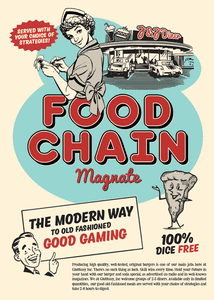
Food Chain Magnate puts players in charge of fast-food chains, organizing staff, producing food and drinks, and advertising across a road-connected city. The winner has the most cash.
Food Chain Magnate supports 2–5 players; community best: 3–4 players; playing time: 120–240 minutes. A WANGO browser trial has not been confirmed.
Background & introduction
Start with a CEO and one restaurant, then recruit and train your workforce. Employees must fit in the company structure to work. Choosing who works and who stays on the beach for training shapes both current production and future growth.
Advertising creates household demand without giving the advertiser ownership of those customers. A chain shares its stock among its restaurants. To compete for a household, it needs a road connection and enough stock to supply the entire order.
The bank supplies money in two stages. Secretly selected reserve cards are revealed when it first breaks, affecting both game length and future CEO capacity. Milestones reward development, and multiple players can claim the same milestone within the same round.
Core rules & scoring
Each round proceeds through Restructuring, Order of Business, Working 9:00–5:00, Dinnertime, Payday, Marketing Campaigns, and Cleanup. Secretly choose working employees; others stay on the beach. The CEO always works, and managers can report only directly to the CEO.
Working actions occur in this order: recruit, train, initiate marketing, obtain food and drinks, place houses and gardens, then place or move restaurants. New hires go to the beach and may be trained immediately. Working employees and busy marketers cannot be trained; trained employees do not work that round.
Resolve households in numerical order at Dinnertime. A restaurant must be road-connected and its chain must supply the full order. Choose the lowest unit price plus distance; ties favor more working waitresses, then earlier turn order. Distance counts map-tile borders crossed along the road.
The base unit price is $10, modified by working pricing employees and the price-reduction milestone. Customer choice uses unit price plus distance without multiplying by order size. Gardens double unit-price sale income, but not marketing milestone bonuses; those bonuses do not affect customer choice.
At Payday, pay $5 per salary-marked employee, including employees on the beach and busy marketers, after applicable discounts. Cleanup normally discards unsold food and drinks; the freezer milestone permits keeping up to ten items in later rounds.
Before wages, you may fire working employees or employees on the beach. The base game has no borrowing action. Busy marketers normally cannot be fired; only after firing all other salaried employees and still being unable to pay must you fire a busy marketer, leaving the campaign running.
Initially put $50 per player in the bank. When it first breaks, reveal and add all selected reserves. From the next round, CEO slots follow the most frequently selected capacity; a tie favors the higher capacity.
When the bank breaks a second time, finish all Dinnertime payments, recording money owed if necessary, then end the game before Payday. Most cash wins; tied players use current turn order, with the earlier player winning.
Rules & gameplay questions
Who gets a first milestone if several players qualify in one round?
Every qualifying player can claim it during that round. Remaining copies of that milestone are removed only at Cleanup; it is not limited to the first player to act.
Does a newly placed advertisement create demand for the same Dinnertime?
No. Campaigns run during Marketing, after Dinnertime. Their new demand matters in later rounds, and unfulfilled demand remains on houses.
Can the freezer save the items discarded to earn it?
No. You still discard normally in the round you earn it. From subsequent Cleanup phases, keep up to ten food and drink tokens.
Does demand belong to the chain that advertised it?
No. Every road-connected chain able to supply the entire household order competes, using unit price plus distance, then working waitresses, then current turn order.
Rules & introduction sources
- Edition
- Splotter base game for 2–5 players: the 2015 third-printing revised English rulebook (15 PDF pages, printed pages 1–14, hosted by Splotter Con), cross-checked with the authorized publisher New Games Order base-game FAQ dated May 25, 2024. Splotter states its current thirteenth printing is identical to previous print runs; this does not claim inspection of that physical printing. Ketchup expansion, Special Edition differences, and introductory variants are excluded.
- Rule references
- Introduction source
- BoardGameGeek
WANGO editorial
| Parameter | Recorded value |
|---|---|
| BGG overall rank (snapshot) | #51 |
| Complexity Weight | 4.18 / 5 |
| Best player count (community) | 3–4 |
| Player range | 2–5 |
| Playing time (minutes) | 120–240 |
| Core mechanisms | Delayed Purchase · Income · Market · Modular Board · Open Drafting · Simultaneous Action Selection · Tech Trees / Tech Tracks · Victory Points as a Resource |
| Chinese publication | Unconfirmed |
| WANGO browser play | No confirmed WANGO trial |
| Year published | 2015 |
| Suggested age | 14+ |
BGG statistics are stored snapshots, not live rankings. Source checked:2026-09-27
Player questions
What is the best player count for Food Chain Magnate, and can I play online?
Food Chain Magnate supports 2–5 players; community best: 3–4 players; playing time: 120–240 minutes. A WANGO browser trial has not been confirmed.
How complex is Food Chain Magnate, and which mechanisms does it use?
Weight: 4.18 / 5. Mechanisms: Delayed Purchase · Income · Market · Modular Board · Open Drafting · Simultaneous Action Selection · Tech Trees / Tech Tracks · Victory Points as a Resource. Chinese publication: Unconfirmed.
Where can I learn Food Chain Magnate?
No rule guide, strategy article or WANGO trial has been confirmed for this record.