Forbidden Stars
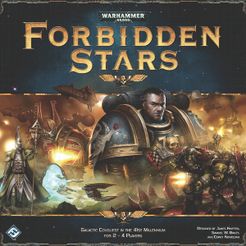
Program hidden, stacked orders to direct fleets and ground armies, balancing combat, upgrades, and blocked routes while collecting your faction’s objectives.
Forbidden Stars supports 2–4 players; community best: 3 players; playing time: 120–180 minutes. A WANGO browser trial has not been confirmed.
Background & introduction
Forbidden Stars is a two-to-four-player war game set in Warhammer 40,000. Each player commands one of four base factions and seeks its own objectives scattered near rival forces. More worlds provide materiel and room to build, but objective tokens are the main route to victory.
Players first take turns placing four hidden orders, then execute orders from the tops of their stacks. Later orders cover earlier ones and can delay an opponent, so plans must account for location, timing, and whether the necessary forces will be ready.
Combat combines dice with a ten-card combat deck. Upgrades replace pairs of cards, while army composition determines available unit abilities. Morale and retreat matter alongside casualties, and Warp Storms move between rounds to disrupt previously open routes.
Core rules & scoring
Setup: Choose base factions, take initial forces and six materiel from faction sheets, and prepare ten-card starting combat decks, event decks, and upgrades. Use the introductory map first; later use full construction rules for systems, initial forces, enemy objectives, and storms. Start the round marker at one.
Planning: Starting with the first player, place hidden orders clockwise until everyone has placed exactly four. A system must contain one of your units or structures, or be adjacent to such a system. Place new orders on top of existing stacks.
Operations: Take turns revealing and resolving one of your orders on top of any stack, then removing it. With none exposed, skip temporarily and act when an order becomes available. A revealed ordinary order may instead go on your event deck, sacrificing its effect for an event draw at refresh.
Deploy: First purchase units in the active system if you have a factory there; then you may buy one structure on a friendly world there. Pay materiel and required forge tokens and meet command requirements based on your cities. Local factory-world capacity limits deployment. The official erratum exempts card- or faction-effect purchases from needing a factory.
Dominate and Strategize: Dominate collects assets from friendly worlds in the active system, then allows your faction ability. Strategize may buy one order upgrade and one combat upgrade if you have a unit or structure there, then goes on your event deck. Combat upgrades replace pairs, keeping the deck at ten cards.
Advance: Move ships first, then ground units into the active system, sourcing from that system and the same single adjacent system. Ground movement needs a legal friendly path and cannot cross storms. One Advance can create only one contested area; an orbital strike is available under its rules only if no combat occurred.
Capacity: Advance may temporarily exceed world or void capacity, but movement may not end with more than five units per area. After the whole order, including combat, destroy excess units. Voids hold three; worlds use their skull icons. Structures do not use unit capacity.
Combat: Roll for unrouted forces, draw five combat cards each, and decide reinforcements. Play up to three execution rounds with simultaneous card selection, attacker resolving first, then damage. If both sides remain, compare final morale; ties favor the defender. The loser retreats legally or is destroyed, and the winner captures remaining structures.
Refresh: Simultaneously collect your own objectives on controlled worlds, then gain materiel and rally routed units. Draw events according to orders on your event deck and choose one for storm movement and its ability. Without an event draw, still reveal a card for storm movement but do not use its ability. Pass first player and advance the round.
Victory: Collecting your faction’s objectives equal to the starting player count wins. Simultaneous qualifiers compare objectives, then friendly worlds, then units on the board, sharing victory if still tied. After round eight without a qualifier, use the same comparisons. A player with no friendly worlds is eliminated; the sole remaining player wins immediately.
Rules & gameplay questions
Do I collect an objective immediately upon taking its world?
No. Objectives are collected simultaneously at the first refresh step, and only your own faction’s tokens count. Occupying a rival objective world can block collection but cannot score that token for you.
Does an order covered by an opponent become wasted this round?
No. Skip temporarily if none of your orders is on top. Once covering orders are removed, resolve it later; operations continues until all map orders are processed.
Can I detour through several systems around a storm or relay troops through a world just captured?
No. The official FAQ limits movement paths to the starting and active systems. Ground units move simultaneously, with legal paths determined before any ground unit moves; newly captured worlds cannot extend those paths.
Does buying a unit through a card still require a factory?
No. The official erratum confines the factory requirement to standard Deploy purchasing. Purchases caused by cards or faction abilities need no factory, while other costs and the specific effect still apply.
Can attacking units placed entirely by an effect retreat after losing?
No. The erratum says that if no unit entered the contested area through an Advance Order, attacking units cannot retreat and are destroyed. Normal Advance attackers must retreat to an area at least one attacking unit came from, respecting path and destination restrictions.
Rules & introduction sources
- Edition
- 2015 base game for 2–4 players, using official Learn to Play, Rules Reference, and FAQ/errata v1.1 dated 17 August 2016. Covers the core action and combat framework without a full faction-card catalogue; excludes fan expansions, added factions, and solo variants. Specific effects follow cards and official errata.
- Rule references
- Introduction source
- BoardGameGeek
WANGO editorial
| Parameter | Recorded value |
|---|---|
| BGG overall rank (snapshot) | #157 |
| Complexity Weight | 3.84 / 5 |
| Best player count (community) | 3 |
| Player range | 2–4 |
| Playing time (minutes) | 120–180 |
| Core mechanisms | Area Majority / Influence · Area Movement · Card Play Conflict Resolution · Deck, Bag, and Pool Building · Dice Rolling · Hand Management · Modular Board · Order Counters · Variable Player Powers |
| Chinese publication | Unconfirmed |
| WANGO browser play | No confirmed WANGO trial |
| Year published | 2015 |
| Suggested age | 14+ |
BGG statistics are stored snapshots, not live rankings. Source checked:2026-09-27
Player questions
What is the best player count for Forbidden Stars, and can I play online?
Forbidden Stars supports 2–4 players; community best: 3 players; playing time: 120–180 minutes. A WANGO browser trial has not been confirmed.
How complex is Forbidden Stars, and which mechanisms does it use?
Weight: 3.84 / 5. Mechanisms: Area Majority / Influence · Area Movement · Card Play Conflict Resolution · Deck, Bag, and Pool Building · Dice Rolling · Hand Management · Modular Board · Order Counters · Variable Player Powers. Chinese publication: Unconfirmed.
Where can I learn Forbidden Stars?
No rule guide, strategy article or WANGO trial has been confirmed for this record.