7 Wonders Duel
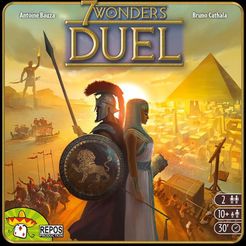
Draft from a shared display of face-up and face-down cards to build a two-player civilization and pursue military, scientific, or civilian victory.
7 Wonders Duel supports 2 players; community best: 2 players; playing time: 30 minutes. A WANGO browser trial has not been confirmed.
Background & introduction
Designed by Antoine Bauza and Bruno Cathala, 7 Wonders Duel reshapes civilization building around a shared card display for two players. Each of its three Ages uses a different overlapping arrangement. Removing a card develops your own city while potentially revealing the next opportunity for your opponent.
On each turn, take an accessible card to construct its Building, discard it for coins, or use it to construct one of your selected Wonders. Resource Buildings provide ongoing construction capacity, commercial cards shape cash flow and trading costs, and chain symbols can make later Buildings free. Each player selects four Wonders, but only seven can be completed in the entire game.
Military and science are development paths that can also end the contest immediately. Reach the opposing capital with the Conflict pawn or collect six different scientific symbols to win at once. Otherwise, after Age III, compare the points generated by Buildings, Wonders, Progress tokens, military position, and treasury.
Core rules & scoring
Setup and access: each player begins with 7 coins and selects 4 Wonders. Each Age uses 20 cards in its prescribed face-up and face-down structure. Only a card with no other card covering it is accessible; reveal newly accessible face-down cards after playing your card.
Three uses: pay a Building’s cost to add it to your city; discard it for 2 coins plus 1 per yellow card in your city; or pay a selected Wonder’s cost and tuck the card face down beneath it. A card used for a Wonder contributes neither its printed cost nor its effects.
Construction and trading: your resource production is reusable each turn and is not consumed. For each missing unit, you normally pay the bank 2 coins plus the matching resource symbols on your opponent’s brown and grey cards. Yellow-card and Wonder production does not increase this price; specific commercial discounts can set a resource price to 1 coin. Any printed coin cost must also be paid.
Free chains: if a constructed Building supplies the white chain symbol shown in a later Building’s cost area, that later Building can be constructed for free without surrendering its predecessor. Without the symbol, you can still pay the normal cost.
Wonders and Ages: when the seventh Wonder is constructed, remove the remaining unbuilt Wonder. Resolve a replay after revealing newly accessible cards; it is lost if the display is empty. At an Age’s end, the militarily weaker player chooses who starts next; if the Conflict pawn is central, the last active player chooses.
Military supremacy: each shield on a Building or Wonder moves the Conflict pawn one space toward the opposing capital. Resolve and remove a military token when entering its zone, making the opponent return the indicated coins to the bank. Reaching the opposing capital wins immediately.
Scientific supremacy: a pair of identical scientific symbols lets you immediately take a Progress token from the board. Six different symbols win immediately. The base game has seven symbols across green Buildings and the Law Progress token; they are not all found on green cards.
Civilian victory: if neither supremacy occurs before Age III ends, add military position points (0/2/5/10), blue/green/yellow/purple Buildings, Wonders, Progress tokens, and 1 point per complete 3 coins. Break a total-score tie with points from blue Buildings; if still tied, share the victory.
Rules & gameplay questions
Do purchased resources permanently increase production?
No. Trading covers only the shortfall for the current construction. Recalculate using your production and the current price next time. Your own production does not need to be stored or returned either: it is available again on your next turn.
Does production on yellow cards increase an opponent’s trading price?
No. The standard price counts matching resource symbols only on the opponent’s brown and grey Buildings, excluding yellow Buildings and Wonders. Payment normally goes to the bank. The Economy Progress token gives its owner the resource-trading money actually paid by the opponent, excluding printed coin costs of Buildings.
How do matching pairs differ from six different scientific symbols?
A matching pair obtains a Progress token from the board; six different symbols win immediately. Law supplies its own scientific symbol and can count toward the six. It does not ask you to choose a symbol from a green card.
Can a replay carry over to the next Age?
No. Reveal newly accessible cards before the extra turn. If the display is empty, lose the replay and use the end-of-Age procedure to choose the next starting player. Theology also does not give a Wonder two replays if it already has that effect.
Must I show the three Progress tokens drawn for the Great Library?
No. The official base-game FAQ says to draw and choose secretly. Reveal only the chosen token and return the other two to the box without revealing them.
Rules & introduction sources
- Edition
- 2015 Repos Production two-player base game, using the official 20-page English rules and base-game entries in the official online FAQ. Excludes Pantheon, Agora, solo variants, and expansion errata.
- Rule references
- Introduction source
- BoardGameGeek
WANGO editorial
| Parameter | Recorded value |
|---|---|
| BGG overall rank (snapshot) | #24 |
| Complexity Weight | 2.23 / 5 |
| Best player count (community) | 2 |
| Player range | 2 |
| Playing time (minutes) | 30 |
| Core mechanisms | End Game Bonuses · Income · Melding and Splaying · Modular Board · Multi-Use Cards · Once-Per-Game Abilities · Open Drafting · Score-and-Reset Game · Set Collection · Sudden Death Ending · Tags · Tech Trees / Tech Tracks · Track Movement · Tug of War · Variable Set-up |
| Chinese publication | Unconfirmed |
| WANGO browser play | No confirmed WANGO trial |
| Year published | 2015 |
| Suggested age | 10+ |
BGG statistics are stored snapshots, not live rankings. Source checked:2026-09-27
Player questions
What is the best player count for 7 Wonders Duel, and can I play online?
7 Wonders Duel supports 2 players; community best: 2 players; playing time: 30 minutes. A WANGO browser trial has not been confirmed.
How complex is 7 Wonders Duel, and which mechanisms does it use?
Weight: 2.23 / 5. Mechanisms: End Game Bonuses · Income · Melding and Splaying · Modular Board · Multi-Use Cards · Once-Per-Game Abilities · Open Drafting · Score-and-Reset Game · Set Collection · Sudden Death Ending · Tags · Tech Trees / Tech Tracks · Track Movement · Tug of War · Variable Set-up. Chinese publication: Unconfirmed.
Where can I learn 7 Wonders Duel?
No rule guide, strategy article or WANGO trial has been confirmed for this record.