Mombasa
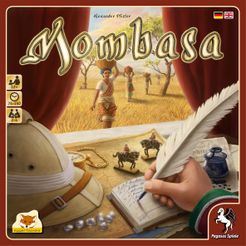
Plan cards over seven rounds, invest in four trading companies, expand their posts and build wealth through diamonds and bookkeeping.
Mombasa supports 2–4 players; community best: 4 players; playing time: 75–150 minutes. A WANGO browser trial has not been confirmed.
Background & introduction
No company belongs to a single player. You may hold shares in several companies and expand any one of them. Coin icons uncovered in its base determine each share's value, so an expansion you arrange may also benefit rival shareholders.
Each round begins with simultaneous card planning, followed by turns using goods, expansion cards, bookkeepers, diamond merchants or bonus markers. Used cards turn face down and stop supporting book requirements and majority comparisons, making action order matter.
Recovery does not return every card at once. First retrieve one resting column, then move this round's cards into the columns linked to their slots. Bringing strong cards back on schedule requires planning their positions alongside shares, cash and personal tracks.
Core rules & scoring
Setup: The introductory setup uses company tracks A1, B1, C1 and D1 with assigned starting tiles. Put 15 trading posts in each company base, build the action deck in A-to-E order and display 12 cards. Each player receives 9 starting cards plus an assigned one-point expansion card; place 3 cards in resting slots as shown by the starting tile. Start with 1 pound and 3 bonus markers with two players or 2 with three to four.
Rounds and planning: Play 7 rounds. Simultaneously place hand cards face down in available action slots, then reveal them together. Start with 3 slots; diamond and bookkeeping progress can each unlock one more for later planning phases, up to 5. Beginning with the first player, take one action per clockwise turn until everyone ends their own action phase.
Goods: Choose any number of face-up action-area cards of one goods type. Use their total units to acquire at most 1 display card and/or advance on company tracks, one space per remaining unit. Price is the card's red crate value plus its display space's red crate value. Acquired cards enter your hand; used goods flip face down. Specific unlocked company bonuses can alter the normal restrictions.
Expansion: Use all action-area expansion cards together to expand one company. Enter regions adjacent to its base or existing posts, paying 1 point across a single border, 2 across a double border, and 1 extra for an opposing company post. Do not enter a region already containing that company. Take each new post from the front of a chosen base column. After expanding, collect all entered regions' rewards, then oust opposing posts and return them under the base rules.
Bookkeeping: Spend bookkeeping points immediately on A or B books for 1 each, C books for 2, or 1 pound per point; never save them. A bookkeeper may first pay 2 pounds to flip one book. Move the ink jar book by book while current face-up cards meet each requirement, never crossing an empty space. Gain only the final book's reward, then separately spend the bookkeeper's points and flip the card.
Diamonds and bonuses: Diamond merchants advance your diamond track and pay money as printed; company-specific merchants gain extra movement from mines controlled by that company. A bonus marker occupies one empty bonus space, meeting its cost or requirement for an immediate reward or a tile reserved for next round. Majority spaces compare current face-up cards, allow ties and do not consume those cards.
Company tracks: The latest reached share icon gives your current share total; do not add all passed icons. Some cards add shares. Crossing a capital call requires payment or stops your marker before it. Special spaces pay money and unlock a bonus effective from your next turn. A track's second bonus and first bonus never combine.
Ending your phase and refreshing: First recover exactly one entire resting column, then move each current action-slot card to its linked resting column and return this round's bonus tiles. Once everyone finishes, move round-track coins, shift and refill the card display, and retrieve markers and reserved tiles as specified. After round 7, proceed directly to final scoring.
Final score: Recover resting cards to check share cards. Add cash, each company's total shares multiplied by its uncovered base coin icons, and the latest money values passed on your diamond and bookkeeping tracks. Book tiles themselves score nothing. Single-share cards cannot be planned as action cards. Highest wealth wins; ties share victory.
Rules & gameplay questions
Are company colors player colors?
No. All players can invest in and expand all four companies. Your player markers record progress toward shares; trading posts belong to companies.
Can I mix goods types to pay for a card?
Normally no: one goods action uses one type. An unlocked company-track bonus that explicitly permits mixed goods overrides this restriction.
Can I split expansion points between two companies?
No. Use all expansion cards in your action area together for one selected company. Any unspent points are lost.
Does meeting book requirements consume goods?
No. Check cards that are still face up, treating each book separately without accumulating requirements. Face-down cards do not count. If an additional bookkeeper is required, the bookkeeper currently moving the ink jar cannot fulfill that extra requirement.
Can cards I just used immediately return to my hand?
Normally no. End your phase by recovering an existing resting column first, and only then add the current round's cards to their linked columns. Do not reverse this order.
Rules & introduction sources
- Edition
- Uses the original 2015 Mombasa English base rules for 2–4 players, including the original box's double-sided company tracks. Introductory setup uses A1/B1/C1/D1. Excludes Skymines, expansions, promotional material and unofficial solo rules.
- Rule references
- Introduction source
- BoardGameGeek
WANGO editorial
| Parameter | Recorded value |
|---|---|
| BGG overall rank (snapshot) | #148 |
| Complexity Weight | 3.89 / 5 |
| Best player count (community) | 4 |
| Player range | 2–4 |
| Playing time (minutes) | 75–150 |
| Core mechanisms | Action Queue · Area Majority / Influence · Deck, Bag, and Pool Building · Hand Management · Investment · Open Drafting · Simultaneous Action Selection · Stock Holding · Turn Order: Claim Action · Variable Player Powers · Victory Points as a Resource · Worker Placement |
| Chinese publication | Unconfirmed |
| WANGO browser play | No confirmed WANGO trial |
| Year published | 2015 |
| Suggested age | 12+ |
BGG statistics are stored snapshots, not live rankings. Source checked:2026-09-27
Player questions
What is the best player count for Mombasa, and can I play online?
Mombasa supports 2–4 players; community best: 4 players; playing time: 75–150 minutes. A WANGO browser trial has not been confirmed.
How complex is Mombasa, and which mechanisms does it use?
Weight: 3.89 / 5. Mechanisms: Action Queue · Area Majority / Influence · Deck, Bag, and Pool Building · Hand Management · Investment · Open Drafting · Simultaneous Action Selection · Stock Holding · Turn Order: Claim Action · Variable Player Powers · Victory Points as a Resource · Worker Placement. Chinese publication: Unconfirmed.
Where can I learn Mombasa?
No rule guide, strategy article or WANGO trial has been confirmed for this record.