The Voyages of Marco Polo
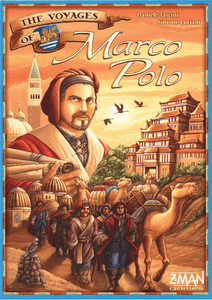
Place dice to acquire goods and camels, fulfill contracts, and establish trading posts along the Silk Road, with distinct characters shaping a five-round journey.
The Voyages of Marco Polo supports 2–4 players; community best: 4 players; playing time: 40–100 minutes. A WANGO browser trial has not been confirmed.
Background & introduction
The Voyages of Marco Polo, designed by Simone Luciani and Daniele Tascini, casts players as travelers and merchants from Marco Polo’s era. Starting from Venice, they score through contracts, city opportunities, and secret destination objectives.
Each round’s dice provide both action capacity and action strength. High values often improve rewards but also increase the cost of entering an occupied blue action area. A player’s colored dice cannot repeat the same area that round, while extra black dice provide another way back in.
Travel needs two dice and money and camels prepared in advance; ordinary characters establish a trading post only in the destination city. Small cities supply continuing income and large cities unlock action cards, creating a five-round balance between contract business and expansion.
Core rules & scoring
Setup and five rounds: Each player has five colored dice, nine trading posts, two camels, a starting contract, two objective cards, and a character. Venice is the normal starting location, subject to character setup exceptions. Take clockwise turns over five rounds; players without dice receive no further turns that round, which ends when everyone has used their dice.
Dice placement: Normally take one main action per turn, assigning the printed number of dice and resolving immediately. The lowest value usually sets the reward limit. Entering an occupied blue area first costs coins equal to your lowest newly placed die, in addition to the action’s own costs. Brown spaces cannot be stacked. Each player color may appear in an area once per round; black and white dice are not player colors, but mixed placements still respect the colored-die restriction.
Market, money, and Khan: Gold, silk, pepper, and camels are four separate market areas with printed dice requirements and reward tables. Take 5 Coins always gives five, but its occupied-space fee still depends on your die. The Khan gives one chosen good and two camels; fill four spaces in sequence, each new die at least matching the preceding value. It has no stacking fee, but the once-per-color restriction remains.
Contracts: Use one die to take one or two contracts from numbered positions no higher than its value. Keep at most two unfulfilled contracts, discarding old ones if space is needed. Fulfilling a contract is a bonus action: pay all goods and camels, take the reward, and retain the completed record. If only one contract remains on display, take only that one; refill two from the special pile only after the selection ends.
Travel and posts: The main Travel action requires two dice and moves at least one step, up to the lower die’s value. Pay the actual step cost and every route surcharge in coins or camels before moving. Normally place a post only in the destination city, never in cities passed through or oases. Each player has at most one post per city. The eighth and ninth posts immediately score five and ten points respectively, subject to explicit character exceptions.
Cities and characters: A small-city post gives its bonus immediately and at the start of subsequent rounds. The first post in a large city earns its one-time trading-post bonus; from their next turn, players with a post may assign one die to its city card. Each city card can be used once per round by one player. Characters can change die values, costs, starting locations, or travel and post rules; follow their text.
Bonus actions: Before or after the main action, fulfill contracts, spend a die for three coins, spend one camel to reroll a die, spend two camels to adjust one die by one, or spend three camels to buy and roll a black die. Never interrupt a main action, and buy at most one black die per turn. Your last die may take three coins and leave no main action; adjustment cannot wrap between one and six.
Round changes and final scoring: The last player to use the main Travel action starts the next round; if nobody traveled, the starter stays. Pay round city and character bonuses, retrieve and roll dice; an opening total below fifteen gives one coin or camel per missing pip. After five rounds score objective cards, one point per ten coins, and Beijing post-space points. A Beijing post also allows one point per two goods, excluding camels. Each player tied for most completed contracts gains seven points. Most points wins; ties compare camels, then share victory.
Rules & gameplay questions
Can I take camels again in the same round?
You cannot place your colored die in that area again, but a black or applicable white die can revisit it, paying the occupied blue-area fee. The four market supplies are separate areas, so using camels does not prevent placing your colored dice in pepper or another market area later.
Do a four and five cost nine coins in an occupied area?
Only four coins, equal to your lowest newly placed die. Existing dice values and quantity do not affect that fee. Pay the action’s own costs as well, including travel steps and route surcharges. Explicit character exemptions apply; the Khan uses its nondecreasing-die rule instead of a stacking fee.
Can a three-step journey build posts in every city and fund later steps?
Ordinary characters place one post only in the city where the entire journey ends, rather than treating it as three separate one-step moves. Pay the whole trip before movement, without spending anticipated bonuses. The official FAQ applies advance payment to Wilhelm von Rubruk and Niccolo and Marco Polo too; resolve their special post rewards afterward.
With one contract left, can I take it and a newly refilled second one?
No. Take the one already there, then refill positions one and two from the special pile after that selection ends. A new contract must first occupy one of your two active slots, rather than being taken and discarded immediately. Fulfillment is a separate bonus action before or after your main action.
After running out of dice, can I take a turn just to fulfill contracts or buy a black die?
You receive no further turns that round once you have no dice, so finish desired bonus actions before your final turn ends. Spending the last die for three coins may leave no main action. Legally buying a black die during your turn supplies another usable die, but bonus actions still cannot interrupt a main action.
Rules & introduction sources
- Edition
- The original 2015 The Voyages of Marco Polo base game for 2–4 players, using Hans im Glück base rules and FAQ 3.0 pages 1–2. Includes explicit base-character exceptions and two- and three-player setup adjustments. Excludes Agents of Venice, The New Characters, other expansion modules, and the separate sequel Marco Polo II.
- Rule references
- Introduction source
- BoardGameGeek
WANGO editorial
| Parameter | Recorded value |
|---|---|
| BGG overall rank (snapshot) | #122 |
| Complexity Weight | 3.18 / 5 |
| Best player count (community) | 4 |
| Player range | 2–4 |
| Playing time (minutes) | 40–100 |
| Core mechanisms | Contracts · Dice Rolling · End Game Bonuses · Point to Point Movement · Resource to Move · Turn Order: Claim Action · Variable Player Powers · Variable Set-up · Worker Placement with Dice Workers |
| Chinese publication | Unconfirmed |
| WANGO browser play | No confirmed WANGO trial |
| Year published | 2015 |
| Suggested age | 12+ |
BGG statistics are stored snapshots, not live rankings. Source checked:2026-09-27
Player questions
What is the best player count for The Voyages of Marco Polo, and can I play online?
The Voyages of Marco Polo supports 2–4 players; community best: 4 players; playing time: 40–100 minutes. A WANGO browser trial has not been confirmed.
How complex is The Voyages of Marco Polo, and which mechanisms does it use?
Weight: 3.18 / 5. Mechanisms: Contracts · Dice Rolling · End Game Bonuses · Point to Point Movement · Resource to Move · Turn Order: Claim Action · Variable Player Powers · Variable Set-up · Worker Placement with Dice Workers. Chinese publication: Unconfirmed.
Where can I learn The Voyages of Marco Polo?
No rule guide, strategy article or WANGO trial has been confirmed for this record.