Railways of the World
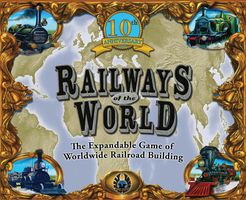
Bid for the first move, issue bonds to build railroads, and deliver goods to matching cities while balancing growing income against recurring interest and final debt penalties.
Railways of the World supports 2–6 players; community best: 5 players; playing time: 120 minutes. A WANGO browser trial has not been confirmed.
Background & introduction
Your railroad company begins without cash, with a low-level engine and a secret Rail Baron objective. Bonds finance construction, and complete links between cities become a network you control. Finding money matters as much as finding a destination for each delivery.
Each full turn begins with an auction, followed by three action rounds. Building, urbanizing, upgrading, delivering, and claiming operations cards compete for those opportunities. Goods must reach a matching city, and engine level limits the number of links traveled. Using an opponent's track gives that player part of the delivery score.
Deliveries advance a position on the income track, while cash arrives during the income phase. Issued bonds remain with the company, requiring dividends every full turn and costing points at the end. Depleted cities trigger the final stretch, and Rail Baron objectives combine with debt to determine the winner.
Core rules & scoring
Begin at 0 income with no cash and a level-1 engine. Choose one of two secretly dealt Rail Baron cards. Prepare goods, operations cards, and empty-city markers for your map and player count. On Eastern U.S., start each city with one fewer cube at 2-3 players, with a minimum of one.
On your turn, issue only the bonds needed for a current purchase or bid, receiving $5,000 per bond without spending an action. Bonds cannot be repaid; each costs $1,000 in dividends per income phase and 1 point at game end. Certificates of five or ten merely consolidate denominations.
Auction first player each full turn. The youngest player opens the first auction; thereafter the previous first player opens. Bid clockwise or pass, with a $1,000 minimum opening bid and no re-entry after passing. Only the winner pays; if everyone passes, first player moves to the previous first player's left.
After the auction, play three action rounds. In each, every player may build track, urbanize, upgrade, deliver one cube, claim an operations card, or pass. Only after all three rounds do players resolve income and dividends, then reveal one operations card for the next full turn.
Build at most four tiles in one action. Begin at a city or your own incomplete link and extend the same continuous link, stopping at another city. Pay the map's terrain costs. Remove track that still fails to connect two cities at the end of the full turn.
Urbanizing costs $10,000: put an available New City tile on a gray city and add two random goods cubes, removing an empty-city marker if present. Upgrading takes a separate action and the new level's printed cost; rise only one level per action, up to level 8.
Deliver one cube along complete links to a matching city, using no more links than your engine level. Own the first link; later links may belong to others. Never repeat a city or link. Stop at the first matching city and return the delivered cube to the bag.
Each complete link used awards its owner 1 track point, with no immediate cash payment. After three rounds, first collect the income printed at your track position in thousands of dollars, then pay $1,000 per issued bond. Issue more bonds if necessary; new debt-service bonds begin paying dividends next income phase.
Claiming an available operations card costs an action; using it does not cost another. Green circles reward the first eligible achievement and cannot be selected. Purple diamonds work during only one of your actions per full turn; red crosses resolve immediately, hand icons can be saved, and permanent cards continue providing their benefit.
Placing the final required empty-city marker triggers the end: finish this full turn, then play one more full turn with three actions each. Eastern U.S. uses 10, 12, 14, 16, or 18 markers at 2-6 players. Add fulfilled Rail Baron bonuses to track points and subtract 1 per bond. Highest score wins; ties favor most links, then most cash.
Rules & gameplay questions
Can I repay bonds after earning enough cash?
Not in the base game. Issued bonds stay until the end and continue requiring dividends. The compendium's between-phase repayment option belongs to the Transcontinental variant, not this single-map game.
Does advancing one track space immediately pay $1,000?
No. Deliveries increase track points. During the income phase, collect the cash value printed at your position, in thousands of dollars. Track points, income at that position, and cash on hand are different quantities.
Can I pass a matching city to make a longer delivery?
No. A base-game delivery ends at the first matching city. It also cannot revisit a city or reuse a link. Engine level counts city-to-city links, not individual track tiles.
Does urbanizing an empty city after the end trigger extend play?
No. Urbanization can remove its empty-city marker, but cannot cancel an end already triggered. Finish the current full turn and then one additional full turn.
Can unfinished track survive into the next full turn?
No. You may continue it during later actions in the same full turn and may join construction from both ends. Any link still incomplete when the third round ends must be removed during settlement.
Rules & introduction sources
- Edition
- Identifies the 2009 Railways of the World base game. Rules are checked against a mirror of Eagle-Gryphon Games' publisher-authored 24-page Rule Book Compendium, print-v3_low, from the 2017-era revised edition: printed pages 2-6 and 10-11 plus cover and contents read. This is not the 2009 in-box booklet. The main text covers the base system on the single Eastern U.S. map, including its marker thresholds; Mexico has different thresholds. Excludes 2005 Railroad Tycoon rules, Steam, other expansion maps, mini-expansions, Transcontinental play, and auction variants.
- Rule references
- Introduction source
- BoardGameGeek
WANGO editorial
| Parameter | Recorded value |
|---|---|
| BGG overall rank (snapshot) | #245 |
| Complexity Weight | 3.02 / 5 |
| Best player count (community) | 5 |
| Player range | 2–6 |
| Playing time (minutes) | 120 |
| Core mechanisms | Action Points · Connections · End Game Bonuses · Hexagon Grid · Income · Loans · Network and Route Building · Open Drafting · Ownership · Pick-up and Deliver · Tile Placement · Turn Order: Auction |
| Chinese publication | Unconfirmed |
| WANGO browser play | No confirmed WANGO trial |
| Year published | 2005 |
| Suggested age | 10+ |
BGG statistics are stored snapshots, not live rankings. Source checked:2026-09-27
Player questions
What is the best player count for Railways of the World, and can I play online?
Railways of the World supports 2–6 players; community best: 5 players; playing time: 120 minutes. A WANGO browser trial has not been confirmed.
How complex is Railways of the World, and which mechanisms does it use?
Weight: 3.02 / 5. Mechanisms: Action Points · Connections · End Game Bonuses · Hexagon Grid · Income · Loans · Network and Route Building · Open Drafting · Ownership · Pick-up and Deliver · Tile Placement · Turn Order: Auction. Chinese publication: Unconfirmed.
Where can I learn Railways of the World?
No rule guide, strategy article or WANGO trial has been confirmed for this record.